-
Use Cases
-
Resources
-
Pricing
The history of rockets spans over a thousand years, beginning with gunpowder-powered fire arrows in ancient China and evolving through the pioneering work of rocketry theorists like Konstantin Tsiolkovsky and Robert Goddard. The 20th century saw rockets become the foundation of space exploration, from Nazi Germany's V-2 missile to the Space Race between the United States and Soviet Union. Today, rockets enable satellite deployment, human spaceflight, and deep-space missions, with modern innovations like reusable boosters transforming access to space. More Less
1440
% complete
Korea developed the hwacha, a multiple rocket launcher capable of firing dozens of singijeon arrows at once. It demonstrated early massed rocket artillery and was famously deployed against Japanese forces in the 1590s.
Image source: Hwacha
1780
% complete
The Kingdom of Mysore under Hyder Ali and Tipu Sultan developed iron-cased rockets with significant range and effectiveness, using them against the British East India Company in the Anglo-Mysore Wars.
Image source: Mysorean rockets
1804
% complete
Inspired by Mysorean rockets, William Congreve developed improved British military rockets used at the Battle of Leipzig and against Fort McHenry in 1814, immortalized as 'the rockets' red glare' in The Star-Spangled Banner.
Image source: Congreve rocket
1903
% complete
Russian schoolteacher Konstantin Tsiolkovsky published 'Exploration of Outer Space by Means of Rocket Devices,' deriving the fundamental rocket equation and proposing liquid-fueled multi-stage rockets for spaceflight.
Image source: Tsiolkovsky rocket equation
Mar 16, 1926
% complete
American physicist Robert Goddard launched the world's first liquid-fueled rocket from a farm in Auburn, Massachusetts. Though it flew only briefly, it proved liquid propellants were viable and founded modern rocketry.
Image source: Robert H. Goddard
1927
% complete
The Society for Space Travel (VfR) was founded in Germany, conducting pioneering liquid-fuel rocket experiments near Berlin that trained many engineers who later built the V-2.
Image source: Verein für Raumschiffahrt
Aug 17, 1933
% complete
Sergei Korolev's Group for the Study of Reactive Motion (GIRD) launched the GIRD-09, the first Soviet hybrid-fueled rocket, followed later that year by the fully liquid-fueled GIRD-X.
1936
% complete
Germany established a large rocket research facility on the Baltic coast at Peenemünde under Wernher von Braun, where the world's most advanced ballistic missiles would be developed.
Image source: Peenemünde Army Research Center
Oct 3, 1942
% complete
Germany successfully test-launched the V-2, the world's first long-range guided ballistic missile powered by liquid fuel. It reached the edge of space, becoming the first human-made object to cross the Kármán line region.
Image source: V-2 rocket
Sep 8, 1944
% complete
Nazi Germany began operational V-2 strikes against London and Antwerp. Over 3,000 V-2s were fired during the war; they could not be intercepted, though they arrived too late to alter the war's outcome.
Sep 1945
% complete
The United States recruited over 1,600 German scientists and engineers, including Wernher von Braun, to work on American rocket programs, forming the core of the future U.S. missile and space effort.
Image source: Operation Paperclip
Apr 16, 1946
% complete
Using captured V-2 hardware and von Braun's team, the U.S. Army launched assembled V-2 rockets from White Sands Proving Ground for high-altitude research, kickstarting American rocket science.
Image source: RTV-G-4 Bumper
Jul 24, 1950
% complete
A Bumper V-2 became the first rocket launched from Cape Canaveral, Florida, beginning the site's transformation into the world's premier spaceport.
Image source: Cape Canaveral Space Force Station
Aug 21, 1957
% complete
The Soviet Union successfully tested the R-7, the first intercontinental ballistic missile, designed under Sergei Korolev. Its powerful booster would be adapted to launch the first satellites and cosmonauts.
Image source: R-7 Semyorka
Oct 4, 1957
% complete
A modified R-7 rocket launched Sputnik 1 into orbit, stunning the world and triggering the Space Race. The successful launch demonstrated Soviet rocket superiority and spurred massive U.S. investment in rocketry.
Image source: Sputnik 1
Jan 31, 1958
% complete
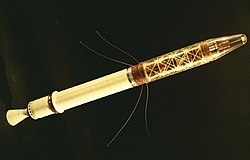
America answered Sputnik by launching Explorer 1 aboard a Jupiter-C rocket developed by von Braun's team at ABMA. The satellite discovered the Van Allen radiation belts.
Image source: Explorer 1
Oct 1, 1958
% complete
The National Aeronautics and Space Administration was created to coordinate U.S. civilian space efforts, consolidating rocket development programs and setting the stage for human spaceflight.
Image source: NASA
May 5, 1961
% complete
Alan Shepard rode a Redstone rocket on America's first crewed suborbital flight, Freedom 7, weeks after Yuri Gagarin's orbital flight on a Vostok rocket made him the first human in space.
Image source: Mercury-Redstone Launch Vehicle
May 25, 1961
% complete
President John F. Kennedy declared the goal of landing a man on the Moon before the decade's end, launching the Apollo program and driving development of the giant Saturn rockets.
Image source: Apollo program
Nov 28, 1966
% complete
Derived from the R-7 ICBM, the Soyuz launcher began flying missions supporting the Soviet Soyuz spacecraft. It became the most frequently launched rocket family in history, still flying today.
Image source: Soyuz (rocket family)
Nov 9, 1967
% complete
The Saturn V, the most powerful rocket ever flown at that time, lifted off on its first uncrewed test flight (Apollo 4). Standing 363 feet tall, it generated 7.6 million pounds of thrust.
Image source: Saturn V
Jul 20, 1969
% complete
A Saturn V rocket carried Neil Armstrong, Buzz Aldrin, and Michael Collins to the Moon. Armstrong and Aldrin landed the lunar module Eagle and became the first humans to walk on another world.
Image source: Apollo 11
May 14, 1973
% complete
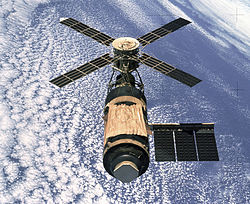
The last Saturn V launched Skylab, America's first space station, repurposing Moon rocket hardware for orbital science and habitation.
Image source: Skylab
Apr 12, 1981
% complete
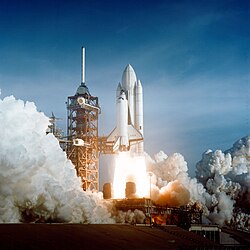
Columbia launched on the first flight of the Space Shuttle, the first reusable orbital spacecraft, riding solid rocket boosters and an external tank. Shuttles flew 135 missions until 2011.
Image source: STS-1
Jan 28, 1986
% complete
Space Shuttle Challenger broke apart 73 seconds after liftoff when an O-ring seal in a solid rocket booster failed in cold weather, killing all seven crew members and grounding the shuttle fleet for nearly three years.
Image source: Space Shuttle Challenger disaster
Jun 4, 1996
% complete
Europe's Ariane 5 heavy-lift rocket made its first flight. Despite a failed maiden voyage due to software errors, it became one of the most reliable commercial launch vehicles, serving for decades.
Image source: Ariane 5
Nov 20, 1998
% complete
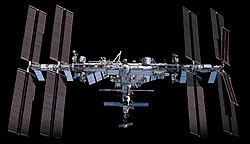
Russia's Proton-K rocket launched Zarya, the first ISS module, beginning over a decade of assembly flights using Russian, American, European, and Japanese launch vehicles.
Image source: International Space Station
Sep 28, 2008
% complete
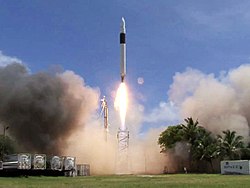
After three failures, SpaceX's Falcon 1 became the first privately developed liquid-fueled rocket to reach orbit, proving commercial companies could build orbital launch vehicles.
Image source: Falcon 1
Dec 21, 2015
% complete
SpaceX landed a Falcon 9 first stage vertically after delivering satellites to orbit, achieving the first recovery of an orbital-class booster and opening the era of reusable rockets.
Image source: Falcon 9 first-stage landing tests
Mar 30, 2017
% complete
SpaceX reused a previously flown Falcon 9 first stage on the SES-10 mission, demonstrating practical rocket reusability and dramatically lowering launch costs.
Image source: SES-10
Feb 6, 2018
% complete
SpaceX launched Falcon Heavy, then the most powerful operational rocket, sending Elon Musk's Tesla Roadster toward Mars orbit and landing two boosters simultaneously at Kennedy Space Center.
Image source: Falcon Heavy
May 30, 2020
% complete
SpaceX's Crew Dragon Demo-2 mission launched Bob Behnken and Doug Hurley on a Falcon 9, restoring American human orbital spaceflight capability and marking the first crewed commercial orbital launch.
Image source: Crew Dragon Demo-2
Or browse the full history timeline directory, with more than 2,000 topics.
This History of Rockets timeline was generated with the help of AI, using information found on the internet.
We work hard to keep these timelines accurate, but mistakes do get through. If you spot one, email us at [email protected] and we'll fix it for future visitors.
Generate yours with AI or build it from scratch, for free.
Export your timeline, add your own events, edit or remove AI-generated events, and much more
No credit card required.
Cancel anytime.
Cancel anytime.
You can create an unlimited number of timelines with up to 10 events on each one, customize how they look, export them to PDF, PNG, PowerPoint, CSV, and Excel, and share them with a link. Paid plans raise the event limit and add features like spreadsheet imports and collaborators.
Yes. You can cancel your subscription from your account page at any time, and you will not be charged again. Your subscription stays active for the rest of the period you already paid for.
Yes. We will email you a reminder before the annual renewal, and we will also email you a receipt.
Yes. You can email us within 15 days of any payment, and we will issue you a full refund.
Check out our pricing docs or send us an email anytime: [email protected].