-
Use Cases
-
Resources
-
Pricing
The history of telecommunications traces humanity's efforts to transmit information over distance, beginning with visual signals like smoke signals and semaphore, advancing through the electric telegraph and telephone in the 19th century, radio and television broadcasting in the early 20th century, and culminating in satellite communications, fiber optics, cellular networks, and the global internet that connect billions of people today. More Less
1726
% complete
Experiments on communication with electricity, initially unsuccessful, started in about 1726. These early efforts laid the groundwork for the eventual development of practical electrical telegraphy in the following century.
Image source: Electrical telegraph
1774
% complete
In 1774, the Swiss physicist Georges Lesage built an electrostatic telegraph consisting of a set of 24 conductive wires a few meters long connected to 24 elder balls suspended from a silk thread, with each wire corresponding to a letter.
1790
% complete
French engineer Claude Chappe began working on visual telegraphy in 1790, using pairs of 'clocks' whose hands pointed at different symbols. His optical semaphore system would go on to spread across France.
Image source: Optical telegraph
1794
% complete
In 1794, the Swedish engineer Abraham Edelcrantz built a quite different visual telegraph system running from Stockholm to Drottningholm, expanding the reach of optical signaling in Europe.
1809
% complete
An early experiment in electrical telegraphy was an 'electrochemical' telegraph created by the German physician, anatomist and inventor Samuel Thomas von Sömmerring in 1809, based on an earlier, less robust design of 1804 by Spanish polymath Francisco Salva Campillo.
Image source: Samuel Thomas von Sömmerring
1816
% complete
The first working telegraph was built by Francis Ronalds in 1816 and used static electricity. Despite its success, it was not adopted for commercial use at the time.
Image source: Francis Ronalds
Sep 2, 1837
% complete
On the other side of the Atlantic Ocean, Samuel Morse developed a version of the electrical telegraph which he demonstrated on 2 September 1837, beginning the American telegraph era.
Image source: Samuel Morse
1838
% complete
Charles Wheatstone and William Fothergill Cooke patented a five-needle, six-wire system, which entered commercial use in 1838. It used the deflection of needles to represent messages.
Image source: Cooke and Wheatstone telegraph
Jan 6, 1838
% complete
Morse's telegraph was demonstrated successfully over three miles (five kilometres) on 6 January 1838, proving the reliability of his system over meaningful distances.
Apr 9, 1839
% complete
The Wheatstone and Cooke needle telegraph started operating over twenty-one kilometres (thirteen miles) of the Great Western Railway on 9 April 1839, marking the first commercial use of an electrical telegraph.
Image source: Great Western Railway
May 24, 1844
% complete
Morse famously transmitted messages over forty miles (sixty-four kilometres) between Washington, D.C., and Baltimore on 24 May 1844, demonstrating the practicality of long-distance telegraphy.
Image source: Baltimore–Washington telegraph line
1851
% complete
The submarine cable across the English Channel, wire coated in gutta percha, was laid in 1851, enabling telegraphic communication between Britain and continental Europe.
Image source: Submarine communications cable
1851
% complete
The patented invention proved lucrative and by 1851 telegraph lines in the United States spanned over 20,000 miles (32,000 kilometres), knitting the country together with near-instant communication.
1857 - 1858
% complete
Transatlantic cables installed in 1857 and 1858 only operated for a few days or weeks, carrying messages of greeting back and forth between James Buchanan and Queen Victoria, before they failed.
Image source: Transatlantic telegraph cable
Jul 27, 1866
% complete
The first successful transatlantic telegraph cable was completed on 27 July 1866, allowing continuous transatlantic telecommunication for the first time and revolutionizing global communication.
1880
% complete
As a result of the rise of electrical telegraphy, the last commercial semaphore line was abandoned in 1880, ending the era of optical telegraphy.
1878 - 1879
% complete
The first commercial telephone services were set up in 1878 and 1879 on both sides of the Atlantic in the cities of New Haven, Connecticut in the US and London, England in the UK.
Image source: History of the telephone
1880
% complete
In 1880, Alexander Graham Bell and co-inventor Charles Sumner Tainter conducted the world's first wireless telephone call via modulated lightbeams projected by photophones, predating radio-based voice transmission.
Image source: Photophone
Jan 25, 1915
% complete
The first transcontinental telephone call occurred on January 25, 1915, connecting the Atlantic and Pacific coasts of the United States by wire for the first time.
Image source: First transcontinental telephone call
Jan 7, 1927
% complete
Transatlantic voice communication remained impossible for customers until January 7, 1927, when a connection was established using radio, opening regular transatlantic telephone service.
Image source: Transatlantic communications cable
Sep 25, 1956
% complete
No cable connection existed until TAT-1 was inaugurated on September 25, 1956, providing 36 telephone circuits across the Atlantic. It was the first transatlantic telephone cable to incorporate hundreds of electronic amplifiers.
Image source: TAT-1
1894 - 1896
% complete
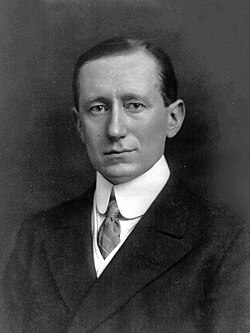
Over several years starting in 1894, the Italian inventor Guglielmo Marconi worked on adapting the newly discovered phenomenon of radio waves to telecommunication, building the first practical wireless telegraphy systems based on radio.
Image source: Guglielmo Marconi
1894 - 1896
% complete
Millimetre wave communication was first investigated by Bengali physicist Jagadish Chandra Bose during 1894–1896, when he reached an extremely high frequency of up to 60 GHz in his experiments.
Image source: Jagadish Chandra Bose
1900
% complete
In 1900, Reginald Fessenden was able to wirelessly transmit a human voice, a landmark achievement in the development of radio broadcasting and voice communication.
Image source: Reginald Fessenden
1901
% complete
Jagadish Chandra Bose introduced the use of semiconductor junctions to detect radio waves when he patented the radio crystal detector in 1901, pioneering semiconductor technology decades ahead of its time.
Dec 1901
% complete
In December 1901, Marconi established wireless communication between St. John's, Newfoundland and Poldhu, Cornwall (England), earning him a Nobel Prize in Physics (shared with Karl Braun) in 1909.
Image source: Wireless telegraphy
1924
% complete
In 1924, Japanese engineer Kenjiro Takayanagi began a research program on electronic television that would produce some of the world's first fully electronic television receivers.
Image source: Kenjiro Takayanagi
1925
% complete
In 1925, Takayanagi demonstrated a cathode-ray tube (CRT) television with thermal electron emission, followed in 1926 by a CRT television with 40-line resolution, the first working example of a fully electronic television receiver.
Mar 25, 1925
% complete
On March 25, 1925, Scottish inventor John Logie Baird publicly demonstrated the transmission of moving silhouette pictures at the London department store Selfridge's, an early milestone in television history.
Image source: John Logie Baird
Oct 1925
% complete
In October 1925, Baird was successful in obtaining moving pictures with halftone shades, which were by most accounts the first true television pictures. This led to a public demonstration of the improved device on 26 January 1926 again at Selfridges.
1927
% complete
In 1927, Takayanagi increased the television resolution to 100 lines, which was unrivaled until 1931. In 1928, he was also the first to transmit human faces in half-tones on television, influencing the later work of Vladimir K. Zworykin.
Sep 7, 1927
% complete
Philo Farnsworth demonstrated crude silhouette images of a fully electronic CRT television to his family in Idaho on September 7, 1927. In 1934, he gave the first public demonstration of the television at Philadelphia's Franklin Institute and opened his own broadcasting station.
Image source: Philo Farnsworth
Sep 30, 1929
% complete
Baird's invention formed the basis of semi-experimental broadcasts done by the British Broadcasting Corporation beginning September 30, 1929, launching the world's first regular television service.
Sep 11, 1940
% complete
On September 11, 1940, George Stibitz was able to transmit problems using teletype to his Complex Number Calculator in New York City and receive the computed results back at Dartmouth College in New Hampshire, an early demonstration of remote computing.
Apr 7, 1969
% complete
ARPANET's development centred on the Request for Comments process, and on April 7, 1969, RFC 1 was published, establishing the collaborative documentation tradition of the Internet.
Image source: Request for Comments
Dec 5, 1969
% complete
A four-node network emerged on December 5, 1969, between the University of California, Los Angeles, the Stanford Research Institute, the University of Utah and the University of California, Santa Barbara. This network would become ARPANET, which by 1981 would consist of 213 nodes.
Image source: ARPANET
Jun 1973
% complete
In June 1973, the first non-US node was added to the network belonging to Norway's NORSAR project, extending ARPANET beyond American borders for the first time.
Oct 29, 1974
% complete
A patent for the Token Ring protocol was filed by Olof Söderblom on October 29, 1974, contributing an important local area networking technology to the growing field of computer communications.
Image source: Token Ring
Dec 1974
% complete
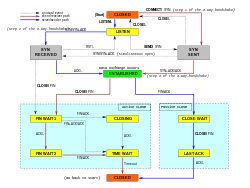
The first Transmission Control Protocol (TCP) specification, RFC 675 (Specification of Internet Transmission Control Program), was written by Vinton Cerf, Yogen Dalal, and Carl Sunshine, and published in December 1974.
Image source: Transmission Control Protocol
Jul 1976
% complete
A paper on the Ethernet protocol was published by Robert Metcalfe and David Boggs in the July 1976 issue of Communications of the ACM, laying the foundation for the dominant local area networking technology.
Image source: Ethernet
Aug 28, 1980
% complete
The User Datagram Protocol (UDP), a more relaxed transport protocol that, unlike TCP, did not guarantee the orderly delivery of packets, was submitted on 28 August 1980 as RFC 768.
Sep 1981
% complete
In September 1981, RFC 791 introduced the Internet Protocol version 4 (IPv4), which became the core addressing protocol of the Internet and remains widely used today.
Image source: Internet Protocol version 4
Aug 1982
% complete
An e-mail protocol, SMTP, was introduced in August 1982 by RFC 821, standardizing electronic mail delivery across networks and enabling the widespread adoption of email.
Image source: Simple Mail Transfer Protocol
May 1996
% complete
HTTP/1.0, a protocol that would make the hyperlinked Internet possible, was introduced in May 1996 by RFC 1945, powering the growth of the World Wide Web.
Image source: HTTP
1958
% complete
The first satellite to relay communications was Project SCORE in 1958, which used a tape recorder to store and forward voice messages, inaugurating the age of satellite telecommunications.
Image source: SCORE (satellite)
1960
% complete
Courier 1B, built by Philco and launched in 1960, was the world's first active repeater satellite, capable of receiving, storing, and retransmitting communications rather than merely reflecting them.
Image source: Courier 1B
1960
% complete
In 1960 NASA launched an Echo satellite; the 100-foot (30 m) aluminized PET film balloon served as a passive reflector for radio communications, bouncing signals between ground stations.
Image source: Project Echo
Jul 10, 1962
% complete
Belonging to AT&T as part of a multi-national agreement between AT&T, Bell Telephone Laboratories, NASA, the British General Post Office, and the French National PTT, Telstar was launched by NASA from Cape Canaveral on July 10, 1962, the first privately sponsored space launch and the first commercial telecommunications satellite.
Image source: Telstar
Nov 22, 1963
% complete
Relay 1 was launched on December 13, 1962, and became the first satellite to broadcast across the Pacific on November 22, 1963, extending satellite communications to new regions of the globe.
Image source: Relay program
1979
% complete
After commercial long-distance telephone service was established via communication satellites, a host of other commercial telecommunications were adapted to similar satellites starting in 1979, including mobile satellite phones, satellite radio, satellite television and satellite Internet access.
Image source: Communications satellite
Oct 29, 2001
% complete
Realization and demonstration, on October 29, 2001, of the first digital cinema transmission by satellite in Europe of a feature film by Bernard Pauchon, Alain Lorentz, Raymond Melwig and Philippe Binant.
Image source: Digital cinema
Or browse the full history timeline directory, with more than 2,000 topics.
This History of Telecommunications timeline was generated with the help of AI, using information found on the internet.
We work hard to keep these timelines accurate, but mistakes do get through. If you spot one, email us at [email protected] and we'll fix it for future visitors.
Generate yours with AI or build it from scratch, for free.
Export your timeline, add your own events, edit or remove AI-generated events, and much more
No credit card required.
Cancel anytime.
Cancel anytime.
You can create an unlimited number of timelines with up to 10 events on each one, customize how they look, export them to PDF, PNG, PowerPoint, CSV, and Excel, and share them with a link. Paid plans raise the event limit and add features like spreadsheet imports and collaborators.
Yes. You can cancel your subscription from your account page at any time, and you will not be charged again. Your subscription stays active for the rest of the period you already paid for.
Yes. We will email you a reminder before the annual renewal, and we will also email you a receipt.
Yes. You can email us within 15 days of any payment, and we will issue you a full refund.
Check out our pricing docs or send us an email anytime: [email protected].