-
Use Cases
-
Resources
-
Pricing
Divergent is a young adult dystopian fiction series written by American author Veronica Roth. Set in a post-apocalyptic Chicago where society is divided into factions based on virtues—Abnegation, Amity, Candor, Dauntless, and Erudite—the trilogy follows Beatrice 'Tris' Prior as she discovers she is Divergent and cannot be categorized into a single faction. The series became a cultural phenomenon in the early 2010s, spawning a major film franchise starring Shailene Woodley and Theo James, and played a significant role in the wave of dystopian YA literature following The Hunger Games. More Less
1000 - 1099
% complete
In the 11th century, the theologian and Doctor of the Church Peter Damian explored a philosophical form of counterfactual speculation in his work De Divina Omnipotentia, questioning whether God could restore things to a different state.
Image source: Peter Damian
1490
% complete
One of the earliest works of fiction with clear alternate-history elements is Joanot Martorell's 1490 epic romance Tirant lo Blanch, which reimagines historical events in its chivalric narrative.
Image source: Tirant lo Blanch
1830
% complete
The Book of Mormon (published 1830) has been described as an 'alternative history' by historian Richard Lyman Bushman, biographer of Joseph Smith.
Image source: Book of Mormon
1836
% complete
Louis Geoffroy's Histoire de la Monarchie universelle: Napoléon et la conquête du monde (1812–1832), published in 1836, was one of the earliest works of alternate history to reach a large audience. The novel imagines Napoleon's First French Empire victorious in the French invasion of Russia and in an invasion of England in 1814, eventually unifying the world under Bonaparte's rule.
1845
% complete
In English, the first known complete alternate history is Nathaniel Hawthorne's short story 'P.'s Correspondence', published in 1845. It depicts a man deemed mad for perceiving a different 1845 in which long-dead figures including poets Robert Burns, Lord Byron, Percy Bysshe Shelley, and John Keats, actor Edmund Kean, British politician George Canning, and Napoleon are still alive.
1895
% complete
The first novel-length alternate history in English is Castello Holford's Aristopia (1895), imagining a utopian society founded in colonial America.
Image source: Castello Holford
1907 - 1926
% complete
A number of alternate history stories and novels appeared in the late 19th and early 20th centuries, such as Joseph Edgar Chamberlin's The Ifs of History (1907) and Charles Petrie's If: A Jacobite Fantasy (1926).
Image source: Alternate history
1923
% complete
Wells' Men Like Gods (1923) features the London-based journalist Mr. Barnstaple crossing into Utopia, a parallel world far more advanced than Earth — some 3000 years ahead of humanity in its development.
Image source: Men Like Gods
1930
% complete
American humorist James Thurber parodied alternate history stories about the American Civil War in his 1930 story 'If Grant Had Been Drinking at Appomattox', accompanied by a brief introduction referencing Scribner's magazine's series 'If Booth Had Missed Lincoln', 'If Lee Had Won the Battle of Gettysburg', and 'If Napoleon Had Escaped to America'.
Image source: A Thurber Carnival
1931
% complete
In 1931, British historian Sir John Squire collected essays from leading historians for his anthology If It Had Happened Otherwise. The essays ranged from serious scholarly efforts to Hendrik Willem van Loon's fanciful portrayal of an independent 20th-century New Amsterdam, a Dutch city-state on Manhattan.
Dec 1933 - 1934
% complete
The December 1933 issue of Astounding published Nat Schachner's 'Ancestral Voices', which was quickly followed by Murray Leinster's 'Sidewise in Time' (1934), pioneering cross-time narratives in pulp science fiction.
Image source: Sidewise in Time
1941
% complete
Robert A. Heinlein's 1941 novelette Elsewhen features a professor who trains his mind to move his body across timelines, exploring multiple possible realities.
1948
% complete
In William Tenn's short story Brooklyn Project (1948), a tyrannical US government ignores warnings about time travel; minor changes to the prehistoric past cause humanity to never exist, its place taken by tentacled underwater intelligent creatures with their own tyrannical government experimenting with time travel.
Image source: Brooklyn
1952
% complete
In Ray Bradbury's classic short story 'A Sound of Thunder' (1952), hunters travel to the Late Cretaceous to hunt dinosaurs whose deaths would seem inconsequential — but a small misstep demonstrates the butterfly effect on history.
1952 - 1955
% complete
Isaac Asimov's short story 'What If—' (1952) is about a couple who can explore alternate realities via a television-like device. This idea also appears in Asimov's novel The End of Eternity (1955), in which the 'Eternals' change the realities of the world without people being aware of it.
Image source: The End of Eternity
1953
% complete
In Ward Moore's Bring the Jubilee (1953), the protagonist lives in an alternate history in which the Confederacy has won the American Civil War, one of the most influential Civil War counterfactuals.
Image source: Bring the Jubilee
1958
% complete
Fritz Leiber developed the concept of a cross-time version of a world war involving rival paratime empires in his Change War series, starting with the Hugo Award-winning The Big Time (1958); later examples include Richard C. Meredith's Timeliner trilogy in the 1970s, Michael McCollum's A Greater Infinity (1982), and John Barnes' Timeline Wars trilogy in the 1990s.
1960 - 1990
% complete
The cross-time theme was further developed by Keith Laumer in the first three volumes of his Imperium sequence, beginning with Worlds of the Imperium, published by Fantastic Stories of the Imagination in 1961 and reprinted by Ace Books in 1962 as half of an Ace Double. The sequence was completed with Zone Yellow (1990).
Image source: Keith Laumer
1962
% complete
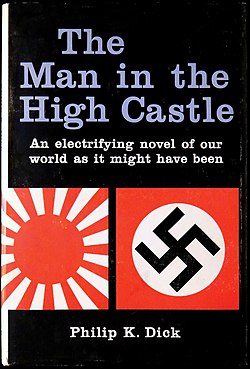
Philip K. Dick's novel The Man in the High Castle (1962) is an alternate history in which Nazi Germany and Imperial Japan won World War II following the assassination of FDR, becoming one of the most celebrated alternate history novels ever written.
Image source: The Man in the High Castle
1969
% complete
Vladimir Nabokov's novel Ada or Ardor: A Family Chronicle (1969) takes place within an alternate North America settled in part by Czarist Russia and borrows from Philip K. Dick's idea of 'alternate-alternate' history, with rumors of a mysterious 'counter-earth'.
Image source: Ada, or Ardor: A Family Chronicle
1970
% complete
Martin Cruz Smith, in his first novel, posited an independent American Indian nation following the defeat of Custer in The Indians Won (1970).
Image source: Indianapolis Indians
1972
% complete
Norman Spinrad wrote The Iron Dream in 1972, framed as a science fiction novel written by Adolf Hitler after fleeing Europe to North America in the 1920s, satirizing fascist themes in pulp fiction.
Image source: The Iron Dream
1973
% complete
Ryō Hanmura's 1973 novel Musubi no Yama Hiroku recreated 400 years of Japan's history from the perspective of a secret magical family with psychic abilities.
1975
% complete
Guido Morselli described the defeat of Italy and France in World War I in his novel Past Conditional (1975; Contro-passato prossimo), wherein the static Alpine front collapses when the Germans and Austrians adopt blitzkrieg twenty years early.
Image source: Guido Morselli
1976
% complete
Kingsley Amis set his novel The Alteration (1976) in the 20th century, but major events of the Reformation never took place, leaving Protestantism limited to the breakaway Republic of New England.
1980
% complete
Beginning with The Probability Broach in 1980, L. Neil Smith wrote several novels postulating the disintegration of the US Federal Government after Albert Gallatin joins the Whiskey Rebellion in 1794, eventually leading to the creation of a libertarian utopia.
Image source: The Probability Broach
1986
% complete
In 1986, a sixteen-part epic comic book series called Captain Confederacy began examining a world where the Confederate States of America won the American Civil War.
1987 - 1989
% complete
The Inc trilogy (1987–89), featuring paratime detectives Sam and Brandy Horowitz, marks the first attempt at merging the paratime thriller with the police procedural. Michael Kurland's Perchance (1988), first volume of the unfinished 'Chronicles of Elsewhen', presented a multiverse of secretive cross-time societies.
1992
% complete
Fatherland (1992), by Robert Harris, is set in Europe following a Nazi victory in World War II, becoming a best-selling example of Nazi-victory alternate history. It was adapted as a TV movie set in a 1964 alternative world where US President Joseph Kennedy and Adolf Hitler agree to meet to discuss ending their Cold War fifteen years after the Axis victory.
Image source: Fatherland (novel)
1997
% complete
In Nick Hancock and Chris England's 1997 book What Didn't Happen Next: An Alternative History of Football it is suggested that, had Gordon Banks been fit to play in the 1970 FIFA World Cup quarter-final, there would have been no Thatcherism and the post-war consensus would have continued indefinitely.
Image source: Gordon Banks
2000 - 2099
% complete
In Eric Flint's 1632 series, a small town in West Virginia is transported to 17th century central Europe and drastically changes the course of the Thirty Years' War, then underway.
2002
% complete
Kim Stanley Robinson's novel The Years of Rice and Salt (2002) starts with Timur turning his army away from Europe and the Black Death killing 99% of Europe's population instead of only a third. Robinson explores world history from AD 1405 (807 AH) to about AD 2045 (1467 AH).
Image source: The Years of Rice and Salt
2004
% complete
John Birmingham's Axis of Time trilogy deals with the culture shock when a United Nations naval task force from 2021 finds itself back in 1942 helping the Allies against Japan and Germany, exploring cultural impacts of people with 2021 ideals interacting with 1940s culture.
2004
% complete
Philip Roth's novel The Plot Against America (2004) looks at an America where Franklin D. Roosevelt is defeated in 1940 in his bid for a third term as President, and Charles Lindbergh is elected, leading to a US featuring increasing fascism and anti-Semitism. HBO adapted it as a miniseries where Lindbergh wins the 1940 election as an anti-war candidate moving the country toward fascism.
Image source: The Plot Against America
2007
% complete
Michael Chabon contributed to the genre with his novel The Yiddish Policemen's Union (2007), exploring a world in which the State of Israel was destroyed in its infancy and many of the world's Jews instead live in a small strip of Alaska set aside by the US government for Jewish settlement.
Image source: The Yiddish Policemen's Union
2012
% complete
C.J. Sansom's Dominion (2012) is similar in concept to Fatherland but is set in England, with Churchill the leader of an anti-German Resistance and other historic persons in various fictional roles.
Image source: Dominion (Sansom novel)
2016
% complete
In the Mecha Samurai Empire series (2016), Peter Tieryas focuses on the Asian-American side of the alternate history, exploring an America ruled by the Japanese Empire while integrating elements of Asian pop culture like mechas and videogames.
Image source: Mecha Samurai Empire series
2022
% complete
In Steve Rhinelander's 2022 novel Poutine and Gin, the point of divergence is the Battle of the Plains of Abraham of the French and Indian War; the novel is a mystery set in 1940 of that timeline. Also in 2022, R.M.'s Hydrogen Wars: Atomic Sunrise appeared, with another point of divergence occurring in 1199, when Richard the Lionheart survives the Siege of Chaluz and makes the Angevin Empire strong enough to survive into the 20th century.
Image source: Battle of the Plains of Abraham
1977
% complete
The Court-Martial of George Armstrong Custer is a 1977 telemovie where George Custer survives the Battle of Little Bighorn and faces a court martial hearing over his incompetence.
1983
% complete
1983 is set on a world where the Iron Curtain never fell and the Cold War continues until the present day of 2003.
1992 - 1996
% complete
In Star Trek's primary universe, there are references to alternative versions of historical events, and entirely alternative ones, such as the rise of Khan Noonien Singh in the fictional Eugenics Wars from 1992 to 1996.
2013
% complete
The Great Martian War 1913–1917 is an alternate history mockumentary where giant Martians with machines invaded Earth during WW1, causing huge technological upgrades and the Entente and Central Powers fighting alongside each other.
Image source: The Great Martian War 1913–1917
2019
% complete
Primal features Spear and Fang from prehistory encountering Ancient Egypt and Vikings eras, and in episode 'The Primal Theory' Charles Darwin is alive in 1890 instead of dying in 1882.
Image source: Primal (TV series)
2021 - 2024
% complete
The Marvel Cinematic Universe series Loki (2021 and 2023) on Disney+ shows an agency which prevents alterations to the timeline, while What If...? (2021–2024) shows alternate universes depicting alternate events from the MCU films.
Image source: What If...? (TV series)
2021
% complete
The anime Fena: Pirate Princess featured an alternate 18th century, blending pirate adventure with a reimagined historical setting.
Image source: Fena: Pirate Princess
Apr 11, 1991
% complete
The 'Usenet Alternate History List' was first posted on 11 April 1991, to the Usenet newsgroup rec.arts.sf-lovers, creating one of the earliest organized online resources for alternate history enthusiasts.
Image source: Uchronia: The Alternate History List
May 1995
% complete
In May 1995, the dedicated newsgroup soc.history.what-if was created for showcasing and discussing alternate histories, giving fans a dedicated online forum.
Image source: Alternate history
1997
% complete
In addition to Usenet discussion forums, in 1997 Uchronia: The Alternate History List was created as an online repository, now containing over 2,900 alternate history novels, stories, essays, and other printed materials in several different languages.
Or browse the full history timeline directory, with more than 2,000 topics.
This History of Divergent timeline was generated with the help of AI, using information found on the internet.
We work hard to keep these timelines accurate, but mistakes do get through. If you spot one, email us at [email protected] and we'll fix it for future visitors.
Generate yours with AI or build it from scratch, for free.
Export your timeline, add your own events, edit or remove AI-generated events, and much more
No credit card required.
Cancel anytime.
Cancel anytime.
You can create an unlimited number of timelines with up to 10 events on each one, customize how they look, export them to PDF, PNG, PowerPoint, CSV, and Excel, and share them with a link. Paid plans raise the event limit and add features like spreadsheet imports and collaborators.
Yes. You can cancel your subscription from your account page at any time, and you will not be charged again. Your subscription stays active for the rest of the period you already paid for.
Yes. We will email you a reminder before the annual renewal, and we will also email you a receipt.
Yes. You can email us within 15 days of any payment, and we will issue you a full refund.
Check out our pricing docs or send us an email anytime: [email protected].