-
Use Cases
-
Resources
-
Pricing
The English language evolved over more than 1,500 years from the Germanic dialects brought to Britain by Anglo-Saxon settlers. It developed through major periods—Old English (influenced by Norse and Latin), Middle English (transformed by Norman French after 1066), and Early Modern English (reshaped by the Renaissance, printing, and Shakespeare)—before becoming a global language spread by the British Empire and shaped by American influence in the modern era. More Less
450 - 700
% complete
A Germanic settlement of Britain took place from the 5th to the 7th century, following the end of Roman rule on the island. Anglo-Saxon migrants from what is now northwest Germany, southern Denmark and the Netherlands brought Ingvaeonic languages that would form the basis of English.
450
% complete
The Anglo-Saxons settled in the British Isles from the mid-5th century and came to dominate the bulk of southern Great Britain, establishing the cultural and linguistic foundations of what would become England.
450 - 700
% complete
English is a West Germanic language that originated from Ingvaeonic languages brought to Britain in the mid-5th to 7th centuries AD by Anglo-Saxon migrants from what is now northwest Germany, southern Denmark and the Netherlands.
Image source: History of English
800
% complete
The earlier runic writing system was replaced by a version of the Latin alphabet introduced by Irish missionaries in the 8th century, allowing Old English to be recorded in written form.
890
% complete
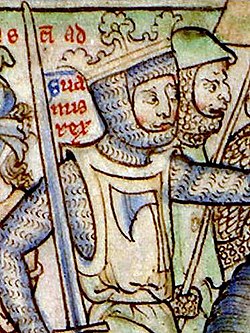
This is the beginning of The Voyages of Ohthere and Wulfstan, a prose text in Old English dated to the late 9th century, providing a rare surviving example of early English prose.
Image source: Ohthere of Hålogaland
790
% complete
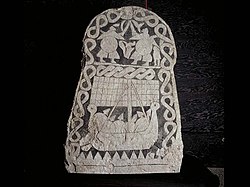
Vikings from modern-day Norway and Denmark began to raid parts of Britain from the late 8th century onward, initiating an era of Scandinavian contact that would profoundly shape the English language.
Image source: Viking Age
800 - 900
% complete
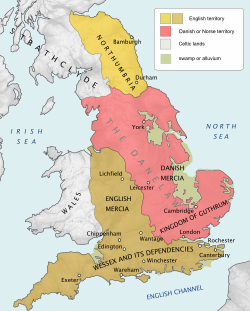
A significant influence upon the shaping of Old English came from contact with the North Germanic languages spoken by the Scandinavian Vikings who conquered and colonized parts of Britain during the 8th and 9th centuries, leading to much lexical borrowing and grammatical simplification.
Image source: Danelaw
850
% complete
The speech of eastern and northern parts of England was subject to strong Old Norse influence due to Scandinavian rule and settlement beginning in the 9th century, leaving lasting marks on vocabulary and grammar.
Image source: Old Norse
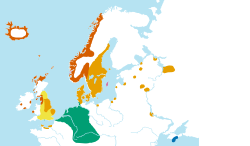
910 - 924
% complete
Most of the areas conquered by the Vikings were retaken by the English under Edward the Elder in the early 10th century, gradually restoring English political control over the Danelaw.
Image source: Edward the Elder
954
% complete
York and Northumbria were not permanently regained until the death of Eric Bloodaxe in 954, marking the end of permanent Scandinavian kingship in northern England.
Image source: Eric Bloodaxe
980 - 1016
% complete
Scandinavian raids resumed in the late 10th century during the reign of Æthelred the Unready, renewing Danish pressure on England and paving the way for Danish kingship.
Image source: Æthelred the Unready
1013 - 1014
% complete
Sweyn Forkbeard was briefly declared king of England in 1013, beginning a period of Danish rule over the English kingdom.
Image source: Sweyn Forkbeard
1016 - 1035
% complete
Sweyn Forkbeard's son Cnut reigned as king of England from 1016 to 1035, followed by his sons Harold Harefoot and Harthacnut until 1042, uniting England in a North Sea empire.
Image source: Cnut
1016 - 1042
% complete
During the rule of Cnut and other Danish kings in the first half of the 11th century, a kind of diglossia may have come about, with the West Saxon literary language existing alongside the Norse-influenced Midland dialect of English, which could have served as a koine or spoken lingua franca.
Image source: Diglossia
1066
% complete
The Old English period is considered to have evolved into the Middle English period some time after the Norman Conquest of 1066, when the language came to be influenced significantly by the new ruling class's language, Old Norman.
1066
% complete
After the Norman Conquest in 1066, Old English was replaced, for a time, by Anglo-Norman French as the language of the upper classes. The Conquest marked the transition from the Old English to the Middle English period.
Image source: Norman Conquest
1066 - 1400
% complete
For centuries after the Conquest, the Norman kings and high-ranking nobles in England spoke Anglo-Norman, a variety of Old Norman originating from a northern langue d'oïl dialect. Until the 14th century, Anglo-Norman and then French were the language of the courts and government.
Image source: Anglo-Norman language
1200
% complete
English literature began to reappear after 1200, when a changing political climate and the decline in Anglo-Norman made it more respectable to write in English.
1258
% complete
The Provisions of Oxford, released in 1258, was the first English government document to be published in the English language after the Norman Conquest.
Image source: Provisions of Oxford
1362
% complete
The Pleading in English Act 1362 made English the only language in which court proceedings could be held, though the official record remained in Latin.
Image source: Pleading in English Act 1362
1362
% complete
In 1362, Edward III became the first king to address Parliament in English, symbolizing the rising status of the English language in official life.
Image source: Edward III of England
1387 - 1400
% complete
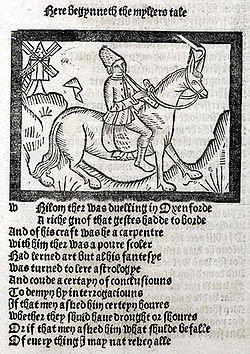
Geoffrey Chaucer, who lived in the late 14th century, is the most famous writer from the Middle English period, and The Canterbury Tales is his best-known work.
Image source: Geoffrey Chaucer
1399
% complete
By the end of the 14th century, the royal court had switched to English, completing the restoration of English as the language of power in England.
Image source: Middle English
1400 - 1500
% complete
Official documents began to be produced regularly in English during the 15th century, cementing English as the language of government administration.
1485
% complete
Middle English was spoken until the late 15th century, roughly from the time of the Norman Conquest in 1066 until the end of the 15th century, before giving way to Early Modern English.
1400 - 1600
% complete
Modern English is often dated from the Great Vowel Shift, which took place mainly during the 15th century and transformed the pronunciation of all long vowels. Its dramatic developments can be seen from c. 1400 to 1600.
Image source: Great Vowel Shift
1400 - 1500
% complete
English underwent extensive sound changes during the 15th century, while its spelling conventions remained largely constant, creating a divergence between pronunciation and spelling.
1500
% complete
Early Modern English – the language used by William Shakespeare – is dated from around 1500, following the Great Vowel Shift.
Image source: Early Modern English
1550 - 1616
% complete
By the time of William Shakespeare (mid 16th – early 17th century), the language had become clearly recognizable as Modern English.
Image source: William Shakespeare
1604
% complete
In 1604, the first English dictionary was published, A Table Alphabeticall, compiled by Robert Cawdrey.
Image source: Table Alphabeticall
1600 - 1700
% complete
In the 17th century, Latin words were often used with their original inflections, but these eventually disappeared, simplifying the adoption of classical vocabulary into English.
1680
% complete
Modern English proper, similar in most respects to that spoken today, was in place by the late 17th century.
1755
% complete
The first authoritative and full-featured English dictionary, the Dictionary of the English Language, was published by Samuel Johnson in 1755, standardizing English spelling and usage.
Image source: A Dictionary of the English Language
1950 - 2000
% complete
Partially due to the influence of the United States and its globalized efforts of commerce and technology, English took on the status of a global lingua franca in the second half of the 20th century.
Or browse the full history timeline directory, with more than 2,000 topics.
This History of English Language timeline was generated with the help of AI, using information found on the internet.
We work hard to keep these timelines accurate, but mistakes do get through. If you spot one, email us at [email protected] and we'll fix it for future visitors.
Generate yours with AI or build it from scratch, for free.
Export your timeline, add your own events, edit or remove AI-generated events, and much more
No credit card required.
Cancel anytime.
Cancel anytime.
You can create an unlimited number of timelines with up to 10 events on each one, customize how they look, export them to PDF, PNG, PowerPoint, CSV, and Excel, and share them with a link. Paid plans raise the event limit and add features like spreadsheet imports and collaborators.
Yes. You can cancel your subscription from your account page at any time, and you will not be charged again. Your subscription stays active for the rest of the period you already paid for.
Yes. We will email you a reminder before the annual renewal, and we will also email you a receipt.
Yes. You can email us within 15 days of any payment, and we will issue you a full refund.
Check out our pricing docs or send us an email anytime: [email protected].