-
Use Cases
-
Resources
-
Pricing
The history of language traces humanity's development of communication from prehistoric spoken tongues tens of thousands of years ago through the invention of writing systems like cuneiform and hieroglyphics, the rise of classical languages such as Latin, Greek, and Sanskrit, the evolution of modern languages, and the scientific study of linguistics that continues to shape how we understand human communication today. More Less
4500 BC - 2500 BC
% complete
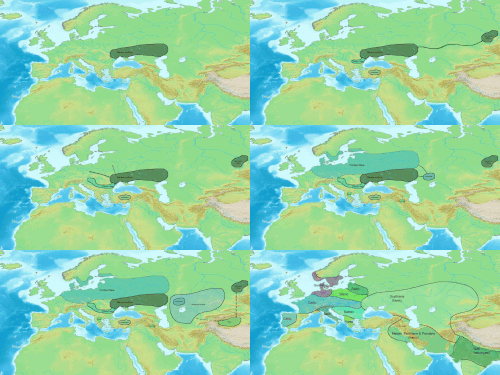
Proto-Indo-European (PIE), the reconstructed common ancestor of languages including English, Latin, Greek, Sanskrit, and Russian, was likely spoken by pastoral communities on the Pontic-Caspian steppe. As its speakers migrated across Eurasia, PIE diversified into numerous daughter languages, forming one of the world's largest language families.
Image source: Proto-Indo-European language
450 AD - 1100 AD
% complete
Germanic tribes migrating to Britain brought dialects that fused into Old English, the language of Beowulf. Heavily influenced later by Norse invaders and Norman conquerors, Old English laid the foundation for the development of Middle and Modern English.
600 AD - 900 AD
% complete
After the fall of the Western Roman Empire, the everyday spoken Latin of different regions diverged into distinct vernaculars. Over several centuries these evolved into the Romance languages, including French, Spanish, Italian, Portuguese, Romanian, and Catalan.
Image source: Romance languages
1066 AD
% complete
William the Conqueror's victory at Hastings installed French-speaking rulers in England. For centuries, French dominated law, government, and high culture while English persisted among common people, resulting in massive French vocabulary borrowing and profound changes to English structure.
Image source: Norman Conquest
1590 AD - 1613 AD
% complete
During the Elizabethan and Jacobean eras, English underwent rapid expansion in vocabulary and expressive range. Shakespeare's plays and the King James Bible (1611) fixed many idioms and word forms, shaping Modern English and cementing its literary prestige.
Image source: Early Modern English
3200 BC
% complete
In ancient Sumer, scribes developed cuneiform, pressing wedge-shaped marks into clay tablets. Originally used for record-keeping of goods and livestock, it evolved into a full writing system capable of expressing literature, law, and religion, marking the beginning of recorded human history.
Image source: Cuneiform
3200 BC
% complete
Ancient Egyptians developed hieroglyphic writing, combining logographic and alphabetic elements. Used for monumental inscriptions and religious texts, hieroglyphs remained in use for over three millennia until the rise of Coptic and the spread of other scripts in Egypt.
Image source: Egyptian hieroglyphs
2600 BC - 1900 BC
% complete
The Indus Valley civilization produced short inscriptions on seals and pottery that remain undeciphered to this day. The Indus script represents one of archaeology's great unsolved mysteries, with scholars still debating whether it encodes a language or serves another symbolic function.
Image source: Indus script
1800 BC
% complete
The Proto-Sinaitic script, developed by Canaanite workers in Egypt, is considered the earliest alphabetic writing. By using signs to represent single consonant sounds rather than whole words or syllables, it dramatically simplified writing and became the ancestor of Phoenician, Hebrew, Greek, and Latin scripts.
Image source: Proto-Sinaitic script
1050 BC
% complete
Phoenician traders carried their 22-letter consonantal alphabet throughout the Mediterranean world. Its simplicity made literacy more accessible, and it directly inspired the Greek, Aramaic, and ultimately Latin alphabets used by billions of people today.
Image source: Phoenician alphabet
800 BC
% complete
Adapting the Phoenician script, the Greeks repurposed certain consonant letters to represent vowel sounds, creating the first complete alphabet. This innovation allowed precise representation of speech and facilitated the flourishing of Greek literature, philosophy, and science.
1440 AD
% complete
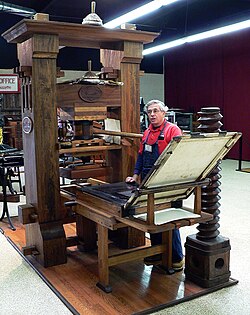
Johannes Gutenberg's movable-type printing press enabled mass production of books. Printed texts encouraged standardized spelling, grammar, and orthography in European vernaculars, dramatically increasing literacy and accelerating the spread of national languages.
Image source: Printing press
1822 AD
% complete
Using the trilingual Rosetta Stone, Champollion announced his decipherment of hieroglyphs, unlocking three thousand years of Egyptian written records. His breakthrough revolutionized Egyptology and demonstrated how bilingual inscriptions can revive lost scripts.
Image source: Jean-François Champollion
1835 AD - 1857 AD
% complete
Henry Rawlinson's copying and decoding of the Behistun inscription, carved in Old Persian, Elamite, and Babylonian, cracked the cuneiform writing system. This opened up the literatures of Mesopotamia, including the Epic of Gilgamesh, to the modern world.
Image source: Behistun Inscription
500 BC
% complete
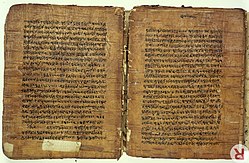
The Indian scholar Pāṇini produced the Aṣṭādhyāyī, a remarkably systematic description of Sanskrit grammar using formal rules. Often regarded as the founder of linguistics, his work anticipated modern concepts such as generative rules and metarules by more than two millennia.
Image source: Pāṇini
100 BC
% complete
Dionysius Thrax's Art of Grammar provided a framework of parts of speech, inflection, and syntax that dominated grammatical teaching in Europe for centuries. His work established grammar as a distinct discipline and influenced later Latin and medieval grammatical traditions.
950 AD - 1000 AD
% complete
The Arab scholar Ibn Jinni wrote influential treatises on Arabic phonetics, phonology, and semantics, analyzing sound production and linguistic variation centuries before similar work in Europe. His studies represent a high point of medieval Arabic linguistic scholarship.
Image source: Ibn Jinni
1492 AD
% complete
Nebrija's Gramática de la lengua castellana was the first published grammar of a Romance vernacular. Presented to Queen Isabella, it reflected the era's belief that language was an instrument of empire, helping fix Castilian Spanish as a standardized national language.
Image source: Antonio de Nebrija
1635 AD
% complete
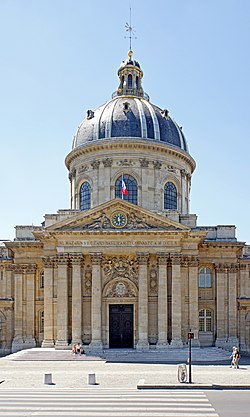
Cardinal Richelieu established the Académie française to perfect and codify the French language. It began publishing an authoritative dictionary and continues to act as France's official authority on French usage, exemplifying institutional language planning.
Image source: Académie Française
1755 AD
% complete
Johnson's dictionary standardized English spelling and usage through meticulously cited definitions. Dominant for over a century, it demonstrated that lexicography could combine scholarship with literary style and profoundly influenced subsequent dictionaries.
Image source: A Dictionary of the English Language
1786 AD
% complete
In a famous address to the Asiatic Society in Calcutta, Jones observed striking similarities between Sanskrit, Greek, and Latin, hypothesizing a common source. His insight launched comparative philology and the study of the Indo-European language family.
Image source: William Jones (philologist)
1816 AD
% complete
Bopp's comparative analysis of verb conjugation systems across Sanskrit, Persian, Greek, Latin, and Germanic languages provided rigorous methodology for historical linguistics, establishing language comparison as a scientific discipline.
Image source: Franz Bopp
1875 AD
% complete
Young German scholars known as Neogrammarians proposed that sound changes operate without exception, following regular laws. Their hypothesis, tested against data like Grimm's Law, gave historical linguistics a predictive, scientific character.
1916 AD
% complete
Published posthumously from students' notes, Saussure's Course introduced key concepts such as the signifier/signified distinction, langue versus parole, and synchronic analysis. It founded structuralism and transformed linguistics into a modern autonomous science.
Image source: Course in General Linguistics
1957 AD
% complete
Chomsky's Syntactic Structures argued that language ability rests on innate mental structures and proposed transformational-generative grammar. His ideas sparked the cognitive revolution, reframed linguistics as a branch of cognitive science, and inspired decades of research on universal grammar.
Image source: Syntactic Structures
400 BC
% complete
Based on the language of classical texts like the Confucian canon, Classical Chinese served as the written standard for China and, through cultural influence, for Korea, Japan, and Vietnam for over two thousand years, functioning much as Latin did in medieval Europe.
100 BC
% complete
As Rome expanded, Latin became the dominant language of administration, law, literature, and scholarship across the Mediterranean and Western Europe. Its standardized classical form, shaped by writers like Cicero and Caesar, left an enduring legacy on European languages and education.
Image source: Latin
632 AD - 750 AD
% complete
Following the death of Muhammad, Arab armies rapidly conquered territories from Spain to Central Asia. Arabic became the language of religion, administration, science, and literature across this vast realm, displacing or transforming many local languages and giving rise to diverse modern Arabic dialects.
Image source: Arabic
1990 AD
% complete
With the rise of the World Wide Web, English solidified its role as the primary language of science, business, aviation, and digital communication. While roughly half of web content is now in English, the internet has also given unprecedented visibility to hundreds of minority languages worldwide.
Image source: English language
Or browse the full history timeline directory, with more than 2,000 topics.
This History of Language timeline was generated with the help of AI, using information found on the internet.
We work hard to keep these timelines accurate, but mistakes do get through. If you spot one, email us at [email protected] and we'll fix it for future visitors.
Generate yours with AI or build it from scratch, for free.
Export your timeline, add your own events, edit or remove AI-generated events, and much more
No credit card required.
Cancel anytime.
Cancel anytime.
You can create an unlimited number of timelines with up to 10 events on each one, customize how they look, export them to PDF, PNG, PowerPoint, CSV, and Excel, and share them with a link. Paid plans raise the event limit and add features like spreadsheet imports and collaborators.
Yes. You can cancel your subscription from your account page at any time, and you will not be charged again. Your subscription stays active for the rest of the period you already paid for.
Yes. We will email you a reminder before the annual renewal, and we will also email you a receipt.
Yes. You can email us within 15 days of any payment, and we will issue you a full refund.
Check out our pricing docs or send us an email anytime: [email protected].