
-
Use Cases
-
Resources
-
Pricing
The history of fast food traces the evolution of quick-service dining from early automats and hamburger stands in the United States to a global industry dominated by chains like McDonald's, KFC, and Burger King. Key milestones include the assembly-line kitchen innovations of the mid-20th century, franchising models that fueled rapid expansion, drive-thru culture, and modern trends toward healthier options and digital ordering. More Less
1850
% complete
The development of trawler fishing in the mid-nineteenth century made large quantities of fish readily available, leading to the development of a British favourite, fish and chips, and the opening of the first fish and chip shop in 1860.
1850 - 1900
% complete
Via the Industrial Revolution, the fish and chip business expanded rapidly in Britain during the 19th century to satisfy the needs of the growing industrial population, providing cheap and filling meals to urban workers.
1860
% complete
The first fish and chip shop opened in Britain in 1860, marking the birth of what would become one of the country's most beloved fast foods. Made possible by advances in trawler fishing, fried fish served with chips became an affordable, hot meal for working people.
1910
% complete
By 1910, there were more than 25,000 fish and chip shops across the UK, demonstrating how deeply embedded this fast food had become in British culture and daily life.
1920 - 1929
% complete
In the 1920s there were more than 35,000 fish and chip shops across the UK, showing continued growth of the industry through the interwar period.
Image source: Fish and chips
1916
% complete
Walter Anderson built the first White Castle restaurant in Wichita, Kansas in 1916, introducing the limited menu, high-volume, low-cost, high-speed hamburger restaurant model that would define American fast food.
Image source: White Castle (restaurant)
1921
% complete
The American company White Castle, founded by Billy Ingram and Walter Anderson in Wichita, Kansas in 1921, is generally credited with opening the first fast food outlet and first hamburger chain, selling hamburgers for five cents each.
1921
% complete
Franchising was introduced in 1921 by A&W Root Beer, which franchised its distinctive syrup. This business model would become fundamental to the rapid expansion of fast food chains worldwide.
Image source: Franchising
1928
% complete
Harry Ramsden's fast food restaurant chain opened its first fish and chip shop in Guiseley, West Yorkshire in 1928, beginning what would grow into a famous British fast food brand.
Image source: Harry Ramsden's
1952
% complete
On a single day in 1952, Harry Ramsden's original shop served 10,000 portions of fish and chips, earning a place in the Guinness Book of Records and demonstrating the massive scale fast food operations could achieve.
1969
% complete
The first bar serving pasztecik szczeciński, Bar "Pasztecik", was founded in 1969 on Wojska Polskiego Avenue 46 in Szczecin, Poland, establishing a distinctive Polish fast food tradition centered on deep-fried stuffed rolls.
Image source: Szczecin pasztecik
1970
% complete
In 1970, consumers in the United States spent $6 billion on fast food, a figure that would grow dramatically over the following decades as the industry expanded nationwide.
2006
% complete
In 2006, the global fast-food market grew by 4.8% and reached a value of £102.4 billion and a volume of 80.3 billion transactions, reflecting the industry's robust worldwide growth.
2010
% complete
As of 2010, millions of workers were employed in food preparation and serving, including fast food, in the United States, making it one of the largest employment sectors in the country.
Apr 2011
% complete
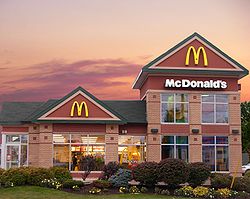
In April 2011, McDonald's hired approximately 62,000 new workers and received a million applications for those positions—an acceptance rate of 6.2%, highlighting both the scale of its workforce needs and the competitiveness of even entry-level fast food jobs.
Image source: McDonald's
2012
% complete
In the United States, consumers spent $160 billion on fast food in 2012, up from just $6 billion in 1970, illustrating the enormous growth of the American fast food market over four decades.
2013
% complete
Time invested on food preparation is getting lower: in 2013, the average woman in the United States spent 47 minutes per day preparing food and the average man spent 19 minutes per day, contributing to demand for convenient fast food options.
Image source: Fast food
2013
% complete
In 2013, the median age of workers in the fast food industry was 28, indicating that the workforce included many adults beyond teenagers, contrary to common perceptions.
2013
% complete
In 2013, the US restaurant industry had total projected sales of $660.5 billion, encompassing fast food outlets as a major component of the broader dining economy.
Image source: Restaurant
2018
% complete
In 2018, the fast-food industry was worth an estimated $570 billion globally, cementing its status as one of the largest industries in the world.
2018
% complete
As of 2018, millions of workers were employed in the areas of food preparation and food servicing, including fast food, in the United States, underscoring the sector's role as a major employer.
2023
% complete
In 2023, the median age of a fast-food worker was 22, and workers' wages make up about one third of the cost of operating a fast food restaurant, highlighting ongoing labor dynamics within the industry.
Dec 1984
% complete
Subway's first non-US location opened in December 1984 in Bahrain, marking the start of the chain's international expansion into markets around the world.
Jan 31, 1990
% complete
On January 31, 1990, McDonald's opened a restaurant in Moscow and broke opening-day records for customers served. The opening was seen as a symbol of Western influence entering the Soviet Union near the end of the Cold War.
May 2009
% complete
As of May 2009, Subway had approximately 39,129 restaurants in 90 countries, making it one of the fastest growing franchises in the world since its international expansion began in 1984.
Image source: Subway (restaurant)
2001
% complete
Eric Schlosser published Fast Food Nation in 2001, arguing that fast food chains are not only a financial but also a psychological bait, luring students toward early employment opportunities without teaching skills, at the cost of wasted time.
Image source: Fast Food Nation
2004
% complete
The 2004 film Super Size Me was designed to highlight the potential negative health effects from the overconsumption of fast food, such as its contribution to obesity, joining other books and films critiquing the industry.
Image source: Super Size Me
2010
% complete
A 2010 study undertaken in the city of Jeddah indicated that fast-food habits were related to an increased level of obesity among adolescents in Saudi Arabia, adding to global concerns about fast food's health effects.
2010
% complete
In a 2010 article in The Atlantic, Kelly Brownell argued that Burger King and McDonald's adopted another dangerous practice for marketing to children, further supporting critiques of fast food companies' advertising strategies.
Image source: Kelly D. Brownell
2014
% complete
In 2014, the World Health Organization published a study which indicated that deregulated food markets were largely to blame for an obesity crisis, and suggested tighter regulations to reverse the trend.
Image source: World Health Organization
2015
% complete
In the United States, it was reported in 2015 that local governments were restricting fast-food chains by limiting the number of restaurants found in certain geographical areas, a regulatory response to health concerns.
2017
% complete
In a 2017 study, fifty-six percent of university students in Germany consumed fast food on a weekly basis, showing the strong hold of fast food on young adults' diets in Europe.
Or browse the full history timeline directory, with more than 2,000 topics.
This History of Fast Food timeline was generated with the help of AI, using information found on the internet.
We work hard to keep these timelines accurate, but mistakes do get through. If you spot one, email us at [email protected] and we'll fix it for future visitors.
Generate yours with AI or build it from scratch, for free.
Export your timeline, add your own events, edit or remove AI-generated events, and much more
No credit card required.
Cancel anytime.
Cancel anytime.
You can create an unlimited number of timelines with up to 10 events on each one, customize how they look, export them to PDF, PNG, PowerPoint, CSV, and Excel, and share them with a link. Paid plans raise the event limit and add features like spreadsheet imports and collaborators.
Yes. You can cancel your subscription from your account page at any time, and you will not be charged again. Your subscription stays active for the rest of the period you already paid for.
Yes. We will email you a reminder before the annual renewal, and we will also email you a receipt.
Yes. You can email us within 15 days of any payment, and we will issue you a full refund.
Check out our pricing docs or send us an email anytime: [email protected].