-
Use Cases
-
Resources
-
Pricing
Ferrari is an Italian luxury sports car manufacturer founded by Enzo Ferrari. Originally established as Auto Avio Costruzioni in 1939, the company produced its first car bearing the Ferrari name in 1947. Renowned for its Formula 1 racing success, distinctive red styling, and exclusive high-performance vehicles, Ferrari has become one of the most prestigious and valuable automotive brands in the world. More Less
1908
% complete
At the age of ten, Enzo Ferrari decided to pursue racing. To this end, he eventually began a career as a racing driver in 1919, laying the groundwork for his later ventures in motorsport and automobile manufacturing.
Image source: Enzo Ferrari
1929
% complete
In 1929, Enzo Ferrari broke from his line of work as a racing driver to found and manage his own racing team, which he named Scuderia Ferrari. This team traces the roots of the Ferrari company back to this year.
1932
% complete
The first use of Ferrari's iconic Prancing Horse logo was at the 1932 24 Hours of Spa-Francorchamps, establishing one of the most recognizable emblems in motorsport history.
Image source: Ferrari
1933
% complete
After Alfa Romeo came under the control of the Italian state in 1933, their racing division was downsized, and Scuderia Ferrari functioned as the unofficial company team throughout the mid-1930s.
1934
% complete
Leading up to the 1934 Grand Prix season, Ferrari began conducting their own research and development while Alfa Romeo continued to supply racing cars, a situation that led to vehicles being engineered within Ferrari themselves.
1930
% complete
The team's first race was the 1930 Mille Miglia, using cars supplied by Alfa Romeo. The first use of the Prancing Horse logo came shortly after, at the 1932 24 Hours of Spa-Francorchamps.
Image source: Mille Miglia
1932 - 1935
% complete
From 1932 to 1935 Scuderia Ferrari also operated a motorcycle racing division, which was conceived as a way to scout and train future Grand Prix drivers.
1947
% complete
Purpose-built for sports car racing, the 125 S achieved the company's first victory at the 1947 Grand Prix of Rome, where it was driven by Franco Cortese, who called it 'a more modern machine, indeed exceptional for those days.'
Image source: Ferrari 125 S
1948
% complete
The 125 S was developed alongside the 125 F1, first raced for the 1948 Grand Prix season. It debuted at the 1948 Italian Grand Prix, where its encouraging performance convinced Enzo to continue the company's costly Grand Prix racing programme.
Image source: Ferrari 125 F1
1949
% complete
The 166 MM barchetta was a capable racing machine — in 1949 it won the 24 Hours of Le Mans, Targa Florio, and Spa 24 Hours — and the car's racing cachet helped build Ferrari's reputation very early in its history. The nickname barchetta, meaning 'little boat,' was first used at the 1948 Turin Auto Show.
Image source: Ferrari 166 S
1949
% complete
In 1949, a 47-year-old Luigi Chinetti became Le Mans' oldest champion to date after racing for 23 full hours, demonstrating remarkable endurance behind the wheel of a Ferrari.
Image source: Luigi Chinetti
1951
% complete
One of the more important races for the company's future was the 1951 Carrera Panamericana, a grueling transcontinental endurance race straddling Mexico's new highway system. After the victory, Luigi Chinetti leveraged Ferrari's fame to scout out new buyers in the United States.
1952
% complete
In 1952 Ferrari won its first Formula One season, filling the vacuum left by Alfa Romeo's departure from the series. By 1957, just ten years after beginning to race, Ferrari had taken home three Formula One World Championships, three World Sportscar Championships, seven Mille Miglia victories, and two wins at Le Mans.
Image source: 1952 Formula One season
1952 - 1953
% complete
Between the 1952 and 1953 Belgian Grands Prix, Alberto Ascari placed first in every single Formula One race, one of the most dominant stretches in the sport's history.
Image source: Alberto Ascari
1957
% complete
Alfonso de Portago died driving a Ferrari at the 1957 Mille Miglia, which accompanied a disaster that killed nine spectators, five of them children. The public was especially roused by his death. Other Ferrari drivers killed in this era included Eugenio Castellotti, Luigi Musso, Peter Collins, and Wolfgang von Trips.
Image source: 1957 Mille Miglia
1960 - 1983
% complete
The North American Racing Team (NART) operated as a privateer team, independent from Ferrari, and grew out of driver arrangements Chinetti had been managing since 1951. NART continued to race until 1983.
1960 - 1965
% complete
Between 1960 and 1965, the company counted two World Driver's Championships, two Constructors' Championships, and six consecutive Le Mans wins, cementing its dominance in endurance racing.
Image source: 24 Hours of Le Mans
1961
% complete
The 156 F1, piloted by champion driver Phil Hill, gave Ferrari both titles of the 1961 Formula One season, while the 246 SP took two victories at the 1961 and 1962 Targa Florio.
Image source: Phil Hill
1961 - 1966
% complete
Eugenio Dragoni became the new F1 team director, a position he would hold until 1966. While his predecessor Tavoni had been popular with his drivers, Dragoni was not, and personal problems between him, Phil Hill, and John Surtees would cause the two to leave the team in 1962 and 1966, respectively.
Jun 1963
% complete
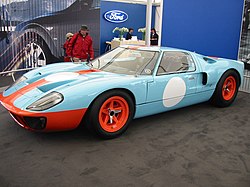
By 1963, Enzo, wishing to focus more closely on Ferrari's racing programme, began searching for a company to which he could outsource manufacturing operations. In June 1963, shortly after Ferrari negotiations fell through, Ford began work on a sports prototype that would be ready to race by the 1964 24 Hours of Le Mans.
Image source: Ford GT40
1966
% complete
The climax of the Ferrari–Ford rivalry was the 1966 24 Hours of Le Mans, where eight of Ford's Mk IIs raced against two Ferrari 330 P3s. Ford's victory marked the end of Ferrari's six-year winning streak, and the beginning of the end for the company's sports car racing programme.
1968
% complete
Following Ford's victory in 1966, Ferrari experienced significant setbacks. A rules change by the FIA rendered Ferrari's newest prototype designs, the 412 P and 330 P4, ineligible for the 1968 World Sportscar Championship. Ferrari's absence that year effectively ended its rivalry with Ford early.
Image source: World Sportscar Championship
1970 - 1971
% complete
The company saw significant competition with Porsche in 1970 and 1971, as the Ferrari 512 proved to be one of the only cars able to keep up with the speedy, light, and reliable Porsche 917; though Porsche maintained an edge, Ferrari still managed several victories.
Image source: Ferrari 512
1973
% complete
Ferrari's F1 woes, combined with pressure from its new owner Fiat, eventually pushed it to abandon sports car racing in 1973. Before bowing out of the discipline, Ferrari won two more World Sportscar Championships, one in 1967 and another in 1972, when it lost only one of that season's eleven races.
1975 - 1979
% complete
It took until 1975 for Ferrari to win another F1 championship. In 1975 and 1977 Niki Lauda won the drivers' title for the team, as did Jody Scheckter in 1979; they also won the constructors' title for three consecutive years, 1975–1977. Clay Regazzoni managed a close second place in 1974, Lauda the same in 1976, and Carlos Reutemann third in 1978.
Image source: Niki Lauda
1980
% complete
Starting with the 1980 season, the team entered an extended title drought. Attempting to fix this problem the team brought in new engineers, including John Barnard and Harvey Postlethwaite; the Postlethwaite-designed 126C2 won the team the 1982 and 1983 constructors' titles.
1982
% complete
Driver casualties, namely the death of Gilles Villeneuve and grave injury of Didier Pironi, also hurt the team, costing them a potential drivers' title in 1982.
Image source: Gilles Villeneuve
1937
% complete
In 1937, Alfa Romeo began to reconsider the inefficient state of affairs with Scuderia Ferrari, and at the end of the year they purchased 80% of Scuderia Ferrari's shares, absorbing it into the company.
1939
% complete
Enzo remained the team's manager until a restructuring in 1939, in which he was laid off, prompting him to establish his own independent company, Auto Avio Costruzioni.
1941 - 1945
% complete
After Italy entered World War II in 1940, racing opportunities dried up and the company was mobilised for wartime production in 1941. It received lucrative contracts to manufacture military hardware during the war years.
1943
% complete
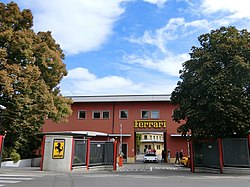
In order to avoid the Allied bombing campaigns occurring throughout Italy, Ferrari moved his factory from Modena to Maranello in 1943. Though the new plant was bombed twice, in November 1944 and February 1945, Ferrari remains in Maranello to this day.
Image source: Maranello
1945
% complete
In 1945, Auto Avio Costruzioni was renamed Auto Costruzioni Ferrari, marking the company's transition toward producing cars under Enzo Ferrari's own name.
Dec 24, 1946
% complete
On 24 December 1946, Enzo Ferrari made Luigi Chinetti his official North American importer. Chinetti had been an immigrant to the United States and had been working towards establishing Ferrari's presence there since 1946.
1947
% complete
Luigi Chinetti established the first US Ferrari dealership, Luigi Chinetti Motors, in 1947; he imported his first Ferrari for US sale in 1949, and managed other vehicle sales perhaps as early as 1948.
1949
% complete
Ferrari vehicles were shipped to the United States, which was to become one of the automaker's primary markets, as early as 1949, following Luigi Chinetti's efforts to build the brand's American presence.
1960
% complete
In 1960, Ferrari was restructured as a public company, Ferrari Società Esercizio Fabbriche Automobili e Corse S.p.A., formalising its corporate structure as it grew.
1960
% complete
By 1960, 40 percent of all Ferrari vehicles were exported to North America, reflecting the success of Luigi Chinetti's sales efforts and the growing importance of the American market.
Oct 1961
% complete
One of the first challenges faced in the new decade occurred in October 1961, when key engineering figures left the company. Before their new venture folded in 1964, they had produced the ATS 2500 GT — the second mid-engined road car in history and the first from Italy — as well as the 'Breadvan,' a custom Ferrari 250 GT.
1965 - 1973
% complete
Ferrari first worked with Fiat in 1965, when new homologation regulations within Formula Two required Ferrari to produce at least 500 examples of its F2 engine, the Dino V6, which was more than its factory was capable of. Between 1966 and 1973, Fiat produced over 7,000 examples of the engine for its Fiat Dino sports car.
Image source: Fiat Dino
Jun 1969
% complete
As Ferrari struggled with sales and production in the late 1960s, it reluctantly turned to Fiat for financial assistance, and the two would complete an acquisition deal in June of 1969. Between 1969 and 1972, sales increased exponentially, though operating revenue and gross operating income both fell drastically soon after the acquisition.
Image source: Fiat
1988
% complete
Enzo Ferrari died in 1988, an event that saw Fiat expand its stake to 90%. His legacy included the versatile Colombo V12 engine, used in various Ferrari models until 1988, having tripled its displacement and nearly quadrupled its power output since its debut.
1991 - 2014
% complete
Enzo was succeeded in 1991 by Luca di Montezemolo, under whose 23-year-long chairmanship the company greatly expanded. Between 1991 and 2014, he increased the profitability of Ferrari's road cars nearly tenfold, both by increasing the range of cars offered and through limiting the total number produced. He was also chairman of Fiat proper between 2004 and 2010.
Image source: Luca di Montezemolo
Jan 2016
% complete
In January 2016, Ferrari officially split off from its former parent company Fiat Chrysler Automobiles, becoming an independent publicly traded company.
2021
% complete
Beginning in 2021, Camilleri was replaced as CEO by Benedetto Vigna, who has announced plans to develop Ferrari's first fully electric model, signalling a new chapter in the company's history.
Image source: Benedetto Vigna
1947
% complete
The first Ferrari sports car, as well as the first car to use Gioacchino Colombo's new V12 engine, was the 1947 125 S. Ferrari itself tends to cast the 125 S's production as the starting point of its history, marking 1947 as its founding date during anniversary celebrations.
1950 - 1966
% complete
The America series of grand touring cars began production in 1950, starting with the 340 America racing model. The series used the Lampredi engine until 1959, then switched to the Colombo beginning in 1960, and ended by 1966.
Image source: Ferrari America
1951
% complete
The company's partnership with Pinin Farina, which began in 1951, solved production issues and allowed Ferrari to produce its cars at a higher volume, shaping the design language of Ferraris for decades to come.
Image source: Pininfarina
1953
% complete
By 1953, Enzo, having grown tired of small-scale sales, hoped to expand and standardise the production of his road cars. The idea of a mass-produced Ferrari could be traced back to the 1953 250 Europa, named after its 3-litre Colombo engine.
Image source: Ferrari 250
1957
% complete
Also named after Alfredo Ferrari, Enzo's late son, was the new Dino marque: first applied in 1957, two years after Alfredo's death, to the Dino 156 F2 open-wheel car. In the 1960s the name would come to be applied to a line of lower-priced Ferraris produced in cooperation with Fiat.
Image source: Dino (marque)
1958
% complete
The 250 GT Coupé became the first series-produced Ferrari in 1958, following an expansion of Pinin Farina's production facilities, marking the company's transition from hand-built to series-produced vehicles.
Image source: Ferrari 250 GT Coupé
1963 - 1964
% complete
The first of these were the 330 and 275 series, which were first produced for the 1963 and 1964 model years, respectively. These were later joined by the 365 series, which began in 1966.
1967
% complete
The Dino 206 GT, first produced for the 1967 model year, was Ferrari's first mass-produced mid-engined street car, as well as the first to be sold under the Dino marque.
Image source: Dino 206 GT and 246 GT
1973 - 1984
% complete
The Berlinetta Boxer, first produced in 1973, was the company's first flagship car to sport a mid-engined design. It was produced, with revisions along the way, until 1984, when it was replaced by the Testarossa.
Image source: Ferrari Berlinetta Boxer
1973 - 1980
% complete
The Dino 308 GT4, the first road Ferrari to use a V8 engine, was launched in 1973. The GT4 was discontinued in 1980, though its engine and underpinnings were used by other Ferraris of this era, such as the 308 and Mondial.
Image source: Ferrari GT4
1973
% complete
A new engine tax induced by the 1973 oil crisis led the company to debore its V8 engine; the result was the 208 GT4, which possessed the lowest displacement V8 ever produced for a road car.
1976 - 1989
% complete
Beginning in 1976, the 400 GT was the first Ferrari to be offered with an automatic transmission, a three-speed Turbo-Hydramatic produced by General Motors. The 365 GT4 2+2, 400 and 412 grand tourers, produced from 1972 to 1989, were the final models to utilize the decades-old Colombo V12.
Image source: Ferrari 365 GT4 2+2, 400 and 412
1986
% complete
By 1986, Ferrari had produced a one-off car for Fiat's chairman, Gianni Agnelli: in celebration of 20 years at the head of Fiat, Agnelli commissioned the Testarossa Spider, which featured many customisations tailored specifically for him.
Image source: Ferrari Testarossa
Or browse the full history timeline directory, with more than 2,000 topics.
This History of Ferrari timeline was generated with the help of AI, using information found on the internet.
We work hard to keep these timelines accurate, but mistakes do get through. If you spot one, email us at [email protected] and we'll fix it for future visitors.
Generate yours with AI or build it from scratch, for free.
Export your timeline, add your own events, edit or remove AI-generated events, and much more
No credit card required.
Cancel anytime.
Cancel anytime.
You can create an unlimited number of timelines with up to 10 events on each one, customize how they look, export them to PDF, PNG, PowerPoint, CSV, and Excel, and share them with a link. Paid plans raise the event limit and add features like spreadsheet imports and collaborators.
Yes. You can cancel your subscription from your account page at any time, and you will not be charged again. Your subscription stays active for the rest of the period you already paid for.
Yes. We will email you a reminder before the annual renewal, and we will also email you a receipt.
Yes. You can email us within 15 days of any payment, and we will issue you a full refund.
Check out our pricing docs or send us an email anytime: [email protected].