
-
Resources
-
Pricing
The history of Ferris wheels traces their development from a spectacular 1893 World's Fair attraction into iconic amusement rides and giant observation structures worldwide. More Less
Build a timeline like this one in minutes, for free. Start Yours →
1890
Since their inception in the late 19th century, Ferris wheels have undergone major transformations in size, materials, and engineering. They developed into both popular attractions and prominent architectural landmarks.
Image source: Ferris wheel
1893
The first Ferris wheel was introduced in 1893 at the World's Columbian Exposition in Chicago, establishing the basic form of the large observation wheel as a major public attraction.
1893
The original Ferris Wheel operated at a Chicago site associated with the World's Columbian Exposition. Its enormous scale made it one of the exposition's most recognizable attractions.
1897
The Wiener Riesenrad was constructed in Vienna, Austria, in 1897. Its iron construction and height of 64.75 meters made it one of the tallest Ferris wheels of its time.
1897
At 64.75 meters, or 212 feet, the Wiener Riesenrad represented a significant early achievement in Ferris-wheel engineering and stood among the tallest examples of its era.
1897
The Wiener Riesenrad was notable for its iron construction, demonstrating the use of durable metal engineering in the development of large Ferris wheels.
1900
In the early 20th century, Ferris wheels continued to evolve. Changes in construction and engineering helped the form remain useful as both an amusement ride and an observation structure.
1906
The Wiener Riesenrad's continued operation after 1906 gave it a lasting historical role in Vienna and distinguished it from the dismantled predecessor of the Chicago tradition.
1906
After the original Ferris Wheel was dismantled in 1906, the Wiener Riesenrad remained in operation. Its continued survival helped establish it as a historical landmark.
1906
The original Ferris Wheel, unlike the Wiener Riesenrad, was dismantled in 1906 after operating at two sites in Chicago and later at a third site in St. Louis.
1985
Technocosmos, also known as Technostar, moved to Expoland in Osaka after Expo '85 in Tsukuba, Ibaraki, for which it had been built, ended.
1999
When erected for the second time at Minato Mirai 21 in 1999, Cosmo Clock 21 added five meters, or 16 feet, to its original 107.5-meter height.
1999
In 1999, Cosmo Clock 21 was erected for a second time at Minato Mirai 21 in Yokohama, demonstrating how large Ferris wheels could be relocated and reassembled.
1970
The late 20th century saw renewed interest in Ferris wheels. Advances in engineering made it possible to build taller and more structurally complex designs.
1970
New engineering capabilities in the late 20th century expanded the possible size and complexity of Ferris wheels, preparing the way for a series of modern height records.
2000
By the 21st century, Ferris wheels had developed beyond amusement rides into architectural landmarks, with their height, engineering complexity, and urban settings contributing to their civic identity.
2000
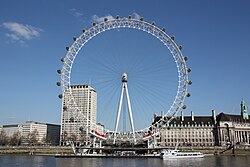
The London Eye's design marked a significant innovation in the development of modern Ferris wheels and helped demonstrate their potential as architectural landmarks.
Image source: London Eye
1989
In 1989, Cosmo Clock 21 in Yokohama, Japan, became the world's tallest Ferris wheel, reaching 107.5 meters, or 353 feet.
1989
Cosmo Clock 21 established its 107.5-meter height record in 1989, illustrating the scale achieved by late-20th-century Ferris-wheel engineering.
2000
The London Eye opened in 2000 and represented a significant innovation in Ferris-wheel design, combining a large observation wheel with a prominent urban architectural setting.
2000
At the turn of the 21st century, Ferris wheels reached new heights as large observation wheels became increasingly prominent features of major urban destinations.
2006
At 160 meters, or 525 feet, the Star of Nanchang surpassed the London Eye and became the new benchmark for Ferris-wheel height.
2006
The Star of Nanchang reached 160 meters, or 525 feet, making it one of the defining large Ferris wheels of the early 21st century.
2006
The Star of Nanchang was completed in China in 2006. Its construction continued the early-21st-century expansion of Ferris-wheel scale.
2008
The Singapore Flyer opened in 2008, continuing the rapid succession of record-setting Ferris wheels in the early 21st century.
2008
When it opened in 2008, the Singapore Flyer stood at 165 meters, or 541 feet, surpassing the 160-meter Star of Nanchang.
2008
The Singapore Flyer reached a height of 165 meters, or 541 feet, making it the tallest Ferris wheel at the time of its opening.
2014
The High Roller launched in Las Vegas in 2014, further extending the scale of modern Ferris wheels and reinforcing their role as major destination attractions.
2014
The High Roller reached 167.6 meters, or 550 feet, making it taller than the Singapore Flyer when it opened.
2014 - 2021
The High Roller held the world's tallest Ferris-wheel record for several years after its 2014 launch, until Ain Dubai was unveiled in 2021.
2021
In 2021, Ain Dubai was unveiled in the United Arab Emirates. At 250 meters, or 820 feet, it became the tallest Ferris wheel in the world.
Image source: Ain Dubai
2021
Ain Dubai's 250-meter height, equivalent to 820 feet, established a new world record and surpassed the 167.6-meter High Roller.
Build a timeline like this one in minutes, for free. Start Yours →
Or browse the full history timeline directory, with more than 2,500 topics.
This History of Ferris Wheels timeline was generated with the help of AI, using information found on the internet.
We work hard to keep these timelines accurate, but mistakes do get through. If you spot one, email us at [email protected] and we'll fix it for future visitors.
Generate yours with AI or build it from scratch, for free.
Export your timeline, add your own events, edit or remove AI-generated events, and much more
No credit card required.
15-day money-back guarantee.
You can create an unlimited number of timelines with up to 10 events on each one, customize how they look, export them to PDF, PNG, PowerPoint, CSV, and Excel, and share them with a link. Timelines made with Timeline Maker AI keep every event the generator created, and you can add up to 5 events of your own. Paid plans remove the event limit, add spreadsheet imports and hide Preceden's branding, and the higher-priced plan also adds collaborators, a custom logo and a custom domain.
Yes. You can cancel your subscription from your account page at any time, and you will not be charged again. Your subscription stays active for the rest of the period you already paid for.
Yes. We email you a reminder 15 days before your annual renewal, and we email you a receipt after every payment.
Yes. You can email us within 15 days of any payment, and we will issue you a full refund.
Check out our pricing docs or send us an email anytime: [email protected].