-
Resources
-
Pricing
The history of water wheels traces how flowing water was harnessed for irrigation, grinding grain, manufacturing, and eventually generating electricity. More Less
Build a timeline like this one in minutes, for free. Start Yours →
400 BC
Paddle-driven water-lifting wheels had appeared in ancient Egypt by the 4th century BC, providing a mechanical means of raising water.
Image source: Noria
400 BC
The compartmentalized water wheel was invented in a rural Egyptian context around the 4th century BC, away from Hellenistic Alexandria, and later spread through North Africa.
400 BC
Archaeological evidence indicates possible water-wheel usage in West Asia during the 4th century BC, although literary evidence for Mesopotamia before the 3rd century BC is lacking.
400 BC
The water wheel first appeared in the ancient Near East, specifically ancient Egypt, during the 4th century BC.
Image source: Water wheel
300 BC - 100 BC
Water wheels were used in Ptolemaic Egypt between the 3rd and 1st centuries BC, as indicated by papyri and other historical evidence.
300 BC
M. J. T. Lewis hypothesized, using indirect evidence from Apollonius of Perge, that the vertical-axle watermill appeared in the early 3rd century BC.
300 BC - 200 BC
Several Greek papyri from Ptolemaic Egypt, dated to the 3rd and 2nd centuries BC, mention the use of water wheels without providing further technical details.
Image source: Ptolemaic Kingdom
300 BC
By the 3rd century BC, water wheels were used in the Near East to move millstones and support small-scale grain grinding.
Image source: Watermill
300 BC - 100 BC
Water wheels were used throughout the Near East during the Hellenistic period, while the sāqiya spread rapidly as a water-lifting device.
300 BC
Archaeological finds at Faiyum include the oldest known archaeological evidence of a water wheel: a sāqiya dating to the 3rd century BC.
240 BC
M. J. T. Lewis assigned the appearance of the horizontal-axle watermill to around 240 BC, identifying Byzantium and Alexandria as possible invention centers.
220 BC - 200 BC
The writings of Callixenus of Rhodes mention a sāqiya in Ptolemaic Egypt during the reign of Ptolemy IV in the late 3rd century BC.
200 BC
Terry S. Reynolds suggests that early norias evolved by the 2nd century BC into vertical watermills in Syria and Asia Minor, from which the technology spread to Greece and the Roman Empire.
200 BC
The earliest known depiction of a compartmented water wheel comes from a tomb painting in Ptolemaic Egypt dating to the 2nd century BC.
200 BC
A 2nd-century BC fresco found at Alexandria depicts a compartmented sāqiya, providing visual evidence for the technology in Ptolemaic Egypt.
Image source: Saqiyah
200 BC
A papyrus dating to the 2nd century BC and found in Faiyum mentions a water wheel used for irrigation.
50 BC - 1 BC
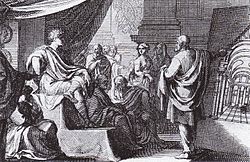
In the late 1st century BC, the Roman architect Vitruvius gave the first clear description of a geared watermill and explained how sāqiya gearing could be applied to one.
Image source: Vitruvius
150 - 200
The breastshot water wheel, the third horizontal-axled type, appears in archaeological evidence from a late 2nd-century AD context in central Gaul.
200
The 2nd-century AD Barbegal complex used sixteen overshot wheels supplied by an artificial aqueduct. It functioned as a proto-industrial grain factory and has been called the greatest known concentration of mechanical power in the ancient world.
350 - 450
The 4th- to 5th-century military treatise De Rebus Bellicis contains the first mention of paddle wheels as propulsion, describing an ox-driven paddle-wheel warship.
500 - 599
The earliest vertical water wheel known in a tide mill dates from 6th-century Killoteran near Waterford, Ireland.
Image source: Tide mill
630
The first known horizontal wheel in a tide mill dates to around 630 at Little Island in Ireland.
800 - 1000
Between the 8th and 10th centuries, Arabs brought irrigation technologies to Spain after adopting them from Roman traditions, helping introduce these devices into Europe.
1000 - 1099
By the 11th century, exploiting water power was commonplace in parts of Europe, supporting agricultural productivity, food surpluses, and large-scale urbanization.
1086
The Domesday survey commissioned by William of Normandy recorded more than six thousand mills across three thousand English locations, compared with fewer than one hundred in the previous century.
Image source: Domesday Book
1100 - 1199
Fulling mills and steel mills may have spread from Islamic Spain to Christian Spain during the 12th century.
1200 - 1299
An exceptionally large water wheel was built at the early 13th-century Real Monasterio de Nuestra Señora de Rueda, a Cistercian monastery in Aragon.
1556
The oldest known drawing of a reversible water wheel was made by Georgius Agricola in 1556.
Image source: Georgius Agricola
600 - 699
After the spread of Islam, engineers continued ancient Near Eastern water technologies. Excavation of a canal in the Basra region revealed remains of a water wheel dating from the 7th century.
700 - 899
Industrial uses of watermills in the Islamic world date to the 7th century, and both horizontal- and vertical-wheeled mills were widespread by the 9th century.
900 - 999
Muhammad ibn Zakariya al-Razi's 10th-century Kitab al-Hawi described an Iraqi noria capable of lifting as much as 153,000 litres of water per hour.
Image source: Abu Bakr al-Razi
900 - 999
In 10th-century Iraq, large shipmills made of teak and iron operated along the Tigris and Euphrates. They could produce ten tons of flour daily for Baghdad's granary.
1000 - 1099
By the 11th century, every province across the Islamic world had industrial watermills, extending from al-Andalus and North Africa to West and Central Asia.
1000 - 1299
Large factory complexes in al-Andalus employed industrial watermills between the 11th and 13th centuries.
1038 - 1075
Ibn Bassal of al-Andalus pioneered the use of the flywheel to smooth power delivery in the sāqiya and noria.
Image source: Ibn Bassal
1206 - 1590
Al-Jazari in the 13th century and Taqi al-Din in the 16th century described numerous inventive water-raising machines in their technological treatises.
Image source: Islamic Golden Age
1206
Ismail al-Jazari's Book of Knowledge of Ingenious Mechanical Devices uses the term “Sindhi wheel” for a sāqiya and records inventive water-raising mechanisms.
Image source: Ismail al-Jazari
1206 - 1526
During the Delhi Sultanate, geared water-raising wheels were introduced into India from the Islamic world.
Image source: Delhi Sultanate
1500 - 1750
Millwrights distinguished the impulse and weight forces acting on water wheels long before the 18th century. In the 16th century, Fitzherbert wrote that a wheel worked through both the weight and the impulse of water.
1600 - 1749
Before 1750, it remained uncertain which force dominated in a water wheel, and it was widely understood that impulse and weight contributed with roughly equal importance.
1700 - 1799
Although water wheels had historically been very inefficient, major advances were made in the 18th century as demand for power increased and suitable water sites became limited.
1750 - 1799
In the mid- to late 18th century, John Smeaton's scientific investigation of water wheels produced major efficiency increases and supplied power needed for the Industrial Revolution.
1750 - 1799
John Smeaton measured a typical flat-board undershot wheel as using about 20 percent of the energy in the water striking it.
Image source: John Smeaton
1800 - 1899
Despite Australia's relatively dry climate, water wheels were constructed in the 19th century where suitable water resources were available.
1827
Water wheels began to be displaced by smaller, less expensive, and more efficient turbines after Benoît Fourneyron developed his first model in 1827.
1847
A water wheel constructed at Jindabyne in 1847 became the first machine used to extract energy from the Snowy River for flour milling.
1849
A design pioneered by Thomas Hewes and refined by William Armstrong Fairburn can be seen in the restored 1849 wheel at the Portland Basin Canal Warehouse.
1900 - 1999
Water wheels remained in commercial use well into the 20th century, although they are no longer in common use today.
1922
A 40-foot-diameter water wheel built at McCoy, Colorado, in 1922 survives as one of many wheels that lifted irrigation water from the Colorado River.
Build a timeline like this one in minutes, for free. Start Yours →
Or browse the full history timeline directory, with more than 2,500 topics.
This History of Water Wheels timeline was generated with the help of AI, using information found on the internet.
We work hard to keep these timelines accurate, but mistakes do get through. If you spot one, email us at [email protected] and we'll fix it for future visitors.
Generate yours with AI or build it from scratch, for free.
Export your timeline, add your own events, edit or remove AI-generated events, and much more
No credit card required.
15-day money-back guarantee.
You can create an unlimited number of timelines with up to 10 events on each one, customize how they look, export them to PDF, PNG, PowerPoint, CSV, and Excel, and share them with a link. Timelines made with Timeline Maker AI keep every event the generator created, and you can add up to 5 events of your own. Paid plans remove the event limit, add spreadsheet imports and hide Preceden's branding, and the higher-priced plan also adds collaborators, a custom logo and a custom domain.
Yes. You can cancel your subscription from your account page at any time, and you will not be charged again. Your subscription stays active for the rest of the period you already paid for.
Yes. We email you a reminder 15 days before your annual renewal, and we email you a receipt after every payment.
Yes. You can email us within 15 days of any payment, and we will issue you a full refund.
Check out our pricing docs or send us an email anytime: [email protected].