-
Resources
-
Pricing
The history of pulleys traces how a simple wheel and rope transformed lifting, transportation, construction, sailing, and engineering. More Less
Build a timeline like this one in minutes, for free. Start Yours →
700 BC
Assyrian reliefs and archaeological evidence from the first millennium BC show sophisticated rope, wheel, and lifting technology. These devices are among the earliest material contexts associated with pulley-like mechanisms in the ancient Near East.
Image source: Pulley
400 BC
Archytas of Tarentum was credited by later writers with important mechanical inventions. His work belongs to the Greek tradition that developed practical machines, including wheels, axles, and lifting arrangements related to the pulley.
Image source: Archytas
250 BC
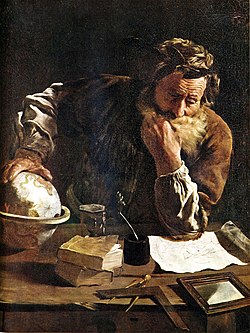
Archimedes of Syracuse is traditionally associated with the development and dramatic demonstration of compound pulley systems. Ancient accounts say that he used multiple pulleys to move heavy loads with comparatively little effort.
Image source: Archimedes
240 BC
According to Plutarch, Archimedes used a compound pulley arrangement to move a large ship at Syracuse, reportedly with his own hand. The story became one of the most famous demonstrations of mechanical advantage in history.
20 BC
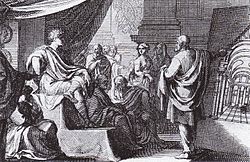
The Roman architect Vitruvius described cranes and hoisting machines using drums, ropes, and pulley blocks in De architectura. These systems supported large-scale construction and illustrate the integration of pulleys into Roman engineering.
Image source: Vitruvius
100 AD
Roman building sites used treadwheel cranes equipped with pulley blocks and ropes to raise masonry. The technology was applied to temples, bridges, aqueducts, and other large structures across the empire.
Image source: Ancient Roman engineering
850 AD
During the Islamic Golden Age, scholars translated and expanded Greek works on mechanics. Their treatises transmitted knowledge of pulley systems, water-raising devices, and hoists to later engineers in the Middle East and Europe.
Image source: Islamic Golden Age
850 AD
The Banū Mūsā brothers wrote The Book of Ingenious Devices in Baghdad. It described numerous mechanical arrangements involving ropes, wheels, valves, and automatic mechanisms, extending the engineering tradition in which pulleys were used.
Image source: Banū Mūsā brothers
1200 - 1400
European builders reintroduced and expanded the use of treadwheel cranes during the High Middle Ages. Pulley blocks combined with human- or animal-powered treadwheels enabled construction of cathedrals, castles, harbors, and city walls.
1206
In The Book of Knowledge of Ingenious Mechanical Devices, al-Jazari illustrated water-raising machines, pumps, clocks, and other mechanisms. His detailed drawings show the continuing refinement of wheels, axles, ropes, and pulley-like components.
Image source: Ismail al-Jazari
350 BC
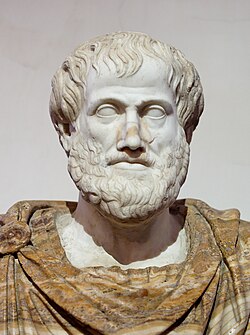
Aristotle discussed mechanical advantage and the operation of machines in works associated with ancient Greek mechanics. His treatment helped establish the intellectual setting in which pulleys were understood as devices for changing force and motion.
Image source: Aristotle
60 AD
Hero of Alexandria described practical machines in his Mechanics, including lifting devices using ropes, wheels, and pulleys. His work transmitted Greek mechanical knowledge and helped formalize the use of pulley combinations.
Image source: Hero of Alexandria
340 AD
Pappus of Alexandria preserved and discussed Greek mechanical knowledge, including the behavior of compound machines. His Mathematical Collection helped later scholars recover ancient ideas about pulley multiplication and equilibrium.
Image source: Pappus of Alexandria
600 AD
Indian scientific and mathematical traditions preserved knowledge of mechanics, weights, and force. Descriptions of lifting equipment and water technology contributed to the wider Eurasian development of rope-and-wheel machines.
Image source: Indian mathematics
1490 - 1519
Leonardo da Vinci filled notebooks with studies of ropes, wheels, hoists, and compound pulley arrangements. His drawings analyzed mechanical advantage and anticipated later engineering approaches, even though many designs were never built.
Image source: Leonardo da Vinci
1586
Simon Stevin's De Beghinselen der Weeghconst, or The Principles of the Art of Weighing, applied mathematical reasoning to statics and equilibrium. Its treatment of forces supported a more rigorous understanding of pulley systems.
Image source: Simon Stevin
1593
Galileo Galilei studied machines and the relation between force, distance, and work. His mechanical investigations helped shift pulley analysis from descriptive craft knowledge toward mathematical physics.
Image source: Galileo Galilei
1676
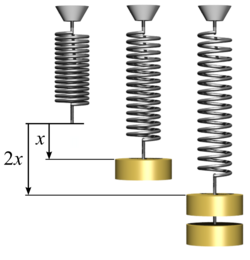
Robert Hooke formulated the relationship between force and elastic extension. Although not a pulley invention, the law later became important for analyzing ropes, belts, springs, and the deflection of pulley-supported systems.
Image source: Hooke's law
1687
Isaac Newton's Principia established the laws of motion and gravitation. These principles provided the general framework for calculating tension, acceleration, load distribution, and mechanical advantage in pulley systems.
Image source: Philosophiæ Naturalis Principia Mathematica
1740 - 1760
Eighteenth-century mathematicians including Daniel Bernoulli and Leonhard Euler advanced the mathematical study of equilibrium, flexible bodies, and motion. Their work improved the theoretical analysis of ropes and pulley-supported loads.
Image source: Leonhard Euler
1745
Jacques de Vaucanson demonstrated finely engineered automata and machinery using coordinated wheels, cords, and linkages. Such work reflected the growing demand for accurately made mechanical components during the early industrial era.
Image source: Jacques de Vaucanson
1798
Eli Whitney's manufacturing methods promoted standardized, interchangeable components. Standardization later made it easier to produce pulley wheels, blocks, bearings, and hoisting hardware in large quantities.
Image source: Eli Whitney
1834
Wilhelm August Julius Albert developed and patented an early wire rope in Germany. Wire rope could carry heavier loads and resist abrasion better than organic fiber rope, enabling more powerful cranes, elevators, and cable systems.
1837
The growth of iron foundries such as Tredegar reflected the nineteenth-century shift from wooden to stronger cast- and wrought-iron machinery. Industrial production made durable pulley blocks and lifting hardware widely available.
1840 - 1900
Nineteenth-century industry refined the block and tackle with iron shells, sheaves, pins, and improved rope. These assemblies became standard equipment in shipyards, warehouses, mines, farms, and construction.
1856
The Bessemer process made large quantities of inexpensive steel available. Stronger steel improved pulley axles, sheaves, crane frames, wire rope, and elevator machinery while lowering the cost of heavy lifting equipment.
Image source: Bessemer process
1980 - 2000
Computer-aided design and finite-element analysis improved the modeling of sheaves, bearings, shafts, and cable contact. Engineers could optimize pulley geometry, reduce weight, and predict fatigue and wear more accurately.
Image source: Computer-aided design
1854
At the New York World's Fair, Elisha Otis demonstrated an elevator equipped with a safety device that prevented the platform from falling if its hoisting rope broke. Pulley-driven elevators helped make tall buildings practical.
Image source: Elisha Otis
1857
Otis installed the first passenger elevator in a New York department store in 1857. The system used ropes, pulleys, and steam power, inaugurating the modern elevator industry and transforming urban architecture.
Image source: Elevator
1860 - 1900
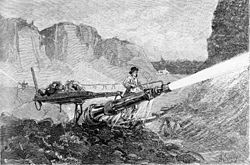
Industrial mines used pulley systems to raise ore, lower workers, transport equipment, and operate skips in shafts. Wire rope and improved hoisting blocks enabled deeper and more productive mining operations.
Image source: Hydraulic mining
1870 - 1883
Construction of the Brooklyn Bridge required extensive cable-handling and lifting equipment. Pulley-like cable saddles, sheaves, and hoists helped place the bridge's enormous suspension cables and structural components.
Image source: Brooklyn Bridge
1880 - 1900
Electric motors increasingly replaced steam and hydraulic power in elevator installations. Traction elevators used a grooved pulley, or sheave, with cables and counterweights to move cars efficiently through tall buildings.
1936
The first modern chairlift opened at Sun Valley, Idaho, in 1936. It used a continuously moving cable supported and driven by large sheaves, adapting pulley technology to passenger transportation on mountain slopes.
1950 - 1970
Industrial and emergency responders developed standardized pulley-based hauling and raising systems, including mechanical-advantage arrangements for confined-space and high-angle rescue. Modern systems combine pulleys with prusiks, ascenders, and specialized rope.
1950 - 1980
Nylon, polyester, and later high-performance fibers made ropes lighter, stronger, and more resistant to moisture. These materials expanded the use of compact pulley systems in climbing, sailing, rescue, and industrial rigging.
1970 - 2000
Modern climbing and mountaineering manufacturers developed compact pulley devices with sealed bearings, side plates, and high-strength alloys. Standardized rescue and hauling systems made mechanical advantage safer and more predictable.
1996
Permanent-magnet motors and compact traction sheaves enabled machine-roomless elevator systems. These designs reduced building space requirements while retaining the cable, counterweight, and pulley principles central to traction elevators.
Build a timeline like this one in minutes, for free. Start Yours →
Or browse the full history timeline directory, with more than 2,500 topics.
This History of Pulleys timeline was generated with the help of AI, using information found on the internet.
We work hard to keep these timelines accurate, but mistakes do get through. If you spot one, email us at [email protected] and we'll fix it for future visitors.
Generate yours with AI or build it from scratch, for free.
Export your timeline, add your own events, edit or remove AI-generated events, and much more
No credit card required.
15-day money-back guarantee.
You can create an unlimited number of timelines with up to 10 events on each one, customize how they look, export them to PDF, PNG, PowerPoint, CSV, and Excel, and share them with a link. Timelines made with Timeline Maker AI keep every event the generator created, and you can add up to 5 events of your own. Paid plans remove the event limit, add spreadsheet imports and hide Preceden's branding, and the higher-priced plan also adds collaborators, a custom logo and a custom domain.
Yes. You can cancel your subscription from your account page at any time, and you will not be charged again. Your subscription stays active for the rest of the period you already paid for.
Yes. We email you a reminder 15 days before your annual renewal, and we email you a receipt after every payment.
Yes. You can email us within 15 days of any payment, and we will issue you a full refund.
Check out our pricing docs or send us an email anytime: [email protected].