-
Use Cases
-
Resources
-
Pricing
900 - 1021
Ptolemy’s description of lenses was commented upon and improved by Ibn Sahl in the 10th century and, most notably, by Alhazen in his Book of Optics, written around 1021. Their work helped establish the theoretical background for later European optical developments.
960 - 1127
Some historical claims hold that single-lens magnifying glasses were used in China during the Northern Song dynasty. The evidence is debated, but the claim forms part of the wider history of early magnification devices.
Image source: History of science and technology in China
1100 - 1199
Flat panes of smoky quartz were used in 12th-century China, while the Inuit used snow goggles to protect their eyes from glare and reflected sunlight. These devices served protective or filtering purposes rather than functioning as modern corrective spectacles.
Image source: Snow goggles
1100 - 1199
Latin translations of Ptolemy’s Optics and Alhazen’s works became available in Europe during the 12th century. Their arrival coincided with the development of reading stones and helped transmit knowledge of lenses and vision.
Image source: Book of Optics
1220 - 1235
In his treatise De iride, or On the Rainbow, written between 1220 and 1235, Robert Grosseteste described the use of optics to read the smallest letters at incredible distances. The passage is an important early reference to magnification.
Image source: Robert Grosseteste
1262
A few years after Grosseteste’s treatise, Roger Bacon wrote about the magnifying properties of lenses in 1262. His discussion contributed to the growing medieval European understanding of optical aids.
Image source: Roger Bacon

1268
The earliest recorded comment on the use of lenses for optical purposes was made by Roger Bacon in 1268. His observation is frequently cited in accounts of the intellectual prehistory of eyeglasses.
1200 - 1299
The earliest ancestors of modern eyeglasses were 13th-century Italian reading stones. These rounded, magnifying lenses were placed directly on text to enlarge letters for readers with impaired near vision.
Image source: Reading stone
1200 - 1299
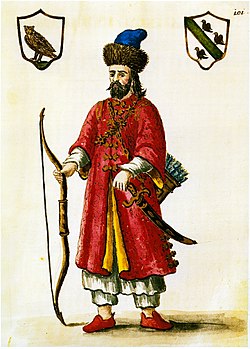
Marco Polo is mistakenly claimed to have encountered glasses during his travels in China in the 13th century. The claim conflicts with the historical evidence that the earliest Chinese mentions of glasses date to the 15th century.
Image source: Marco Polo
1250 - 1299
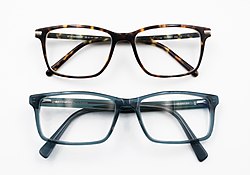
The development of the first glasses took place in northern Italy during the second half of the 13th century. The region became the center of early spectacle manufacture and experimentation.
Image source: Glasses
1290
The first glasses are estimated to have been made in central Italy, most likely in Pisa or Florence, by about 1290. These early spectacles generally consisted of two simple lenses mounted in a frame.
1300 - 1399
During the 14th century, glasses became very common objects. Francesco Petrarca wrote that he did not need glasses until he was 60, while Franco Sacchetti mentioned them frequently in his Trecentonovelle.
1301
By 1301, guild regulations in Venice governed the sale of glasses. The regulations show that spectacles had already become a commercial product subject to organized oversight.
Feb 23, 1306
In a sermon delivered on 23 February 1306, the Dominican friar Giordano da Pisa wrote that it was not yet twenty years since the art of making glasses had been discovered. His statement provides contemporary evidence for the recent emergence of spectacles.
1320
A separate guild of Venetian spectacle makers was formed in 1320. Its creation reflects the growing specialization and economic importance of spectacle production in medieval Italy.
1352
Tommaso da Modena’s 1352 portrait of Cardinal Hugh de Saint-Cher reading in a scriptorium is the earliest pictorial evidence for the use of glasses. The image shows spectacles being used in an intellectual and religious setting.
1400
The earliest surviving physical examples of glasses were found under the floorboards at Kloster Wienhausen, a convent near Celle in Germany. They have been dated to around 1400.
1400 - 1499
The earliest mentions of glasses in China occur in the 15th century. Chinese sources state that the glasses were imported, rather than documenting an independent Chinese invention.
1403
An altarpiece in the church of Bad Wildungen, now in Germany, contains an early depiction of glasses north of the Alps. The image dates to 1403 and demonstrates the spread of spectacles beyond Italy.
1466
The world’s first specialist shop for spectacles, an establishment comparable to a modern optician, opened in Strasbourg in 1466. Strasbourg was then part of the Holy Roman Empire and is now in France.
1600 - 1699
A 17th-century claim that Salvino degli Armati of Florence invented glasses in the 13th century was later exposed as erroneous. The story illustrates how inaccurate inventor traditions became attached to the origins of spectacles.
1907
In 1907, Professor Berthold Laufer speculated that glasses may not have been invented independently in China and Europe. After ruling out the Turks, he proposed India as a possible location of origin.
1971
In a 1971 article in the British Journal of Ophthalmology, Rishi Agarwal argued that the Indian scholar Vyasatirtha was observed with glasses in the 1520s. He proposed that lenses may have reached Europe through Arab intermediaries, although the cited dates postdate established Italian spectacles and evidence exists for Italian exports to the Middle East.
1450 - 1499
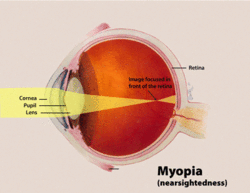
Concave lenses for correcting myopia, or near-sightedness, first appeared in the mid-15th century. Their use expanded the function of spectacles beyond magnifying text for presbyopic readers.
Image source: Near-sightedness
1604
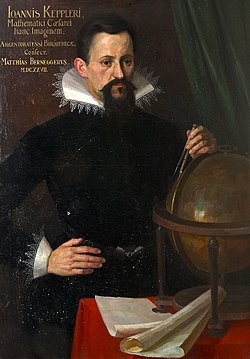
In 1604, Johannes Kepler published the first correct explanation of why convex and concave lenses could correct presbyopia and myopia. His account provided a scientific basis for understanding refractive correction.
Image source: Johannes Kepler
1825
The British astronomer George Airy designed the first lenses for correcting astigmatism in 1825. His work extended spectacle correction to another major form of refractive error.
Image source: George Biddell Airy
1900 - 1930
In the early 20th century, Moritz von Rohr and Zeiss, with assistance from H. Boegehold and A. Sonnefeld, developed Zeiss Punktal spherical point-focus lenses. These lenses dominated the eyeglass-lens field for many years.
Image source: Carl Zeiss AG
2008
In 2008, Joshua Silver designed eyewear with adjustable corrective lenses. The design allowed the wearer’s optical correction to be changed rather than relying on a permanently fixed prescription.
1727
The modern style of glasses held by temples passing over the ears was developed sometime before 1727, possibly by British optician Edward Scarlett. This design made spectacles more stable and practical for everyday wear.
1750 - 1819
Temple-mounted glasses were not immediately successful. During the second half of the 18th century and into the early 19th century, designs with attached handles, including scissors-glasses and lorgnettes, were fashionable.
1800 - 1928
In the United Kingdom, wearing glasses was characterized during the 19th century as a sign of weakness and effeminacy. Neville Cardus recorded this social attitude in writing published in 1928.
1897
After his vision deteriorated in 1897, Tim Killick became the first professional cricketer to play while wearing glasses continuously. His example reflects the growing practical use of spectacles in professional sport.
1900 - 1999
During the 20th century, glasses came to be considered a component of fashion. Different frame shapes, materials, and styles repeatedly entered and left popular use.
2012
In 2012, some NBA players wore lensless glasses with thick plastic frames resembling horn-rimmed glasses during post-game interviews. The style reflected geek chic and drew comparisons with Jaleel White’s character Steve Urkel.
2017
As of 2017, dentists and surgeons in Canada and other countries were required to wear safety glasses to protect against infection from patients’ blood and other body fluids. The requirement represents a modern occupational and medical use of protective eyewear.
Or browse the full history timeline directory, with more than 2,500 topics.
This History of Eyeglasses timeline was generated with the help of AI, using information found on the internet.
We work hard to keep these timelines accurate, but mistakes do get through. If you spot one, email us at [email protected] and we'll fix it for future visitors.
Generate yours with AI or build it from scratch, for free.
Export your timeline, add your own events, edit or remove AI-generated events, and much more
No credit card required.
Cancel anytime.
Cancel anytime.
You can create an unlimited number of timelines with up to 10 events on each one, customize how they look, export them to PDF, PNG, PowerPoint, CSV, and Excel, and share them with a link. Paid plans raise the event limit and add features like spreadsheet imports and collaborators.
Yes. You can cancel your subscription from your account page at any time, and you will not be charged again. Your subscription stays active for the rest of the period you already paid for.
Yes. We will email you a reminder before the annual renewal, and we will also email you a receipt.
Yes. You can email us within 15 days of any payment, and we will issue you a full refund.
Check out our pricing docs or send us an email anytime: [email protected].