
-
Resources
-
Pricing
The history of screws traces the development of the helical principle from ancient Greek machines to essential fasteners used in construction, manufacturing, medicine, and technology. More Less
Build a timeline like this one in minutes, for free. Start Yours →
100 BC
Screw presses appeared in the ancient Mediterranean world for pressing oil, wine, and other materials. Their controlled conversion of rotary motion into high linear force established the screw as an important machine element.
100
Roman engineers adopted and refined screw presses for agriculture and manufacturing. Wooden threaded components demonstrated that screw technology could be made large, durable, and useful outside experimental mechanisms.
1450
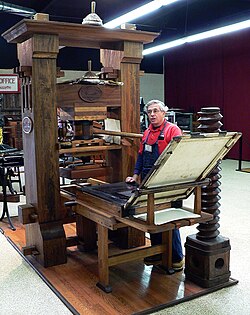
The hand-operated printing presses associated with Johannes Gutenberg used a large wooden screw to apply pressure to paper and type. This application helped make the screw press central to European printing.
Image source: Printing press
1495
Leonardo da Vinci's notebooks contain studies of screws, screw-cutting arrangements, and threaded mechanisms. His drawings helped preserve and develop Renaissance understanding of the geometry and mechanical advantages of screws.
Image source: Leonardo da Vinci
1500 - 1599
During the sixteenth century, European armorers, clockmakers, and instrument makers increasingly used small iron and brass screws. These early fasteners were generally made individually by forging, filing, and hand-forming their threads.
1569
French mathematician and engineer Jacques Besson published designs for machine tools, including apparatus for producing screws. His work contributed to the gradual movement from hand-made threads toward repeatable mechanical production.
1678
Joseph Moxon's Mechanick Exercises described practical methods used by craftsmen, including techniques for making and using screws. Such technical publications helped circulate workshop knowledge about threaded fasteners.
1800
Henry Maudslay introduced a highly influential screw-cutting lathe around 1800. By synchronizing carriage travel with spindle rotation, it enabled accurate, repeatable threads and became foundational to modern machine-tool production.
1818
Industrial screw production expanded in Britain and the United States during the early nineteenth century as dedicated factories introduced machines for heading, slotting, and threading. This reduced the cost of screws and made them practical for mass-produced goods.
1840 - 1849
Automatic screw machines developed in the mid-nineteenth century combined turning, cutting, and feeding operations. They made large quantities of small metal screws economically and supported the growth of sewing machines, clocks, firearms, and other industries.
1841
Joseph Whitworth proposed a standardized British thread system with a defined angle, pitch series, and rounded crest and root. The British Standard Whitworth system was among the first widely adopted national standards for interchangeable screw threads.
Image source: Joseph Whitworth
1864
William Sellers promoted a practical American thread form with a 60-degree profile and flattened crest and root. It influenced the later Unified Thread Standard and improved interchangeability among manufactured fasteners.
1907
The United States adopted increasingly formal national standards for screw threads in the early twentieth century. These standards specified diameters, pitches, classes of fit, and thread forms for interchangeable bolts and screws.
1918
Engineering standards organizations increasingly formalized terms such as major diameter, pitch, lead, thread angle, and tolerance. Shared terminology made it easier for manufacturers to design, inspect, and exchange threaded parts.
Image source: Screw thread
1930 - 1939
Black oxide conversion coatings became widely used on steel screws and tools. The finish offered modest corrosion resistance, reduced glare, and a durable dark appearance without substantially changing dimensions.
1970 - 1979
CNC lathes and automated inspection brought programmable control to screw and fastener production. Manufacturers could produce complex threads, miniature screws, and tight tolerances with greater consistency and less manual setup.
Image source: Numerical control
1980 - 1989
Metric threads became dominant in much of the world's automotive, machinery, and engineering production. International standards simplified sourcing and improved compatibility across increasingly global supply chains.
1980 - 1988
International Organization for Standardization work consolidated metric screw-thread specifications into the ISO metric system. The standards defined preferred diameters, pitches, tolerances, and fit classes for global manufacturing.
1990 - 1999
High-volume fastener plants combined cold heading, multi-station forming, automated thread rolling, optical inspection, and statistical process control. These methods improved throughput while maintaining consistent dimensions and surface quality.
1908
Canadian inventor Peter L. Robertson patented a square recess and matching driver. The Robertson drive resisted cam-out better than a straight slot and became especially important in Canadian woodworking and construction.
1908 - 1914
Robertson's company developed machinery for manufacturing his recessed-head screws at scale. Their ability to hold a driver on the screw helped accelerate assembly with portable and production tools.
1932
Henry F. Phillips patented a cruciform recess designed to center a driver and permit controlled cam-out during powered assembly. The design addressed the needs of rapidly expanding automobile and appliance production.
1933
The Phillips Screw Company was established to commercialize the cruciform drive. Its licensing and tooling work helped spread Phillips screws through American industrial manufacturing.
1936
General Motors adopted Phillips screws for automobile assembly, providing a major industrial breakthrough for the design. Powered drivers could seat the screws quickly and consistently on moving production lines.
1962
The Pozidriv recess was developed in the United Kingdom as an improvement on the Phillips design. Additional radial features increased engagement and reduced cam-out, particularly when higher torque was applied.
1967
Camcar Textron patented the six-lobed Torx drive. Its star-shaped geometry distributed torque across broad contact surfaces, reduced driver wear and cam-out, and became popular in automotive, electronics, and machinery.
1970 - 1979
Tamper-resistant drives such as the Tri-Wing were developed for applications where ordinary tools should not permit easy disassembly. Security screws became common in electronics, aerospace equipment, public fixtures, and consumer products.
1980 - 1989
Torx and related hexalobular drives spread widely through automotive manufacturing during the 1980s. Their high torque capacity and resistance to stripping suited automated assembly and compact engine-compartment fasteners.
1930 - 1939
Self-tapping screws, whose hardened threads form or cut mating threads in a workpiece, became common in sheet metal, electrical equipment, and appliances. They reduced the need for pre-threaded holes and separate nuts.
1940 - 1949
The expansion of gypsum-board construction popularized specialized drywall screws with sharp points, deep threads, and bugle-shaped heads. Their geometry secured panels while reducing tearing of the paper facing.
1940 - 1949
Improved production of corrosion-resistant stainless steels made stainless screws increasingly practical for marine, chemical, food-processing, and outdoor applications. Their cost was higher, but their resistance to rust extended service life.
Image source: Stainless steel
1970 - 1979
Specialized thread-forming screws became important in plastic housings and lightweight materials. Their lobed or asymmetric profiles displaced material rather than cutting it, improving pull-out resistance and reducing cracking.
1980 - 1989
Self-drilling screws, often called tek screws, incorporated drill-like points that penetrate sheet metal without a separate pilot hole. They accelerated metal-building, HVAC, roofing, and appliance assembly.
1990 - 1999
Aerospace manufacturers increasingly used high-strength titanium, nickel-based, and corrosion-resistant steel screws alongside advanced coatings. These fasteners were engineered for extreme loads, vibration, temperature changes, and weight constraints.
2000 - 2099
The growth of mobile phones, laptops, cameras, and other compact electronics drove demand for miniature screws with specialized heads, fine pitches, corrosion-resistant coatings, and tightly controlled lengths.
2000 - 2099
Environmental restrictions on hexavalent chromium encouraged wider use of zinc-flake, trivalent-chromium, organic, and other lower-impact coatings. These finishes sought to preserve corrosion protection while reducing hazardous processing chemicals.
2010 - 2019
Additive manufacturing made it practical to print threaded holes, captive nuts, and custom screw interfaces directly into prototypes and low-volume parts. Designers also developed thread geometries tailored to printed plastics and metals.
Image source: 3D printing
2010 - 2019
Connected torque tools and digital fastening systems began recording torque, angle, operator, and part data. Although the screw itself remained passive, these systems improved traceability and quality control in automotive and aerospace assembly.
2020 - 2029
Fastener manufacturers increasingly investigated recycled steel, lower-carbon production, recyclable coatings, and bio-based polymer screws. These efforts reflect pressure to reduce the environmental footprint of high-volume screw production.
Build a timeline like this one in minutes, for free. Start Yours →
Or browse the full history timeline directory, with more than 2,500 topics.
This History of Screws timeline was generated with the help of AI, using information found on the internet.
We work hard to keep these timelines accurate, but mistakes do get through. If you spot one, email us at [email protected] and we'll fix it for future visitors.
Generate yours with AI or build it from scratch, for free.
Export your timeline, add your own events, edit or remove AI-generated events, and much more
No credit card required.
15-day money-back guarantee.
You can create an unlimited number of timelines with up to 10 events on each one, customize how they look, export them to PDF, PNG, PowerPoint, CSV, and Excel, and share them with a link. Timelines made with Timeline Maker AI keep every event the generator created, and you can add up to 5 events of your own. Paid plans remove the event limit, add spreadsheet imports and hide Preceden's branding, and the higher-priced plan also adds collaborators, a custom logo and a custom domain.
Yes. You can cancel your subscription from your account page at any time, and you will not be charged again. Your subscription stays active for the rest of the period you already paid for.
Yes. We email you a reminder 15 days before your annual renewal, and we email you a receipt after every payment.
Yes. You can email us within 15 days of any payment, and we will issue you a full refund.
Check out our pricing docs or send us an email anytime: [email protected].