-
Resources
-
Pricing
The history of plows traces the development of agricultural tools from simple wooden implements to advanced, tractor-drawn and precision-guided machines. More Less
Build a timeline like this one in minutes, for free. Start Yours →
1000 BCE
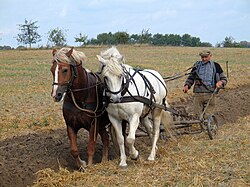
The earliest plows with detachable and replaceable shares date from around 1000 BCE in the Ancient Near East, allowing worn cutting parts to be replaced.
Image source: Plough
500 BCE
The earliest known iron plowshares date from about 500 BCE in China, marking an important development in the durability of plowing equipment.
202 BCE - 220
Chinese plows from the Han period onward achieved efficient designs that generally required only two animals, and later often a single animal, unlike the larger teams commonly used in Europe.
250 - 400
The Romans achieved a heavy-wheeled moldboard plow in the late third and fourth centuries AD, with archaeological evidence including finds from Roman Britain.
300 - 1000
Although Greek and Roman plows could use moldboards, they often tied them to the shaft with rope, making them more fragile than Chinese designs; iron moldboards did not appear in Europe until the tenth century.
400 - 500
The word is thought to have originally referred to the wheeled heavy plow common in Roman northwestern Europe by the fifth century AD.
2003
Vladimir Orel tentatively connected plough with the Proto-Indo-European stem *blōkó-, associated with Old Armenian peɫem and Welsh bwlch, while noting that the word may not be Indo-European.
2013
In 2013, Guus Kroonen proposed that the word may derive through a vṛddhi formation from *plag/kkōn, meaning sod.
575 - 650
Moldboards are documented in Britain from the late sixth century onward, showing the presence of moldboard technology in early medieval Europe.
600 - 1700
Before the eighteenth century, European moldboards were usually made of wood and were straight, despite the moldboard plow having appeared in Europe by early medieval or possibly late Roman times.
750 - 850
The general adoption of the heavy carruca plow in Europe accompanied the spread of the three-field system in the later eighth and early ninth centuries.
Image source: Carruca
750 - 850
The combination of the carruca heavy plow and the three-field system improved agricultural productivity per unit of land in northern Europe.
Image source: Three-field system
1279
By the end of the Song dynasty in 1279, Chinese plows had reached a level of development that would not be seen in Holland until the seventeenth century.
1300 - 1700
The advanced heavy iron moldboard tradition that developed in China eventually spread westward to the Netherlands, where it contributed to later agricultural change.
1500 - 1700
Before the curved moldboard and related eighteenth-century design principles became widespread, European plows commonly required teams of four, six, or eight draft animals, contrasting with the smaller teams used by Chinese plows.
1600 - 1700
Plow development in the Netherlands helped lead into the Agricultural Revolution, whose methods and machinery transformed European farming.
Image source: Neolithic Revolution
1700 - 1800
The moldboard plow introduced in the eighteenth century represented a major technological advance over earlier straight wooden moldboards.
1730
In 1730, Joseph Foljambe in Rotherham, England, used new shapes to create the Rotherham plow, whose moldboard was covered with iron.
1789
In 1789, Robert Ransome began casting plowshares in a disused malting at St Margaret's Ditches in Ipswich, England.
Image source: Ransomes, Sims & Jefferies
1833
John Lane invented a steel plow in 1833, advancing the use of stronger and more durable materials in plow construction.
1837
In 1837, John Deere introduced a steel plow that was substantially stronger than iron designs and could work soils in parts of the United States previously considered unsuitable for farming.
Image source: John Deere (inventor)
1837
Seeking a smoother, more polished plow surface, John Deere experimented with portions of saw blades and was making polished cast-steel plows by 1837.
1800 - 1900
A device that functioned as a saw but was pulled like a plow was used in nineteenth-century Scandinavia to cut blocks of ice for export to Great Britain.
Image source: Ice trade
1850
The invention of the mobile steam engine made it possible to apply steam power to plowing from about 1850.
Image source: Traction engine
1850 - 1860
John Fowler, an English agricultural engineer and inventor, is credited with inventing the plowing engine and associated balance plow in the mid-nineteenth century.
Image source: John Fowler (agricultural engineer)
1876
Australian inventor Richard Bowyer Smith and his brother Clarence Herbert Smith invented the stump-jump plow in 1876.
Image source: Stump-jump plough
1900 - 1910
At the beginning of the twentieth century, J. Kemna of Eastern Prussia became a leading continental producer of steam-powered plows and challenged the market dominance of English companies.
1900 - 1920
Steam-powered and other earlier traction systems were eventually superseded by tractors powered by internal-combustion engines in the early twentieth century.
Image source: Tractor
Build a timeline like this one in minutes, for free. Start Yours →
Or browse the full history timeline directory, with more than 2,500 topics.
This History of Plows timeline was generated with the help of AI, using information found on the internet.
We work hard to keep these timelines accurate, but mistakes do get through. If you spot one, email us at [email protected] and we'll fix it for future visitors.
Generate yours with AI or build it from scratch, for free.
Export your timeline, add your own events, edit or remove AI-generated events, and much more
No credit card required.
15-day money-back guarantee.
You can create an unlimited number of timelines with up to 10 events on each one, customize how they look, export them to PDF, PNG, PowerPoint, CSV, and Excel, and share them with a link. Timelines made with Timeline Maker AI keep every event the generator created, and you can add up to 5 events of your own. Paid plans remove the event limit, add spreadsheet imports and hide Preceden's branding, and the higher-priced plan also adds collaborators, a custom logo and a custom domain.
Yes. You can cancel your subscription from your account page at any time, and you will not be charged again. Your subscription stays active for the rest of the period you already paid for.
Yes. We email you a reminder 15 days before your annual renewal, and we email you a receipt after every payment.
Yes. You can email us within 15 days of any payment, and we will issue you a full refund.
Check out our pricing docs or send us an email anytime: [email protected].