
-
Use Cases
-
Resources
-
Pricing
The history of forks traces the evolution of a specialized eating and cooking tool from ancient civilizations to its widespread adoption as standard tableware. More Less
Build a timeline like this one in minutes, for free. Start Yours →
1868
In 1868, the territorial legislature accepted a proposal to create Quillehuyte County from the western portions of Clallam and Jefferson counties.
1869
The proposal to establish Quillehuyte County was dissolved one year after its acceptance by the territorial legislature.
Jan 1878
Luther and Esther Ford claimed the first homestead on the prairie in January 1878, beginning the documented settler history of the Forks area.
1879
The Fords' 160-acre property included the area's first dairy, established in 1879, and was later joined by additional homesteads.
1884
A post office opened in 1884 in the cabin of Ole Nelson, a local trapper. It was named Forks because the settlers' preferred name, Ford's Prairie, had already been used by another settlement in the territory.
1889
Settler Daniel Pullen burned down the village in 1889, during the early period of Forks' development.
1889
In 1889, a reservation was created near Forks. The same year, settler Daniel Pullen burned down the village.
1912
The town of Forks was platted in 1912 on the homestead of Merrill Whittier, a hop farmer.
1925
The buildings destroyed by the January 1925 fire were replaced later that year, alongside plans for a new high school and social halls.
Jan 10, 1925
A fire on January 10, 1925, destroyed six buildings on the west side of Forks.
1930
Another fire on Main Street caused further damage in 1930.
Aug 7, 1945
Forks was officially incorporated on August 7, 1945, after an election by the constituents who became its first town members.
1890 - 1899
During the late nineteenth century, settlers and small-time loggers cleared timber around the prairie, transforming the landscape for settlement and agriculture.
1897
The federal government established the Olympic Forest Reserve in 1897. Although it was later reduced in size, the reserve became important to the region's long-term conservation history.
1900 - 1907
Logging continued on non-federal land in the early twentieth century, while protected federal lands increasingly shaped the surrounding region.
1900 - 1999
For much of the twentieth century, Forks' economy was fueled by the local timber industry, which provided employment and shaped the community's identity.
1907
Logging activity slowed during the national recession of 1907, affecting the local timber economy.
1909
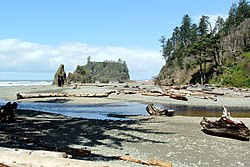
Land from the gradually reduced forest reserve later contributed most of the area for Olympic National Monument, established in 1909, and for the Olympic National Forest.
Image source: Olympic National Park
1916
Timber companies followed the earlier settlers and small-time loggers. Merrill & Ring was operating around the Pysht River by 1916.
1927
A new road passable for automobiles opened between Lake Crescent and Forks in 1927, improving the town's connection with the Olympic Peninsula.
1930
Rayonier #10, construction number 3348, was built for stock by Lima in 1930.
1931
The automobile road from Lake Crescent to Forks was replaced by the Olympic Loop Highway, now U.S. Route 101, in 1931.
1945
In 1945, Rayonier acquired locomotive #10 for its lumber operation near Forks.
1959
Rayonier #10 was retired near the north end of Forks and placed in Tillicum Park in 1959.
Jan 1995
The Olympic Connection was introduced in January 1995 to fill a 60-mile gap in transit service along the U.S. Route 101 corridor.
1964
The scholarship committee awarded its first scholarship in 1964 to Robert Henry, who later became a dentist. Since then, it has awarded more than one million dollars in scholarships to Forks students.
1989
The Forks High School carpentry class constructed a 3,200-square-foot building in 1989. It presents local timber-industry history, including the lives of earlier loggers and their tools.
1999
The Forks Lions Club erected an attractive shelter over locomotive Rayonier #10 in 1999.
2010
The 2010 census recorded 3,532 people, 1,264 households, and 849 families residing in Forks.
2020
The 2020 census recorded a population of 3,335 in Forks.
2003
In 2003, an executive on the economic development council described Forks as transitioning from a logging community to a tourist community.
2005 - 2008
Forks gained popularity as a key setting in Stephenie Meyer's Twilight series, published from 2005 to 2008.
Image source: Twilight (novel series)

2005 - 2009
In December 2005, 74 visitors signed the Forks Visitor Center guest book. After the Twilight series was released, the number rose substantially to 2,540 visitors in December 2009.
2007
In 2007, the Forks City Council passed a resolution celebrating Stephenie Meyer Day in honor of the Twilight novels and films. The event was set for September 13, the fictional birthday of Bella Swan.
2008 - 2012
Related Twilight film adaptations released from 2008 to 2012 further increased Forks' visibility and tourism appeal.
Image source: The Twilight Saga (film series)

2008 - 2010
Average annual tourism rose from 6,000 visitors before Twilight to 18,000 in 2008, the year of the first film, and nearly 73,000 by 2010.
2015
In 2015, Twilight-related events were still driving tourism. Visitor numbers had peaked in 2010 and later settled at about 50 percent above their pre-Twilight level.
Build a timeline like this one in minutes, for free. Start Yours →
Or browse the full history timeline directory, with more than 2,500 topics.
This History of Forks timeline was generated with the help of AI, using information found on the internet.
We work hard to keep these timelines accurate, but mistakes do get through. If you spot one, email us at [email protected] and we'll fix it for future visitors.
Generate yours with AI or build it from scratch, for free.
Export your timeline, add your own events, edit or remove AI-generated events, and much more
No credit card required.
15-day money-back guarantee.
15-day money-back guarantee.
You can create an unlimited number of timelines with up to 10 events on each one, customize how they look, export them to PDF, PNG, PowerPoint, CSV, and Excel, and share them with a link. Timelines made with Timeline Maker AI keep every event the generator created, and you can add up to 5 events of your own. Paid plans remove the event limit, add spreadsheet imports and hide Preceden's branding, and the higher-priced plan also adds collaborators, a custom logo and a custom domain.
Yes. You can cancel your subscription from your account page at any time, and you will not be charged again. Your subscription stays active for the rest of the period you already paid for.
Yes. We email you a reminder 15 days before your annual renewal, and we email you a receipt after every payment.
Yes. You can email us within 15 days of any payment, and we will issue you a full refund.
Check out our pricing docs or send us an email anytime: [email protected].