
-
Resources
-
Pricing
The history of sunglasses traces the development of devices designed to protect the eyes from glare and ultraviolet radiation, evolving from simple tinted materials into essential medical, technological, and fashion accessories. More Less
Build a timeline like this one in minutes, for free. Start Yours →
1459
In 1459, Nuno Fernandes requested spectacles to protect his eyes while horseriding in snow. The surviving account mentions protection from reflected glare but does not describe the actual spectacles.
Image source: Sunglasses
1700 - 1799
By the 18th century, Venetian women and children used tinted, mirror-like Murano glasses known as gondola glasses, or vetri da gondola and da dama, to shield their eyes from glare reflected by canal water.
1700 - 1799
In the late 18th century, the Doge and other wealthy Venetians, possibly including Goldoni, wore tinted spectacles with pieces of cloth attached at the sides as sun guards. These were called goldoni glasses.
1800 - 1999
It has been popularly claimed that yellow, amber, and brown-tinted glasses were used to alleviate light sensitivity associated with syphilis in the 19th and early 20th centuries. However, no sources have been found documenting such prescriptions.
1706
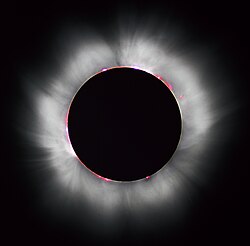
King Louis XIV’s court watched the 1706 solar eclipse through a telescope fitted with a smoky glass filter, an early example of using darkened glass for direct solar observation.
Image source: Solar eclipse
1752
Around 1752, James Ayscough began experimenting with tinted spectacle lenses. His work contributed to the development of colored lenses, although the early experiments were not necessarily intended specifically for ultraviolet protection.
1772
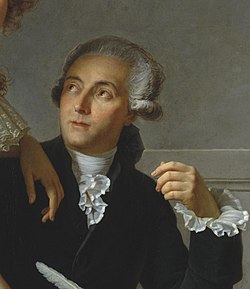
A 1772 depiction of scientist Antoine Lavoisier is among the earliest surviving images of a person wearing sunglasses. Lavoisier worked with amplified sunlight, making eye protection particularly relevant.
Image source: Antoine Lavoisier
1800 - 1888
Jean-Marie-Théodore Fieuzal was the first to argue that yellow shaded glasses could protect against ultraviolet radiation. His advocacy helped shift attention from glare reduction toward optical health.
1899
By 1899, Rodenstock GmbH produced what may have been the first sunglasses intended to shield the eyes from ultraviolet light rather than merely reduce visible glare.
1913
Crookes lenses were introduced in 1913. Made from glass containing cerium, they were designed to completely block ultraviolet light and became an important development in protective eyewear.
1936
Polarized sunglasses first became available in 1936, when Edwin H. Land experimented with lenses incorporating his patented Polaroid filter. Polarization reduced reflected glare from surfaces such as water and roads.
1947
The Armorlite Company began producing lenses from CR-39 resin in 1947. The lightweight plastic material became an important alternative to glass for sunglass lenses.
1995
In 1995, Jerry Garcia’s sunglasses were described as using a polykrypton-C type of lens, characterized at the time as cutting-edge.
2001
SR-91 is a proprietary sunglass-lens material introduced by Kaenon Polarized in 2001.
1800 - 1899
By the 19th century, railway travelers wore tinted spectacles to reduce the intense glare encountered during journeys. This helped extend darkened eyewear beyond specialized scientific and military settings.
1895
By 1895, sunglasses were being mentioned in advertisements, including advertisements published in The Sioux City Journal. This indicates that darkened eyewear had entered commercial public awareness.
1929
Inexpensive mass-produced sunglasses made from celluloid were first produced by Sam Foster in 1929. Their low cost helped make sunglasses accessible to a much larger consumer market.
1938
In 1938, Life magazine described sunglasses as a new fad on city streets and a favorite affectation of thousands of American women. It reported that 20 million pairs had been sold in the United States in 1937, although only about one-quarter of wearers supposedly needed them for eye protection.
1952
Introduced in 1952, trapezoidal lenses were wider at the top than at the bottom and were inspired by the popular Browline eyeglass shape. The style became associated with James Dean, Roy Orbison, Elvis Presley, Bob Marley, The Beatles, and other performers.
1980
Browlines were adapted into sunglasses form in the 1980s and rapidly became one of the most popular styles. Their popularity has risen and fallen repeatedly in the decades since.
1980 - 1999
The rise of New wave, New Romanticism, The Blues Brothers, 1950s and 1960s nostalgia, and the anti-disco backlash revived Wayfarers. A lucrative 1982 product-placement deal helped make the model the best-selling style between 1980 and 1999.
1980
Aviators’ association with disco culture contributed to a decline in their popularity by 1980, although the design continued to be produced and worn.
1982
The Clubmaster model was introduced in 1982. Essentially a plastic version of the Browline design, it became one of the best-known modern variants of the style.
1982 - 1986
A 1982 product-placement deal helped revive aviators, especially through their appearances in Top Gun and Cobra. The films were associated with a 40 percent rise in aviator popularity in 1986.
1982 - 1999
Product placement put Wayfarers into numerous films and television programs, including The Breakfast Club and Moonlighting, reinforcing their status as a defining popular style.
2000 - 2012
1980s nostalgia, the hipster subculture, and the television series Mad Men helped revive Wayfarers after a slump during the 1990s and 2000s. A 2000 redesign, the New Wayfarer, also contributed to their resurgence.
2000
Aviators became popular again around 2000 as the hippie movement experienced a brief revival. Their visibility was further reinforced by the MTV program Jackass.
2012
By 2012, Wayfarers had surpassed aviators in popularity, completing a major shift in the relative prominence of two of the most recognizable sunglass designs.
1861 - 1865
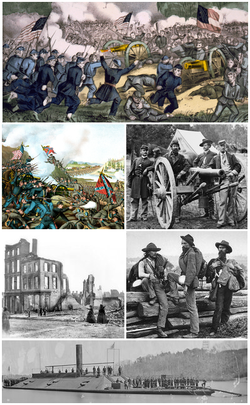
Reports later described American Civil War soldiers using “shell spectacles,” or verres de cocquille, to protect their eyes from sunlight during long marches.
Image source: American Civil War
1866
In 1866, Walter Alden wrote about soldiers using shell spectacles to guard against sunlight. His report is among the late-19th-century references documenting practical use of darkened eyewear.
1885
In The Optical Manual, published in 1885, British military writer T. Longmore reported that soldiers in Egypt were equipped with tinted-glass eye protectors.
1936
Bausch & Lomb introduced the aviator design in 1936 for issue to United States military aviators. Its large lenses and distinctive teardrop shape were intended to provide broad coverage.
1969
In 1969, sunglasses were used aboard Eagle, the Apollo 11 lunar module, during the first crewed mission to land on the Moon.
Image source: Apollo 11
1971
Australia introduced the world’s first national standards for sunglasses in 1971, establishing an early formal framework for their safety and performance.
1990
Australian sunglass standards were updated and expanded in 1990 as AS 1067.1-1990, Sunglasses and fashion spectacles. The standard included separate safety and performance requirements.
1995
A 1995 study reported that expensive brands and polarizing sunglasses did not guarantee optimal UVA protection. The Australian Competition and Consumer Commission likewise warned that consumers could not rely on price as an indicator of quality.
2002
Since 2002, NASA has used frames based on the Austrian company Silhouette’s Titan Minimal Art designer model, combined with specially dark lenses developed by the company and NASA optometrist Keith Manuel.
2002
In 2002, the earlier European standards EN 166:1995, EN 167:1995, and EN 168:1995 were republished as a revised standard under the name EN 1836:1997, incorporating two amendments.
2003
The ANSI Z87.1-2003 standard introduced requirements for basic-impact and high-impact protection, extending formal safety guidance for protective eyewear.
2003
In 2003, AS/NZS 1067:2003, Sunglasses and fashion spectacles, replaced the earlier Australian standard. It addressed safety and performance requirements for sunglasses and fashion spectacles.
2005
The European standard EN 1836:2005 defined four transmittance ratings: 0 for insufficient UV protection, 2 for sufficient protection, 6 for good protection, and 7 for full protection, in which no more than 5 percent of 380-nanometer rays are transmitted.
2008
As of 2008, Xiamen, China, was the world’s largest producer of sunglasses. Its port exported approximately 120 million pairs each year.
2013
The first part of a three-part standards work, covering sunglasses for general use, was first published in 2013. A new edition followed in 2022.
2015
The second part of the three-part standards work, covering filters for direct observation of the Sun, was published in 2015.
2022
The third part of the standards work, covering sunglasses for running, cycling, and similar active lifestyles, was published in 2022. The general-use section also received a new edition that year.
Build a timeline like this one in minutes, for free. Start Yours →
Or browse the full history timeline directory, with more than 2,500 topics.
This History of Sunglasses timeline was generated with the help of AI, using information found on the internet.
We work hard to keep these timelines accurate, but mistakes do get through. If you spot one, email us at [email protected] and we'll fix it for future visitors.
Generate yours with AI or build it from scratch, for free.
Export your timeline, add your own events, edit or remove AI-generated events, and much more
No credit card required.
15-day money-back guarantee.
You can create an unlimited number of timelines with up to 10 events on each one, customize how they look, export them to PDF, PNG, PowerPoint, CSV, and Excel, and share them with a link. Timelines made with Timeline Maker AI keep every event the generator created, and you can add up to 5 events of your own. Paid plans remove the event limit, add spreadsheet imports and hide Preceden's branding, and the higher-priced plan also adds collaborators, a custom logo and a custom domain.
Yes. You can cancel your subscription from your account page at any time, and you will not be charged again. Your subscription stays active for the rest of the period you already paid for.
Yes. We email you a reminder 15 days before your annual renewal, and we email you a receipt after every payment.
Yes. You can email us within 15 days of any payment, and we will issue you a full refund.
Check out our pricing docs or send us an email anytime: [email protected].