-
Use Cases
-
Resources
-
Pricing
Georgia is a nation in the Caucasus region with a history spanning thousands of years. From the ancient kingdoms of Colchis and Iberia, through Christianization in the 4th century and a medieval Golden Age under Queen Tamar, Georgia endured Mongol, Persian, and Ottoman influences before being annexed by Russia in the 19th century. After a brief independence from 1918 to 1921, it became part of the USSR until restoring independence in 1991. More Less
1300 BC - 1201 BC
% complete
The Kingdom of Colchis arose along the eastern Black Sea coast, becoming one of the earliest known states in the South Caucasus. It is famed as the destination of Jason and the Argonauts in Greek mythology, who came to retrieve the Golden Fleece.
Image source: Colchis
800 BC - 799 BC
% complete
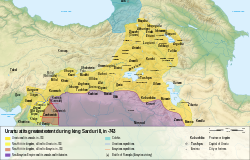
The Urartian kingdom expanded northward into the South Caucasus, building fortresses in what is now southern Georgia and leaving inscriptions that provide some of the earliest written records of the region.
Image source: Urartu
600 BC - 599 BC
% complete
Greek settlers established trading colonies such as Phasis (modern Poti) and Dioscurias on Georgia's Black Sea coast, linking Colchis to the Mediterranean world through commerce in gold, timber, and slaves.
Image source: Greek colonisation
400 BC - 399 BC
% complete
The Kingdom of Iberia (Kartli) was established around modern Mtskheta, becoming the dominant power in eastern Georgia and a frequent battleground between Rome and Persia for regional influence.
Image source: Kingdom of Iberia
65 BC
% complete
Roman general Pompey invaded the Kingdom of Iberia during his Caucasian campaign, defeating King Artoces and bringing Iberia into the Roman sphere of influence.
Image source: Caucasian campaign of Pompey
337 AD
% complete
King Mirian III converted to Christianity after being converted by Saint Nino, making Iberia one of the first countries in the world to adopt Christianity as its official state religion.
Image source: Christianization of the Kingdom of Iberia
580 AD
% complete
After abolishing the Iberian monarchy, Sasanian Persia ruled eastern Georgia directly through a marzpan (viceroy), integrating it into the Iranian imperial system until Byzantine intervention shifted control.
Image source: Sasanian Iberia
736 AD
% complete
Arab forces under Marwan II conquered much of Georgia, and an Islamic emirate was established at Tbilisi that would last for several centuries amid ongoing struggles with local Christian rulers.
Image source: Emirate of Tbilisi
813 AD
% complete
Ashot I of the Bagrationi family became presiding prince of Tao-Klarjeti with Byzantine support, founding the dynasty that would later unify Georgia under a single crown.
1001 AD
% complete
Georgian forces under David III of Tao defeated combined Muslim armies, weakening Arab and regional emirate power and paving the way for the eventual unification of Georgian lands.
1008 AD
% complete
By inheriting Abkhazia and Kartli-Iberia, Bagrat III united most Georgian lands into a unified medieval kingdom, marking the birth of the Georgian state that would flourish in subsequent centuries.
Image source: Bagrat III of Georgia
1064 AD
% complete
Successive Seljuk Turkish raids ravaged Georgian territory, destroying cities and countryside and plunging the kingdom into crisis before its dramatic recovery under David IV.
Image source: Seljuk Empire
1071 AD
% complete
The Seljuk victory over the Byzantine Empire removed the major Christian power shielding Georgia, forcing Georgian kings to confront Seljuk dominance alone before mounting their reconquista.
Image source: Battle of Manzikert
1121 AD
% complete
David IV's decisive victory over a large Seljuk coalition near Tbilisi broke Muslim power in the region, allowing him to liberate Tbilisi and ushering in Georgia's golden age.
Image source: Battle of Didgori
1184 AD - 1213 AD
% complete
Queen Tamar presided over Georgia's greatest territorial extent and cultural flowering, sponsoring epic poetry like Rustaveli's 'The Knight in the Panther's Skin' and expanding influence across the Caucasus.
Image source: Tamar I
1236 AD
% complete
Mongol armies swept through the Caucasus, forcing Georgia into vassalage. The kingdom was fragmented and burdened by tribute, beginning centuries of decline from its golden-age peak.
Image source: Mongol invasions of Georgia
1386 AD - 1403 AD
% complete
Timur (Tamerlane) launched eight devastating campaigns against Georgia, sacking Tbilisi, destroying churches, and leaving the kingdom economically shattered and depopulated.
Image source: Timurid invasions of Georgia
1466 AD
% complete
The unified Georgian kingdom collapsed into the kingdoms of Kartli, Kakheti, and Imereti plus principalities like Mingrelia and Guria, leaving the divided states vulnerable to Ottoman and Persian encroachment.
Image source: Kingdom of Georgia
1555 AD
% complete
Ottoman Turkey and Safavid Persia partitioned spheres of influence in the Caucasus, placing western Georgia under Ottoman sway and eastern Georgia under Persian domination.
Image source: Peace of Amasya
Jul 24, 1783
% complete
King Erekle II of Kartli-Kakheti placed his kingdom under Russian protection in exchange for military aid, a pact that foreshadowed full annexation but failed to prevent Persian devastation shortly after.
Image source: Treaty of Georgievsk
1795 AD
% complete
Persian ruler Agha Muhammad Khan Qajar razed Tbilisi, massacring thousands and destroying much of the city — a catastrophe that pushed Georgia decisively toward seeking Russian protection.
Image source: Siege of Tbilisi (1795)
1801 AD
% complete
Tsar Paul I formally incorporated the Kingdom of Kartli-Kakheti into the Russian Empire, ending Bagrationi royal rule and beginning more than a century of Russian administration.
Image source: 2014 Russian annexation of Crimea
1810 AD
% complete
Russia absorbed the Kingdom of Imereti, completing the incorporation of core Georgian lands into the empire; the remaining principalities were gradually brought under direct control by the 1860s.
Image source: Kingdom of Imereti
1850 AD - 1900 AD
% complete
Writers like Ilia Chavchavadze led a national revival, preserving the Georgian language and identity despite Russification policies, laying intellectual groundwork for future independence.
Image source: Ilia Chavchavadze
May 26, 1918
% complete
Following the collapse of the Russian Empire, Georgia declared independence in Tbilisi, establishing a democratic republic led by Mensheviks that granted universal suffrage and women voting rights.
Image source: Democratic Republic of Georgia
Apr 9, 1989
% complete
Soviet troops violently dispersed pro-independence demonstrators in Tbilisi, killing at least 19 people including many women. The massacre galvanized the Georgian national movement toward independence.
Image source: April 9 tragedy
Apr 9, 1991
% complete
Exactly two years after the April 9 tragedy, Georgia declared the restoration of independence following a referendum, electing Zviad Gamsakhurdia as its first post-Soviet president.
Image source: United States Declaration of Independence
1992 AD - 1993 AD
% complete
Post-Soviet Georgia descended into civil strife while wars with breakaway regions Abkhazia and South Ossetia displaced hundreds of thousands, leaving both territories outside effective Georgian control.
Image source: War in Abkhazia (1992–1993)
Nov 2003
% complete
Peaceful protests over fraudulent elections toppled Eduard Shevardnadze's government, sweeping pro-Western reformer Mikheil Saakashvili into office and launching sweeping anti-corruption reforms.
Image source: Rose Revolution
Aug 7, 2008 - Aug 12, 2008
% complete
Russia fought a five-day war with Georgia over South Ossetia and Abkhazia, then recognized both regions as independent states, freezing Georgian NATO aspirations and straining ties with Moscow.
Image source: Russo-Georgian War
Jun 27, 2014
% complete
Georgia signed an Association Agreement with the European Union, deepening political and economic integration with Europe and anchoring the country's westward trajectory.
Image source: Georgia–European Union relations
Feb 25, 1921
% complete
Bolshevik forces overthrew the Democratic Republic and established the Georgian SSR, ending three years of independence and incorporating Georgia into the Soviet Union.
Image source: Red Army invasion of Georgia
Aug 28, 1924 - Sep 1924
% complete
A nationwide anti-Soviet rebellion was brutally suppressed by Red Army forces, with thousands executed, extinguishing organized resistance to Bolshevik rule for decades.
Image source: August Uprising
1937 AD - 1938 AD
% complete
Under Stalin, himself a Georgian, purges devastated Georgia's political and cultural elites; poets like Titsian Tabidze and Paolo Iashvili were persecuted or driven to suicide.
Image source: Great Purge
Or browse the full history timeline directory, with more than 2,000 topics.
This History of Georgia (Country) timeline was generated with the help of AI, using information found on the internet.
We work hard to keep these timelines accurate, but mistakes do get through. If you spot one, email us at [email protected] and we'll fix it for future visitors.
Generate yours with AI or build it from scratch, for free.
Export your timeline, add your own events, edit or remove AI-generated events, and much more
No credit card required.
Cancel anytime.
Cancel anytime.
You can create an unlimited number of timelines with up to 10 events on each one, customize how they look, export them to PDF, PNG, PowerPoint, CSV, and Excel, and share them with a link. Paid plans raise the event limit and add features like spreadsheet imports and collaborators.
Yes. You can cancel your subscription from your account page at any time, and you will not be charged again. Your subscription stays active for the rest of the period you already paid for.
Yes. We will email you a reminder before the annual renewal, and we will also email you a receipt.
Yes. You can email us within 15 days of any payment, and we will issue you a full refund.
Check out our pricing docs or send us an email anytime: [email protected].