-
Use Cases
-
Resources
-
Pricing
Country music is a uniquely American genre that originated in the rural South in the early 20th century, blending folk traditions, blues, gospel, and Appalachian ballads. Over the decades it evolved through styles like honky-tonk, bluegrass, rockabilly, outlaw country, and modern pop-country, becoming one of the most popular music genres in the United States. More Less
Jun 14, 1923
% complete
Fiddlin' John Carson recorded 'Little Old Log Cabin in the Lane' for Okeh Records in Atlanta, widely considered the first commercial recording of country music. Its unexpected success opened the door for the recording of rural Southern music.
Image source: Fiddlin' John Carson
Nov 28, 1925
% complete
The WSM Barn Dance in Nashville, later renamed the Grand Ole Opry, began broadcasting and became the longest-running radio program in American history, making Nashville a hub of country music.
Image source: Grand Ole Opry
1927 - 1933
% complete
Known as the 'Singing Brakeman,' Jimmie Rodgers blended blues, yodeling, and folk into a distinctive style that sold millions of records before his death in 1933, shaping the blueprint of the country singing star.
Image source: Jimmie Rodgers
Jul 25, 1927 - Aug 5, 1927
% complete
Producer Ralph Peer recorded the Carter Family and Jimmie Rodgers in Bristol, Tennessee/Virginia. These 'Bristol Sessions' are often called the 'Big Bang' of country music, establishing its first major stars and commercial foundation.
Image source: Bristol sessions
1935
% complete
Gene Autry rose to fame as Hollywood's singing cowboy, bringing country music to mass audiences through film, records, and radio, and paving the way for country's national popularity.
Image source: Gene Autry
1938
% complete
Roy Acuff's arrival at the Opry with hits like 'The Great Speckled Bird' made him the show's biggest star and helped cement Nashville as the center of the country music world.
Image source: Roy Acuff
1939
% complete
Bill Monroe formed his band the Blue Grass Boys and developed a fast, virtuosic acoustic style that became known as bluegrass, a foundational genre within country music.
Image source: Bill Monroe
1946 - 1953
% complete
Postwar honky-tonk music, with artists like Hank Williams, Ernest Tubb, and Lefty Frizzell, reflected the hard-drinking dancehall culture of Texas and the Southwest and dominated country charts.
Image source: Honky-tonk
1946
% complete
Hank Williams signed with MGM Records and soon released classics like 'Move It On Over' and 'Lovesick Blues,' becoming one of the most influential songwriters and performers in country history.
Image source: Hank Williams
1952
% complete
Kitty Wells became the first female solo artist to top the country charts, opening the door for generations of women in country music.
Image source: Kitty Wells
Jan 1, 1953
% complete
Hank Williams died en route to a New Year's Day show in Ohio. His death at 29 cemented his legend and left an indelible mark on country music songwriting.
Image source: Death of Hank Williams
Jul 5, 1954
% complete
Elvis Presley's recording of 'That's All Right' at Sun Studio fused country and rhythm and blues, launching rockabilly and forever linking country with early rock and roll.
Image source: That's All Right
May 21, 1956
% complete
Johnny Cash's first number-one hit established his signature boom-chicka-boom sound and began a legendary career spanning country, rockabilly, and gospel.
Image source: I Walk the Line
Jan 1, 1957
% complete
Patsy Cline's performance on Arthur Godfrey's Talent Scouts and crossover hit 'Walkin' After Midnight' brought her pop success and helped define the Nashville Sound.
Image source: Patsy Cline
1957 - 1964
% complete
Producers Chet Atkins and Owen Bradley crafted a polished style with lush strings and background vocals, broadening country's appeal to pop audiences through artists like Jim Reeves and Eddy Arnold.
Image source: Nashville sound
Mar 5, 1963
% complete
Patsy Cline was killed in a plane crash near Camden, Tennessee, cutting short the career of one of country's greatest voices at age 30.
Image source: The Patsy Cline Story
1966
% complete
Merle Haggard and Buck Owens popularized the Bakersfield Sound, a raw, electric, twang-heavy alternative to polished Nashville productions that influenced decades of country rock.
Sep 20, 1968
% complete
Tammy Wynette's signature ballad became one of the best-selling country singles by a woman and defined her reign as the 'First Lady of Country Music.'
Image source: Stand by Your Man
1969 - 1972
% complete
Glen Campbell's television show brought country-flavored pop to mainstream America, exemplifying the countrypolitan crossover era.
Image source: The Glen Campbell Goodtime Hour
1972
% complete
Willie Nelson moved to Austin, Texas, embracing a freewheeling hippie-country hybrid that fueled the outlaw country movement centered on Austin's Armadillo World Headquarters.
Image source: Willie Nelson
1973
% complete
Waylon Jennings gained creative control over his recordings, producing a rougher, rock-influenced sound with albums like 'Lonesome, On'ry and Mean' that defined outlaw country.
Image source: Waylon Jennings
1976
% complete
The compilation featuring Waylon Jennings, Willie Nelson, Jessi Colter, and Tompall Glaser became the first country album certified platinum, proving outlaw country's mass appeal.
Image source: Wanted! The Outlaws
Oct 3, 1977
% complete
Dolly Parton's pop-crossover album and title track brought her massive mainstream success while she remained rooted in country storytelling.
Image source: Here You Come Again (song)
Jun 13, 1980
% complete
The film 'Urban Cowboy' and its soundtrack triggered a nationwide craze for country music and mechanical bull riding, boosting crossover acts like Kenny Rogers and Anne Murray.
Image source: Urban Cowboy
1986
% complete
Randy Travis's debut 'Storms of Life' led a return to traditional honky-tonk and gospel-inflected country, countering the pop excesses of the early 1980s alongside Dwight Yoakam and Reba McEntire.
Image source: Randy Travis
Apr 12, 1989
% complete
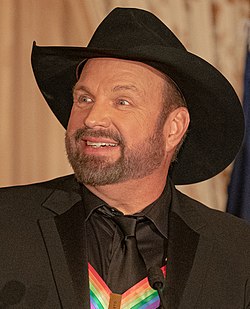
Garth Brooks's self-titled debut launched a career that made him the best-selling solo albums artist in U.S. history, blending rock energy with country storytelling and expanding the genre's audience dramatically.
Image source: Garth Brooks
1992
% complete
Billy Ray Cyrus's line-dancing smash topped charts worldwide and sparked a line-dancing fad, marking country's peak pop visibility in the early 1990s.
Image source: Achy Breaky Heart
Nov 4, 1997
% complete
Shania Twain's third album became the best-selling studio album by a female artist and the best-selling country album ever, fusing country with pop production for global crossover success.
Image source: Come On Over
Mar 10, 2003
% complete
Natalie Maines criticized President George W. Bush on the eve of the Iraq War, triggering boycotts and a national debate about politics in country music; the band later rebranded as The Chicks.
Image source: The Chicks
2014
% complete
Taylor Swift, who began as a teenage country songwriter, fully embraced pop with her album '1989,' illustrating country's role as a springboard for global superstars.
Image source: 1989 (album)
Nov 4, 2015
% complete
Chris Stapleton's breakout performance with Justin Timberlake at the CMA Awards and his acclaimed album 'Traveller' sparked a renewed appreciation for soulful, traditional country craft.
Image source: Chris Stapleton
Apr 8, 2019
% complete
Lil Nas X's genre-blending hit spent a record 19 weeks atop the Billboard Hot 100, igniting conversations about race, genre boundaries, and the future of country music.
Image source: Old Town Road
Or browse the full history timeline directory, with more than 2,000 topics.
This History of Country Music timeline was generated with the help of AI, using information found on the internet.
We work hard to keep these timelines accurate, but mistakes do get through. If you spot one, email us at [email protected] and we'll fix it for future visitors.
Generate yours with AI or build it from scratch, for free.
Export your timeline, add your own events, edit or remove AI-generated events, and much more
No credit card required.
Cancel anytime.
Cancel anytime.
You can create an unlimited number of timelines with up to 10 events on each one, customize how they look, export them to PDF, PNG, PowerPoint, CSV, and Excel, and share them with a link. Paid plans raise the event limit and add features like spreadsheet imports and collaborators.
Yes. You can cancel your subscription from your account page at any time, and you will not be charged again. Your subscription stays active for the rest of the period you already paid for.
Yes. We will email you a reminder before the annual renewal, and we will also email you a receipt.
Yes. You can email us within 15 days of any payment, and we will issue you a full refund.
Check out our pricing docs or send us an email anytime: [email protected].