-
Use Cases
-
Resources
-
Pricing
Music festivals have evolved from ancient religious and cultural celebrations into massive modern events that shape popular culture. This timeline traces key milestones, including the birth of jazz and blues festivals in the early 20th century, the revolutionary counterculture festivals of the 1960s such as Woodstock and Monterey Pop, the rise of genre-specific events like Rock am Ring and Lollapalooza, and the emergence of contemporary global giants like Glastonbury, Coachella, and Tomorrowland. More Less
Aug 13, 1876
% complete
Richard Wagner opened his own purpose-built opera house in Bayreuth, Germany, to stage the complete premiere of his four-opera Ring cycle. The festival pioneered the idea of a composer-curated event drawing an international audience, becoming a landmark in the history of classical music festivals.
Image source: Bayreuth Festival
1920
% complete
The inaugural Salzburg Festival in Austria featured a production of Hugo von Hofmannsthal's morality play Everyman on Cathedral Square. It grew into one of the world's most prestigious festivals for opera, drama, and classical concert music.
Image source: Salzburg Festival
Jul 17, 1954
% complete
Elaine and Louis Lorillard founded the first annual jazz festival in America in Newport, Rhode Island, attracting tens of thousands of fans. It established the template for the multi-day outdoor genre-specific music festival and helped legitimize jazz as a major concert attraction.
Image source: Newport Jazz Festival
1958
% complete
The Monterey Jazz Festival debuted at the Monterey County Fairgrounds in California, becoming the longest continuously running jazz festival in North America and cementing California's role in American festival culture.
Image source: Monterey Jazz Festival
Jul 11, 1959
% complete
Founded by Pete Seeger and others, the Newport Folk Festival brought together traditional and contemporary folk artists in Rhode Island, launching careers and creating a model for artist-driven grassroots festivals.
Image source: Newport Folk Festival
1961
% complete
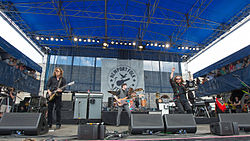
The Mariposa Folk Festival began near Toronto, Canada, helping to popularize folk music and inspiring the growth of the folk revival movement across North America through performances by emerging singer-songwriters.
Image source: Mariposa Folk Festival
Jul 25, 1965
% complete
Bob Dylan's decision to perform with an electric band at the Newport Folk Festival shocked folk purists and became one of the most legendary moments in festival history, symbolizing the collision of folk tradition with rock and roll.
Image source: Electric Dylan controversy
Jun 16, 1967 - Jun 18, 1967
% complete
Held during the Summer of Love, the Monterey Pop Festival introduced Jimi Hendrix, Janis Joplin, and The Who to American audiences. Its three-day format with multiple stages set the blueprint for all subsequent rock festivals.
Image source: Monterey International Pop Festival
Aug 15, 1969 - Aug 18, 1969
% complete
The Woodstock Music and Art Fair on Max Yasgur's farm in Bethel, New York, became the defining event of the counterculture era, featuring iconic performances by Jimi Hendrix, Santana, and Crosby, Stills & Nash amid rain, mud, and peace.
Image source: Woodstock
Dec 6, 1969
% complete
The Rolling Stones' free concert at Altamont Speedway in California descended into violence, including the fatal stabbing of a concertgoer by Hells Angels security guards, shattering the utopian image of the 1960s festival scene.
Image source: Altamont Free Concert
Aug 26, 1970 - Aug 30, 1970
% complete
The 1970 Isle of Wight Festival drew an estimated 600,000 people, larger than Woodstock, to see acts like Jimi Hendrix, The Who, and The Doors, marking both the peak of the British rock festival era and Hendrix's final UK performance.
Image source: Isle of Wight Festival 1970
Sep 19, 1970
% complete
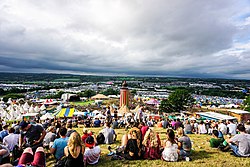
Michael Eavis organized the first Pilton Pop, Blues and Folk Festival on his Somerset farm, inspired by Led Zeppelin. Glastonbury would grow over decades into the world's largest greenfield music and performing arts festival.
Image source: Glastonbury Festival
1971
% complete
The National Jazz and Blues Festival, which had evolved into the Reading Festival, embraced rock and heavy music, eventually becoming one of Britain's most enduring and beloved annual rock gatherings.
Image source: Reading and Leeds Festivals
1967
% complete
Claude Nobs founded the Montreux Jazz Festival on the shores of Lake Geneva, Switzerland. Over time it welcomed rock, soul, and pop legends alongside jazz greats, becoming one of Europe's premier destination festivals.
Image source: Montreux Jazz Festival
1971
% complete
Denmark's Roskilde Festival began as a hippie gathering and evolved into Northern Europe's largest music festival, run as a nonprofit donating proceeds to humanitarian causes and pioneering European large-scale camping festivals.
Image source: Roskilde Festival
Sep 3, 1982 - Sep 5, 1982
% complete
Apple co-founder Steve Wozniak funded the US Festival in San Bernardino, California, blending technology exhibits with huge rock lineups. Despite financial losses, it demonstrated the commercial potential of mega-festivals.
Image source: US Festival
Jul 13, 1985
% complete
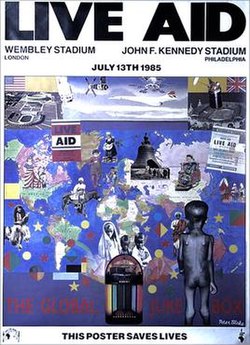
Organized by Bob Geldof, Live Aid staged simultaneous benefit concerts at London's Wembley Stadium and Philadelphia's JFK Stadium, watched by nearly two billion people worldwide and proving festivals could drive global activism.
Image source: Live Aid
Jan 25, 1992
% complete
Australia's Big Day Out toured multiple cities each summer with alt-rock and punk lineups, establishing the traveling multi-city festival model that spread throughout the Asia-Pacific region.
Image source: Big Day Out
Jul 26, 1997 - Jul 27, 1997
% complete
Japan's largest outdoor music festival launched at the base of Mount Fuji before moving to Naeba Ski Resort. It introduced Japan to the international camping festival experience with global rock headliners.
Image source: Fuji Rock Festival
Jul 1991
% complete
Perry Farrell of Jane's Addiction created Lollapalooza as a traveling festival celebrating alternative culture, bringing grunge, hip-hop, and indie bands together and defining the sound of the early 1990s before settling in Chicago permanently in 2005.
1999
% complete
Ultra grew from a small Miami beach party tied to the Winter Music Conference into one of the world's biggest electronic music events, spawning the Ultra Worldwide franchise of sister festivals across five continents.
Image source: Ultra Music Festival
Oct 9, 1999 - Oct 10, 1999
% complete
Goldenvoice launched Coachella in Indio, California, combining alternative rock with art installations. It later became America's most influential festival, known for surprise reunions, celebrity culture, and livestreaming to millions.
Jun 30, 2000
% complete
A crowd crush during Pearl Jam's set killed nine young fans, prompting the festival industry worldwide to overhaul crowd safety management, barrier design, and emergency response protocols.
Jun 21, 2002 - Jun 23, 2002
% complete
Bonnaroo launched on a 700-acre farm in Manchester, Tennessee, emphasizing jam bands, camping community, and sustainability, becoming a cornerstone of the American festival circuit.
Image source: Bonnaroo
Aug 2005
% complete
Belgium's Tomorrowland transformed electronic dance music culture with its elaborate fairytale stages, drawing hundreds of thousands of visitors from around the world and fueling the global EDM boom of the 2010s.
Image source: Tomorrowland (festival)
Jul 24, 2010
% complete
A tunnel bottleneck at Germany's Love Parade techno festival caused a deadly crush that killed 21 people and injured hundreds, leading to the cancellation of the beloved Berlin-born event and renewed scrutiny of festival site planning.
Image source: Love Parade disaster
Apr 15, 2011 - Apr 17, 2011
% complete
Coachella partnered with YouTube to stream performances live worldwide, revolutionizing festival access and turning sets into viral moments viewed by millions who never attended in person.
Image source: Coachella (festival)
Mar 2020 - 2021
% complete
The COVID-19 pandemic forced mass cancellations of virtually every major music festival globally, including Glastonbury and Coachella, devastating the live music economy and accelerating virtual festival experiments until mass vaccination allowed returns in 2021.
Image source: Impact of the COVID-19 pandemic on the music industry
Nov 5, 2021
% complete
A deadly crowd crush during Travis Scott's headline set at Astroworld Festival in Houston killed ten people and injured hundreds, triggering lawsuits, congressional scrutiny, and another reckoning over festival crowd control practices.
Image source: Astroworld Festival crowd crush
Or browse the full history timeline directory, with more than 2,000 topics.
This History of Music Festivals timeline was generated with the help of AI, using information found on the internet.
We work hard to keep these timelines accurate, but mistakes do get through. If you spot one, email us at [email protected] and we'll fix it for future visitors.
Generate yours with AI or build it from scratch, for free.
Export your timeline, add your own events, edit or remove AI-generated events, and much more
No credit card required.
Cancel anytime.
Cancel anytime.
You can create an unlimited number of timelines with up to 10 events on each one, customize how they look, export them to PDF, PNG, PowerPoint, CSV, and Excel, and share them with a link. Paid plans raise the event limit and add features like spreadsheet imports and collaborators.
Yes. You can cancel your subscription from your account page at any time, and you will not be charged again. Your subscription stays active for the rest of the period you already paid for.
Yes. We will email you a reminder before the annual renewal, and we will also email you a receipt.
Yes. You can email us within 15 days of any payment, and we will issue you a full refund.
Check out our pricing docs or send us an email anytime: [email protected].