-
Use Cases
-
Resources
-
Pricing
The history of music recording traces the evolution of technologies used to capture and reproduce sound, beginning with mechanical devices like Edison's phonograph and Berliner's gramophone, progressing through electrical recording, magnetic tape, vinyl records, cassettes, CDs, digital audio files, and ultimately to today's streaming platforms. More Less
1300
% complete
In the 14th century, a mechanical bell-ringer controlled by a rotating cylinder was introduced in Flanders, extending the tradition of automated music reproduction begun with earlier cylinder-based instruments.
Image source: Carillon
1400
% complete
Similar designs appeared in barrel organs in the 15th century, using pinned cylinders to mechanically reproduce melodies and paving the way for later automated musical devices.
Image source: Barrel organ
1598
% complete
Musical clocks, which incorporated mechanisms to play tunes at set times, appeared by 1598, continuing the lineage of cylinder-driven automatic instruments.
Image source: Musical clock
1800
% complete
Around 1800, music boxes emerged as popular consumer devices that used pinned metal cylinders or discs to play melodies, bringing mechanical music reproduction into everyday homes.
Image source: Music box
1805
% complete
In 1805, barrel pianos were introduced, employing a rotating pinned barrel to mechanically depress piano keys and play pre-programmed tunes automatically.
Image source: Barrel piano
1876
% complete
The player piano, first demonstrated in 1876, used a punched paper scroll that could store a long piece of music, allowing a piano to perform automatically without a human player.
Image source: Player piano
1892
% complete
The fairground organ, developed in 1892, used a system of accordion-folded punched cardboard books to store and reproduce music mechanically at fairs and amusement venues.
Image source: Fairground organ
1896 - 2008
% complete
Piano rolls were in continuous mass production from 1896 to 2008, providing a durable medium for storing and reproducing performances on player pianos for over a century.
Image source: Piano roll
1902
% complete
A Supreme Court copyright case noted that in 1902 alone there were between 70,000 and 75,000 player pianos manufactured, and between 1,000,000 and 1,500,000 piano rolls produced, illustrating the format's enormous popularity.
1904
% complete
This technology to record a live performance onto a piano roll was not developed until 1904, allowing pianists' actual playing to be captured and replayed on player pianos.
1857
% complete
The first device that could record actual sounds as they passed through the air was the phonautograph, patented in 1857 by Parisian inventor Édouard-Léon Scott de Martinville. It could not play recordings back; its purpose was only visual study of sound waves.
Image source: Phonautograph
1857
% complete
The earliest known recordings of the human voice are phonautograph recordings, called phonautograms, made in 1857, capturing sound as undulating lines on paper decades before playback became possible.
1877
% complete
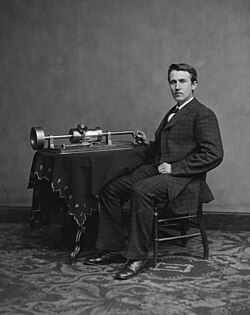
In 1877, Edison was working on a machine that would transcribe telegraphic signals onto paper tape, which could then be transferred over the telegraph again and again—work that led directly to his invention of the phonograph.
Image source: Thomas Edison
1877
% complete
The first practical sound recording and reproduction device was the mechanical phonograph cylinder, invented by Thomas Edison in 1877 and patented in 1878, launching the era of recorded sound.
Image source: Phonograph
Apr 30, 1877
% complete
On April 30, 1877, French poet, humorous writer and inventor Charles Cros submitted a sealed envelope containing a letter to the Academy of Sciences in Paris fully explaining his proposed method for sound recording, called the paleophone.
Image source: Charles Cros
1887
% complete
The next major technical development was the gramophone record, generally credited to Emile Berliner and patented in 1887, though others, most notably Alexander Graham Bell in 1881, had demonstrated similar disk apparatus earlier.
Image source: Phonograph record
1888 - 1910
% complete
Mass-production techniques enabled cylinder recordings to become a major new consumer item in industrial countries, and the cylinder was the main consumer format from the late 1880s until around 1910, when discs began to dominate.
Image source: Phonograph cylinder
1901
% complete
A process for mass-producing duplicate wax cylinders by molding instead of engraving them was put into effect in 1901, making cylinder records cheaper and more widely available.
1910 - 1918
% complete
By 1910, and by the end of World War I, the disc had become the dominant commercial recording format. In various permutations, the audio disc remained the primary medium for consumer sound recordings until the end of the 20th century.
2008
% complete
An 1860 phonautogram of 'Au Clair de la Lune', a French folk song, was played back as sound for the first time in 2008 by scanning it and using software to convert its undulating line into a corresponding digital audio file.
Image source: Au clair de la lune
1890 - 1932
% complete
Experiments in 1881 transmitting sound from the Paris Opera showed listeners could follow singers' movements with earpieces on each ear. This discovery was commercialized in 1890 with the Théâtrophone system, which operated for over forty years until 1932.
Image source: Théâtrophone
1906
% complete
In 1906, Lee De Forest invented the Audion triode vacuum tube, an electronic valve that could amplify weak electrical signals—a key enabler of electrical recording and broadcasting.
Image source: Triode
1915
% complete
By 1915, the Audion tube was in use in long-distance telephone circuits that made conversations between New York and San Francisco practical, demonstrating vacuum-tube amplification at scale.
Image source: Audion
Nov 11, 1920
% complete
The first electrical recording issued to the public, with little fanfare, was of the November 11, 1920, funeral service for The Unknown Warrior in Westminster Abbey, London.
Image source: The Unknown Warrior
1924
% complete
Marsh's electrically recorded Autograph Records were already being sold to the public in 1924, a year before the major record companies offered electrical recordings, but their sound quality was too low to show obvious advantages over acoustic methods.
1924
% complete
By 1924 Western Electric, armed with superior microphones, amplifiers, and a patented electromechanical recorder from 1918, arranged a demonstration for the Victor Talking Machine Company and Columbia Phonograph Company, who both licensed the system.
1924
% complete
In 1924, German engineer Kurt Stille improved the Telegraphone magnetic wire recorder with an electronic amplifier, advancing the feasibility of magnetic sound recording.
Image source: Valdemar Poulsen
Feb 1925
% complete
Victor and Columbia made their earliest published electrical recordings in February 1925 but withheld release until November 1925, having agreed privately not to publicize the new process until enough electrically recorded repertory was available.
Image source: Phonograph record
1930
% complete
The BBC started using Blattnerphones in 1930 to record radio programs, bringing magnetic steel-tape recording into professional broadcasting.
Image source: Ludwig Blattner
1935
% complete
The K1 Magnetophon was the first practical tape recorder, developed by AEG in Germany in 1935, marking the true beginning of magnetic tape recording.
Image source: Magnetophon
Mar 1935
% complete
In 1933, Guglielmo Marconi's company purchased the rights to the Blattnerphone, and newly developed Marconi-Stille recorders were installed in the BBC's Maida Vale Studios in March 1935.
Image source: Sound recording and reproduction
1948
% complete
The Ampex 200 model, launched in 1948, was the first commercial tape recorder in the United States; within a few years Les Paul had invented the first multitrack tape recorder, ushering in another technical revolution in the recording industry.
Image source: Ampex
1951
% complete
Les Paul's 1951 recording of How High the Moon, on which he played eight overdubbed guitar tracks, is an early landmark example of multitrack overdubbing in popular music.
Image source: How High the Moon
Dec 1931
% complete
In December 1931, British electronics engineer Alan Blumlein submitted a patent application for making an actor's voice follow movement across a film screen; it became UK patent number 394,325 in 1933, laying the foundation for modern stereo.
Image source: Alan Blumlein
1937
% complete
A major breakthrough in practical stereo sound was made by Bell Laboratories, which in 1937 demonstrated a practical two-channel stereo system using dual optical sound tracks on film.
1938
% complete
Major movie studios quickly developed three-track and four-track sound systems, and the first stereo sound recording for a commercial film was made by Judy Garland for the MGM movie Listen, Darling in 1938.
Image source: Listen, Darling
1941
% complete
German audio engineers working on magnetic tape developed stereo recording by 1941, extending multichannel techniques into the emerging tape medium.
Image source: Tape recorder
1941
% complete
Walt Disney's Fantasia, the first commercially released movie with a stereo soundtrack, was released in 1940, and its 1941 release used the innovative Fantasound sound system.
Image source: Fantasia (1940 film)
1946
% complete
Ernest Ansermet's recording of Igor Stravinsky's Petrushka was key in the development of full frequency range records and alerting the listening public to high fidelity in 1946.
Image source: High Fidelity (film)
1948
% complete
The long-playing 33⅓ rpm microgroove LP record was developed at Columbia Records and introduced in 1948, allowing extended works to fit on a single disc.
1949
% complete
The short-playing but convenient 7-inch 45 rpm microgroove vinyl single was introduced by RCA Victor in 1949, becoming the standard format for hit singles.
Image source: Single (music)
1954
% complete
German audio engineers issued their first Stereosonic tape in 1954, building on the stereo magnetic tape recording techniques they had developed during the war years.
Image source: Magnetic cartridge
1956
% complete
Regular releases of Fantasia used standard mono optical 35 mm stock until 1956, when Disney released the film with a stereo soundtrack using the Cinemascope four-track magnetic sound system.
1957
% complete
The history of stereo recording changed after the late 1957 introduction of the Westrex stereo phonograph disc, which used the groove format developed earlier by Alan Blumlein and enabled compatible stereo LPs.
1964
% complete
The compact cassette was introduced by the Philips electronics company in 1964 and went on to become a major consumer audio format for music distribution and home recording.
Image source: Cassette tape
1966
% complete
The Dolby A noise reduction system, invented by Ray Dolby and introduced into professional recording studios in 1966, suppressed the background hiss that was one downside of mastering on tape instead of recording directly to disc.
Image source: Dolby noise-reduction system
1979
% complete
Advances in electronic and mechanical miniaturization led to the Sony Walkman, a pocket-sized cassette player introduced in 1979, revolutionizing how people listened to recorded music on the go.
Image source: Walkman
1982
% complete
The advent of digital sound recording and the compact disc in 1982 brought significant improvements in the quality and durability of recordings, transforming the music industry's primary format.
Image source: Compact disc
1972
% complete
Prior to the Sound Recording Amendment, copyright in US sound recordings was handled at the state level. Federal copyright law preempts most state laws but allows state copyright in sound recordings to continue for one full term after 1972, meaning protection runs until 2067.
Image source: Copyright Act of 1909
Or browse the full history timeline directory, with more than 2,000 topics.
This History of Music Recording timeline was generated with the help of AI, using information found on the internet.
We work hard to keep these timelines accurate, but mistakes do get through. If you spot one, email us at [email protected] and we'll fix it for future visitors.
Generate yours with AI or build it from scratch, for free.
Export your timeline, add your own events, edit or remove AI-generated events, and much more
No credit card required.
Cancel anytime.
Cancel anytime.
You can create an unlimited number of timelines with up to 10 events on each one, customize how they look, export them to PDF, PNG, PowerPoint, CSV, and Excel, and share them with a link. Paid plans raise the event limit and add features like spreadsheet imports and collaborators.
Yes. You can cancel your subscription from your account page at any time, and you will not be charged again. Your subscription stays active for the rest of the period you already paid for.
Yes. We will email you a reminder before the annual renewal, and we will also email you a receipt.
Yes. You can email us within 15 days of any payment, and we will issue you a full refund.
Check out our pricing docs or send us an email anytime: [email protected].