-
Use Cases
-
Resources
-
Pricing
The history of vinyl records traces the evolution of recorded sound technology from Thomas Edison's phonograph and Emile Berliner's flat disc gramophone to the golden age of long-playing (LP) albums and 45 RPM singles. Despite the rise of cassettes, CDs, and digital streaming, vinyl has experienced a remarkable resurgence since the 2000s, remaining a beloved physical music format for collectors and audiophiles worldwide. More Less
1857
The phonautograph was invented in 1857 by Frenchman Édouard-Léon Scott de Martinville, allowing sound vibrations to be traced visually onto a medium. Prior to this, tuning forks had been used to create direct tracings of sound-producing objects, as by English physicist Thomas Young in 1807.
Image source: Phonautograph

1877
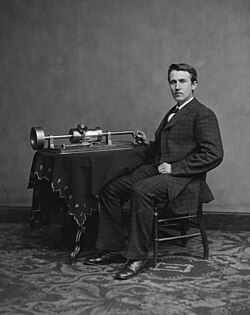
Thomas Edison invented the first phonograph, which etched sound recordings onto phonograph cylinders. This invention launched the era of recorded sound and set the stage for competition between cylinder and disc formats.
Image source: Phonograph
1890
Manufacture of disc records began in the late 19th century, at first competing with earlier cylinder records. The phonograph record had co-existed with the phonograph cylinder from the late 1880s and had effectively superseded it by around 1912.
Image source: Phonograph record

1894
As early as 1894, Emile Berliner's United States Gramophone Company was selling single-sided 7-inch discs with an advertised standard speed of "about 70 rpm". At the beginning of the 20th century, these early 7-inch discs played for two minutes, the same as cylinder records.
Image source: Emile Berliner

1901
Abandoning Berliner's "Gramophone" trademark for legal reasons in the United States, Johnson's and Berliner's separate companies reorganized in 1901 to form the Victor Talking Machine Company in Camden, New Jersey, whose products would come to dominate the market for several decades. In January 1901 Victor also introduced the 10-inch disc, increasing playing time to three and a half minutes.
Image source: Victor Talking Machine Company

1903 - 1906
The short-lived 14-inch record was introduced by Victor in the spring of 1903, the 12-inch disc in the summer of 1903 and the 8-inch disc in 1906, all increasing the playing time and fidelity over the 7-inch format.
1903
In 1903 The Gramophone Company in England made the first complete recording of an opera, Verdi's Ernani, on 40 single-sided discs.
Image source: Gramophone Company

1909
German record company Odeon pioneered the album in 1909 when it released the Nutcracker Suite by Tchaikovsky on four double-sided discs in a specially designed package. Increasingly from the early 20th century, both sides of the record were used to carry the grooves.
Image source: Album

1912
In 1912, the Gramophone Company set 78 rpm as their recording standard, based on the average of recordings they had been releasing at the time, and started selling players whose governors had a nominal speed of 78 rpm. Speed governors were part of a wave of improvement introduced rapidly after 1897, and by 1925, 78 rpm was standardized across the industry. For about half a century, discs made from shellac ran at this speed, earning them the nickname "78s".
1923
When King Oliver's Creole Jazz Band, including Louis Armstrong on his first recordings, recorded 13 sides at Gennett Records in Richmond, Indiana, in 1923, one side was 2:09 and four sides were 2:52–2:59. Lillian Hardin Armstrong remembered that at first Oliver and his young second trumpet stood next to each other and Oliver's horn could not be heard.
Image source: King Oliver

This History of Vinyl Records timeline was generated with the help of AI, using information found on the internet.
We work hard to keep these timelines accurate, but mistakes do get through. If you spot one, email us at [email protected] and we'll fix it for future visitors.
Generate yours with AI or build it from scratch, for free.