
-
Use Cases
-
Resources
-
Pricing
The history of hard drives traces the evolution of magnetic data storage from room-sized machines to compact, fast, and high-capacity devices used in computers, servers, and data centers. More Less
Build a timeline like this one in minutes, for free. Start Yours →
1953
IBM recognized an immediate application for what it called a Random Access File: a high-capacity storage system offering rapid random access at relatively low cost.
Image source: IBM 305 RAMAC

1956
IBM announced the IBM 305 RAMAC computer and its associated disk storage system, introducing magnetic disk storage as a new form of computer secondary storage.
1957
IBM began commercial hard-disk-drive usage by shipping production IBM 305 RAMAC systems containing the IBM Model 350 disk storage unit. The IBM 350 stored five million six-bit characters, equivalent to about 3.75 megabytes.
Image source: History of IBM magnetic disk drives

1957
Manufacturing began in California's Silicon Valley with IBM's production shipment of the RAMAC 350, marking the beginning of the hard-drive industry.
Image source: Hard disk drive
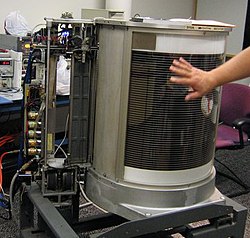
1961
The IBM 1301 Disk Storage Unit introduced self-acting air bearings, or self-flying heads, with one head for each disk surface. Each module stored 28 million six-bit characters.
Image source: History of IBM magnetic disk drives

1961
Bryant Computer Products introduced its 4000 series disk drives, offering up to 205 megabytes on as many as 26 platters measuring 29 inches in diameter.
1962
The IBM 1311 became the first disk drive to use removable media. Its IBM 1316 disk pack stored two million characters and allowed disk packs to be exchanged between drives.
1963
IBM followed the 1301 with the IBM 1302, which provided four times the capacity of its predecessor.
1964
Burroughs introduced the B-475 disk drive as part of the B5500 system. It used a head-per-track design, eliminating the need for mechanical head movement between tracks.
Image source: Burroughs Corporation

Mar 24, 1970
United States Patent 3,503,060, arising from the IBM RAMAC program, was issued. It is generally considered the fundamental patent for disk drives.
Build a timeline like this one in minutes, for free. Start Yours →
This History of Hard Drives timeline was generated with the help of AI, using information found on the internet.
We work hard to keep these timelines accurate, but mistakes do get through. If you spot one, email us at [email protected] and we'll fix it for future visitors.
Generate yours with AI or build it from scratch, for free.


