-
Use Cases
-
Resources
-
Pricing
The History of London spans nearly two millennia, beginning with its foundation as the Roman settlement of Londinium around 43 AD. Over the centuries, London grew from a provincial Roman town into a major medieval trading city, survived devastating events such as the Great Plague of 1665 and the Great Fire of 1666, and emerged as the heart of the British Empire during the Victorian era. Today, it stands as one of the world's leading financial, cultural, and political centers. More Less
600
% complete
After the Roman withdrawal from Britain, Anglo-Saxons established a trading settlement known as Lundenwic west of the old Roman city, in the area of modern Covent Garden. It became a flourishing port town engaged in trade across the North Sea.
Image source: Anglo-Saxon London
871
% complete
Viking forces attacked London during their campaigns against the Anglo-Saxon kingdoms. King Alfred the Great eventually recaptured the city in 886 and restored its defenses, resettling the area within the old Roman walls in what became known as Lundenburg.
Image source: Great Heathen Army
Dec 25, 1066
% complete
Following his victory at Hastings, William the Conqueror was crowned King of England at Westminster Abbey on Christmas Day. The coronation cemented London's status as England's preeminent city and began a tradition of royal ceremonies centered on Westminster.
Image source: Coronations of William the Conqueror and Matilda
1078
% complete
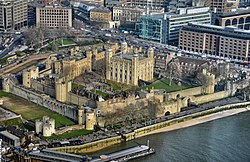
William the Conqueror ordered the construction of the White Tower, the central keep of the Tower of London, to intimidate and control the city's population. The fortress expanded over centuries, serving as royal palace, prison, and home of the Crown Jewels.
Image source: Tower of London
Jun 15, 1215
% complete
King John sealed Magna Carta at Runnymede beside the Thames, just outside London. The charter limited royal power and granted rights that would shape English governance, with Londoners playing a key role in pressuring the king to agree.
Image source: Magna Carta
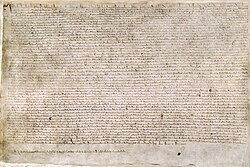
1314
% complete
The Gothic Old St Paul's Cathedral was completed after more than a century of construction, with one of the tallest spires in Europe. For nearly three centuries it dominated the London skyline until its destruction in the Great Fire of 1666.
Image source: Old St Paul's Cathedral
1348 - 1349
% complete
The Black Death swept through London in 1348–49, killing an estimated half of the city's population. Overflowing churchyards such as East Smithfield bore witness to the catastrophe, which profoundly reshaped the city's economy and society.
Image source: Black Death in England
Jun 13, 1381 - Jun 15, 1381
% complete
Rebels led by Wat Tyler stormed into London, seizing the Tower of London and burning buildings. The young King Richard II met the rebels, and after Tyler was killed at Smithfield, the revolt collapsed, though it exposed deep social tensions.
Image source: Peasants' Revolt
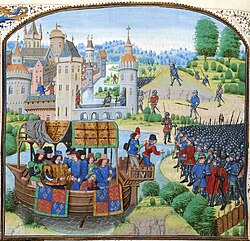
1483
% complete
The young King Edward V and his brother Richard were lodged in the Tower of London by their uncle, Richard III, and were never seen again. Their presumed murder became one of history's most enduring mysteries.
Image source: Princes in the Tower
47
% complete
Following the Roman conquest of Britain, the Romans established a settlement called Londinium on the north bank of the River Thames. The site's advantageous river crossing made it a natural hub for trade, and it rapidly grew into the principal city and commercial center of Roman Britain.
Image source: Londinium
60
% complete
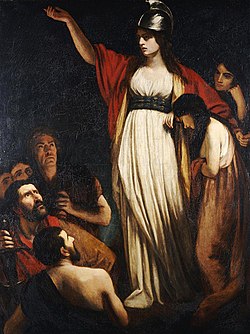
Queen Boudica of the Iceni tribe led a massive revolt against Roman rule, marching on Londinium and burning it to the ground. The city was utterly destroyed, but the Romans rebuilt it, fortifying it with walls and re-establishing it as a thriving provincial capital.
Image source: Boudica
1534
% complete
Henry VIII's Act of Supremacy severed ties with the Catholic Church, triggering sweeping religious changes across London. Monasteries were dissolved, including major religious houses within the city, transforming London's religious and physical landscape.
Image source: English Reformation
May 19, 1536
% complete
Anne Boleyn, Henry VIII's second wife, was executed by beheading on Tower Green after being convicted of treason on dubious charges. Her death shocked Europe and marked a dramatic episode in the Tudor dynasty's turbulent court politics.
Image source: Anne Boleyn
1576
% complete
James Burbage opened The Theatre in Shoreditch, London's first successful purpose-built playhouse. It paved the way for Elizabethan playgoing culture and the golden age of English drama associated with Shakespeare and the Globe Theatre.
Image source: Shoreditch
1599
% complete
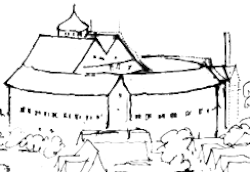
Shakespeare's company built the Globe Theatre on the south bank of the Thames, where many of his greatest plays premiered. The open-air playhouse became the iconic home of Elizabethan drama until it burned down in 1613.
Image source: Globe Theatre
Nov 5, 1605
% complete
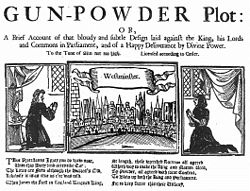
Guy Fawkes was caught guarding explosives beneath the House of Lords in a failed Catholic plot to blow up Parliament and kill King James I. The discovery is commemorated annually with bonfires and fireworks across Britain.
Image source: Gunpowder Plot
1665 - 1666
% complete
The last major epidemic of bubonic plague in England killed an estimated 100,000 Londoners, nearly a quarter of the city's population. Streets emptied, mass burial pits filled, and the city ground to a halt before the epidemic subsided in 1666.
Image source: Great Plague of London
Sep 2, 1666 - Sep 5, 1666
% complete
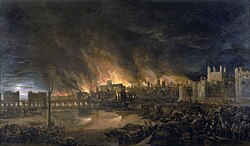
A fire beginning in a bakery on Pudding Lane raged for four days, destroying some 80 percent of the medieval City of London, including Old St Paul's Cathedral. Remarkably few died, and the disaster enabled the rebuilding of London in brick and stone.
Image source: Great Fire of London
1697 - 1710
% complete
Sir Christopher Wren's masterpiece replaced the cathedral destroyed in the Great Fire. Its dome became an enduring symbol of London, and Wren also rebuilt dozens of parish churches across the City in the decades after the fire.
Image source: St Paul's Cathedral
Jul 27, 1694
% complete
Established to fund England's war against France, the Bank of England became the cornerstone of British finance. Its headquarters in Threadneedle Street, 'the Old Lady of Threadneedle Street,' helped establish London as the world's leading financial centre.
Image source: Bank of England
1720 - 1751
% complete
Cheap gin flooded London's streets, leading to widespread drunkenness among the urban poor, famously satirized in Hogarth's 'Gin Lane.' A series of parliamentary acts eventually curbed consumption, illustrating early attempts at social regulation.
Image source: Gin Craze
1749
% complete
Henry Fielding established the Bow Street Runners, often regarded as London's first professional police force. Based at Bow Street Magistrates' Court, they laid groundwork for modern policing in Britain.
Image source: Bow Street Runners
Nov 18, 1750
% complete
Westminster Bridge became only the second bridge over the Thames in London, ending London Bridge's centuries-long monopoly. It spurred development south of the river, including growth of Lambeth and Southwark.
Image source: Westminster Bridge
Jun 2, 1780 - Jun 9, 1780
% complete
Anti-Catholic protests led by Lord George Gordon descended into a week of violent rioting, the most destructive in London's history. Prisons were stormed, Catholic chapels burned, and the army eventually restored order, killing hundreds.
Image source: Gordon Riots
Sep 29, 1829
% complete
Home Secretary Robert Peel founded the Metropolitan Police, creating London's first modern police force. Nicknamed 'bobbies' after Peel, officers patrolled the streets in distinctive blue uniforms, pioneering civilian policing worldwide.
Image source: Metropolitan Police
May 1, 1851 - Oct 15, 1851
% complete
Housed in Joseph Paxton's revolutionary glass-and-iron Crystal Palace in Hyde Park, the Great Exhibition showcased industrial achievements from around the world. It drew six million visitors and symbolized Victorian Britain's confidence and global reach.
Image source: Great Exhibition
Jan 10, 1863
% complete
The Metropolitan Railway opened the world's first underground passenger railway between Paddington and Farringdon. Steam locomotives carried crowds through gas-lit tunnels, revolutionizing urban transport and giving rise to the nickname 'the Tube.'
Image source: London Underground
Aug 31, 1888 - Nov 9, 1888
% complete
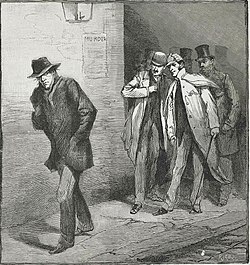
A series of brutal murders of women in London's impoverished East End gripped the nation and horrified the world. The killer was never identified, and the case drew attention to the dire living conditions in Whitechapel's slums.
Image source: Jack the Ripper
1889
% complete
The Local Government Act 1888 created the County of London, administered by the London County Council, the first elected body governing the whole metropolis. It marked a milestone in unifying governance of a sprawling city that had grown far beyond the old City boundaries.
Image source: County of London
1903 - 1914
% complete
Emmeline Pankhurst's suffragettes campaigned vigorously in London for women's voting rights, staging demonstrations, window-smashing raids, and hunger strikes. Their militant tactics kept women's suffrage at the forefront of national politics.
Image source: Women's Social and Political Union
May 31, 1915
% complete
Zeppelin airships launched the first aerial bombing raid on London during World War I, killing civilians and bringing the war to the capital's streets for the first time. Later Gotha bomber raids intensified the threat, foreshadowing future air warfare.
Image source: The Blitz
Oct 4, 1936
% complete
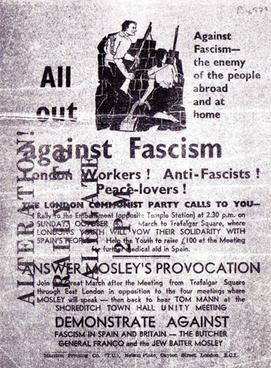
East End residents, Jewish groups, and trade unionists blocked Oswald Mosley's British Union of Fascists from marching through Stepney. Police attempting to clear the way clashed with protesters, who successfully turned back the march in a famous anti-fascist stand.
Image source: Battle of Cable Street
Sep 7, 1940 - May 11, 1941
% complete
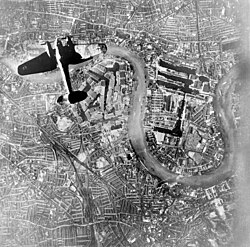
Nazi Germany began sustained bombing of London, attacking for 57 consecutive nights and killing tens of thousands of civilians. Londoners sheltered in Tube stations and cellars while the city endured the bombing with famed resilience, embodied in the phrase 'Keep Calm and Carry On.'
Image source: The Blitz
Jul 29, 1948 - Aug 14, 1948
% complete
London hosted the first post-war Olympic Games, staged amid rationing and austerity just three years after World War II ended. Known as the Austerity Games, they symbolized recovery and renewal without new venue construction.
Image source: 1948 Summer Olympics
Dec 5, 1952 - Dec 9, 1952
% complete
A lethal combination of cold weather and coal smoke produced a dense smog blanketing London for five days, killing thousands and sickening hundreds of thousands. The disaster prompted the Clean Air Act 1956 and transformed environmental policy.
Image source: Great Smog of London
1965 - 1969
% complete
London exploded as a center of music, fashion, and youth culture, driven by bands like the Beatles and Rolling Stones, designers like Mary Quant, and icons such as Twiggy. Carnaby Street and Chelsea became symbols of a vibrant, liberated era.
Image source: Swinging Sixties
Mar 8, 1973
% complete
The Provisional IRA began a campaign of bombings in London, targeting landmarks including the Old Bailey car bomb of 1973, Harrods in 1983, and Bishopsgate in 1993. Attacks continued until the peace process brought a ceasefire in the mid-1990s.
Image source: Provisional Irish Republican Army campaign
1982
% complete
After devastating floods struck London in 1928 and 1953, the Thames Barrier was constructed at Woolwich to protect the city from storm surges. One of the world's largest movable flood barriers, it remains vital to London's flood defenses.
Image source: Thames Barrier
Dec 31, 1999
% complete
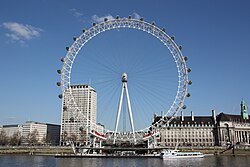
London celebrated the millennium with ambitious projects including the Millennium Dome in Greenwich and the giant observation wheel on the South Bank. The London Eye became one of the UK's most popular tourist attractions, marking the city's regeneration.
Image source: London Eye
Or browse the full history timeline directory, with more than 2,000 topics.
This History of London timeline was generated with the help of AI, using information found on the internet.
We work hard to keep these timelines accurate, but mistakes do get through. If you spot one, email us at [email protected] and we'll fix it for future visitors.
Generate yours with AI or build it from scratch, for free.
Export your timeline, add your own events, edit or remove AI-generated events, and much more
No credit card required.
Cancel anytime.
Cancel anytime.
You can create an unlimited number of timelines with up to 10 events on each one, customize how they look, export them to PDF, PNG, PowerPoint, CSV, and Excel, and share them with a link. Paid plans raise the event limit and add features like spreadsheet imports and collaborators.
Yes. You can cancel your subscription from your account page at any time, and you will not be charged again. Your subscription stays active for the rest of the period you already paid for.
Yes. We will email you a reminder before the annual renewal, and we will also email you a receipt.
Yes. You can email us within 15 days of any payment, and we will issue you a full refund.
Check out our pricing docs or send us an email anytime: [email protected].