-
Use Cases
-
Resources
-
Pricing
100
The great city of Teotihuacan rose in the Valley of Mexico, becoming one of the largest cities in the ancient world. Its massive pyramids of the Sun and Moon dominated Mesoamerica for centuries before its mysterious decline around 550 CE.
Image source: Teotihuacan
250 - 900
The Classic period of Maya civilization flourished in southern Mexico, with powerful city-states like Palenque, Calakmul, and Yaxchilan developing advanced writing, astronomy, mathematics, and monumental architecture.
Image source: Maya civilization
550
Teotihuacan declined and was largely abandoned, likely due to internal strife, resource depletion, and invasions. Its fall reshaped political power across Mesoamerica and paved the way for new powers like the Toltecs.
900 - 1150
The Toltecs built a powerful empire centered at Tula, influencing much of Mesoamerica with their military prowess and culture. Their legacy deeply shaped later Aztec mythology and claims of legitimacy.
Image source: Toltec
1325
The Mexica (Aztecs) founded their capital Tenochtitlan on an island in Lake Texcoco, guided by a prophecy involving an eagle perched on a cactus. The city grew into one of the largest and most sophisticated in the world.
Image source: Tenochtitlan
1428
Tenochtitlan, Texcoco, and Tlacopan formed the Aztec Triple Alliance, creating an empire that dominated central Mexico through conquest and tribute until the Spanish arrival nearly a century later.
Image source: Aztec Empire
Feb 1519 - Aug 13, 1521
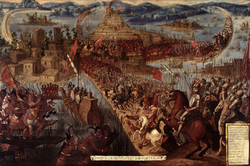
Hernán Cortés led Spanish forces and indigenous allies against the Aztec Empire. After sieges, alliances, and devastating smallpox epidemics, Tenochtitlan fell to the conquistadors, ending Aztec rule and beginning Spanish colonization.
Image source: Spanish conquest of the Aztec Empire
Aug 13, 1521
After a brutal siege lasting months, Cuauhtémoc surrendered to Cortés, marking the definitive end of the Aztec Empire and the symbolic beginning of New Spain on the ruins of the Aztec capital.
1531
According to tradition, the Virgin Mary appeared to Juan Diego on Tepeyac Hill, becoming Our Lady of Guadalupe. Her veneration fused indigenous and Catholic traditions and became central to Mexican national identity.
Image source: Our Lady of Guadalupe
Apr 16, 1531
Puebla was founded as a planned Spanish settlement intended to support trade between Mexico City and Veracruz. It grew into a major colonial center renowned for its architecture, ceramics, and cuisine.
Image source: Puebla (city)
1535
Spain formally established the Viceroyalty of New Spain with Antonio de Mendoza as its first viceroy, organizing colonial administration that would govern Mexico for nearly three centuries.
Image source: New Spain
1546
The discovery of rich silver deposits at Zacatecas launched one of colonial Mexico's most important mining centers, fueling the Spanish Empire's economy and driving northward expansion of New Spain.
Image source: Zacatecas
1550 - 1590
A prolonged conflict between Spanish colonists and nomadic Chichimeca peoples in northern New Spain, ended partly through 'peace by purchase,' which involved providing goods to indigenous groups rather than continued warfare.
Image source: Chichimeca War
1565 - 1815
The Manila Galleon linked Acapulco with the Philippines, creating a lucrative trans-Pacific trade route that brought Asian goods, silver flows, and cultural exchange to New Spain for 250 years.
Image source: Manila galleon
1573 - 1813
Built atop the ruins of the Templo Mayor, the Mexico City Metropolitan Cathedral became the centerpiece of colonial religious life, taking 240 years to complete and blending Gothic, Baroque, and Neoclassical styles.
Image source: Mexico City Metropolitan Cathedral
Jun 8, 1692
Food shortages and grain speculation sparked a major riot in Mexico City, during which crowds burned the viceregal palace, exposing deep social tensions within colonial society.
Image source: Mexico City Riot of 1692
Apr 17, 1695
The death of Sor Juana, the brilliant nun, poet, and scholar known as the 'Tenth Muse,' marked the loss of colonial Mexico's greatest intellectual figure and a pioneering voice for women's education.
Image source: Juana Inés de la Cruz
Sep 16, 1810
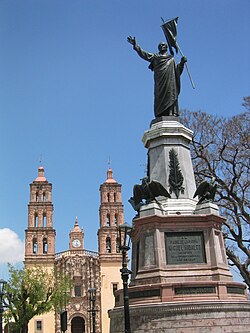
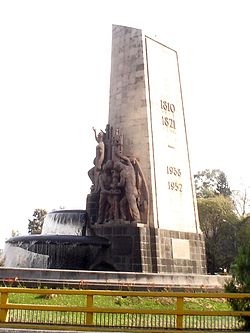
Father Miguel Hidalgo y Costilla issued his famous cry for independence in the town of Dolores, igniting an eleven-year war against Spanish rule that would ultimately create the nation of Mexico.
Image source: Cry of Dolores
Jul 31, 1811
After early rebel victories, Hidalgo was captured and executed by Spanish authorities in Chihuahua, but he became a martyr whose memory inspired the continuing independence struggle.
Image source: Miguel Hidalgo y Costilla
Feb 24, 1821
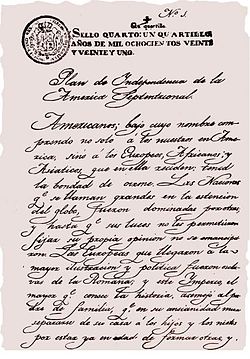
Agustín de Iturbide and Vicente Guerrero issued the Plan of Iguala, proposing the Three Guarantees—religion, independence, and unity—which united royalist and insurgent forces behind independence.
Image source: Plan of Iguala
Aug 24, 1821
Spanish Viceroy Juan O'Donojú signed the Treaty of Córdoba, formally recognizing Mexico's independence and ending three centuries of Spanish colonial rule.
Image source: Treaty of Córdoba
May 19, 1822 - Mar 19, 1823
Iturbide was crowned Emperor Agustín I of Mexico, but his empire collapsed within a year amid financial crisis and opposition, leading to his abdication and exile.
Image source: First Mexican Empire
Oct 4, 1824
Mexico adopted its first constitution as an independent nation, establishing a federal republic with states, a bicameral congress, and a president, modeled partly on the United States system.
Image source: 1824 Constitution of Mexico
Oct 2, 1835 - Apr 21, 1836
American settlers in Texas revolted against Mexican rule, declaring the Republic of Texas after victories including San Jacinto. The loss foreshadowed further territorial conflicts with the United States.
Image source: Texas Revolution
Nov 1838 - Mar 9, 1839
France blockaded Veracruz demanding compensation for damages to French citizens, including a pastry chef's shop. Mexico's defeat forced payment and briefly boosted Santa Anna's political standing.
Image source: Pastry War
Apr 25, 1846 - Feb 2, 1848
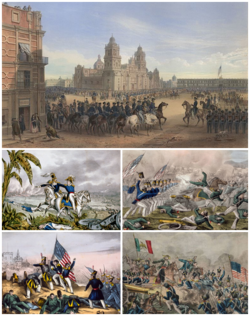
War between Mexico and the United States resulted in decisive American victories, including the capture of Mexico City, and the Treaty of Guadalupe Hidalgo ceded over half of Mexico's territory, including California and the Southwest.
Image source: Mexican–American War
1855 - 1861
Liberal reformers led by Benito Juárez enacted sweeping changes limiting Church power, separating church and state, and promoting civil rights, provoking fierce conservative resistance and civil war.
Image source: La Reforma
Dec 1861 - Jun 19, 1867
France invaded Mexico and installed Maximilian I as emperor. Republican forces under Benito Juárez resisted, and Maximilian was captured and executed in 1867, restoring the republic.
Image source: Second French intervention in Mexico
May 5, 1862
Mexican forces under General Ignacio Zaragoza defeated the French army at Puebla, an unlikely victory celebrated annually as Cinco de Mayo, symbolizing Mexican resistance to foreign intervention.
Image source: Battle of Puebla
1876 - 1911
Porfirio Díaz ruled Mexico for over three decades, modernizing infrastructure and attracting foreign investment while suppressing dissent, creating prosperity for elites alongside deep inequality that fueled revolution.
Image source: Porfirio Díaz
Nov 20, 1910 - 1920
Francisco Madero called for revolt against Díaz, sparking a decade-long revolution involving figures like Pancho Villa and Emiliano Zapata that transformed Mexican politics and society.
Image source: Mexican Revolution
Feb 5, 1917
Revolutionary leaders drafted a progressive constitution guaranteeing land reform, labor rights, secular education, and national control over natural resources; it remains Mexico's governing document today.
Image source: Constitution of Mexico
1926 - 1929
Catholic rebels rose up against anticlerical policies of the post-revolutionary government, resulting in a bloody conflict resolved through negotiated peace brokered with U.S. mediation.
Image source: Cristero War
Mar 18, 1938
President Cárdenas nationalized foreign oil companies, creating PEMEX, a landmark assertion of economic sovereignty celebrated annually in Mexico.
Image source: Mexican oil expropriation
May 22, 1942
After German submarines sank Mexican tankers, Mexico declared war on the Axis powers and sent the Escuadrón 201 fighter squadron to serve in the Pacific, strengthening ties with the United States.
Image source: Mexico during World War II
Oct 2, 1968
Government forces opened fire on student protesters in Mexico City's Plaza de las Tres Culturas days before the Olympics, killing hundreds and marking a dark chapter of authoritarian rule.
Image source: Tlatelolco massacre
Sep 19, 1985
A magnitude 8.0 earthquake devastated Mexico City, killing thousands and exposing government inefficiency, spurring grassroots civic organization that influenced democratization.
Image source: 1985 Mexico City earthquake
Jan 1, 1994
The North American Free Trade Agreement among Mexico, the United States, and Canada transformed Mexico's economy, boosting exports while sparking debates over inequality and rural displacement.
Image source: North American Free Trade Agreement
Jan 1, 1994
The Zapatista Army of National Liberation seized towns in Chiapas on NAFTA's launch day, drawing global attention to indigenous rights and poverty and reshaping Mexican politics.
Image source: Zapatista Army of National Liberation
Jul 2, 2000
Vicente Fox of the PAN defeated the long-ruling Institutional Revolutionary Party, marking a historic democratic transition after seven decades of single-party dominance.
Image source: 2000 Mexican general election
Or browse the full history timeline directory, with more than 2,500 topics.
This History of Mexico timeline was generated with the help of AI, using information found on the internet.
We work hard to keep these timelines accurate, but mistakes do get through. If you spot one, email us at [email protected] and we'll fix it for future visitors.
Generate yours with AI or build it from scratch, for free.
Export your timeline, add your own events, edit or remove AI-generated events, and much more
No credit card required.
Cancel anytime.
Cancel anytime.
You can create an unlimited number of timelines with up to 10 events on each one, customize how they look, export them to PDF, PNG, PowerPoint, CSV, and Excel, and share them with a link. Paid plans raise the event limit and add features like spreadsheet imports and collaborators.
Yes. You can cancel your subscription from your account page at any time, and you will not be charged again. Your subscription stays active for the rest of the period you already paid for.
Yes. We will email you a reminder before the annual renewal, and we will also email you a receipt.
Yes. You can email us within 15 days of any payment, and we will issue you a full refund.
Check out our pricing docs or send us an email anytime: [email protected].