-
Use Cases
-
Resources
-
Pricing
The History of North Macedonia spans thousands of years, encompassing ancient Macedonian kingdoms, Roman and Byzantine rule, Slavic settlement, five centuries under the Ottoman Empire, Yugoslav federation membership, and its peaceful independence in 1991. The modern nation emerged from the breakup of Yugoslavia and resolved a decades-long naming dispute with Greece in 2019, adopting the name North Macedonia. More Less
550 - 600
% complete
South Slavic tribes settled in the territory of present-day North Macedonia in the 6th century AD, gradually establishing themselves in the region.
Image source: Slavs
687 - 695
% complete
In the late 7th century Justinian II organized massive expeditions against the Sklaviniai of the Greek peninsula, reportedly capturing over 110,000 Slavs and transferring them to Cappadocia.
Image source: Justinian II
976 - 1018
% complete
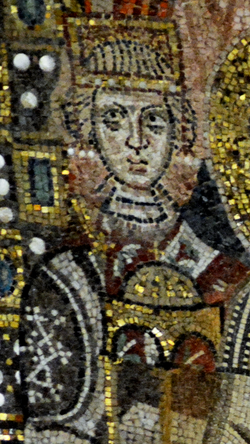
At the end of the 10th century, much of what is now North Macedonia became the political and cultural center of the First Bulgarian Empire under Tsar Samuel, while Byzantine emperor Basil II ruled the eastern part including Preslav from 972.
Image source: Samuel of Bulgaria
1018
% complete
After several decades of almost incessant fighting, Bulgaria came under Byzantine rule in 1018.
Image source: Byzantine conquest of Bulgaria
1100 - 1400
% complete
During the period in the 12th, 13th and early 14th century, parts of modern western North Macedonia were under the rule of the Albanian noble Gropa family, which ruled territories between Ohrid and Debar.
Image source: Gropa family
1197
% complete
Dobromir Chrysos rebelled against the emperor; after an unsuccessful imperial campaign in autumn 1197, the emperor sued for peace and recognized his rights to lands between the Strymon and Vardar, including Strumica and the fortress of Prosek.
Image source: Dobromir Chrysos
1200 - 1400
% complete
In the 13th and 14th centuries, Byzantine control was punctuated by periods of Bulgarian and Serbian rule over the region.
1257 - 1277
% complete
Konstantin Asen, a former nobleman from Skopje, ruled as tsar of Bulgaria from 1257 to 1277.
Image source: Constantine I Tih
1380 - 1450
% complete
The city of Debar and some other territories, after the ending of Gropa family rule, were ruled by the Albanian Royal House of Kastrioti during the end of the 14th century and the first half of the 15th century.
Image source: Principality of Kastrioti
1371 - 1912
% complete
Conquered by the Ottoman army at the end of the 14th century, the region remained part of the Ottoman Empire for over 500 years as part of the province or Eyalet of Rumelia.
Image source: Rumelia Eyalet
1437 - 1468
% complete
After the death of Prince Gjon Kastrioti in 1437, many parts of his domains were conquered by the Ottoman Empire, but during the 15th century they were restored to Albanian rule under the League of Lezhë led by Gjergj Kastrioti Skanderbeg.
Image source: League of Lezhë
1465
% complete
In the second half of the 15th century, Skanderbeg occupied places in modern western North Macedonia under Ottoman rule, including the well-known city of Ohrid, in the Battle of Ohrid.
Image source: Battle of Ohrid
Jan 17, 1468
% complete
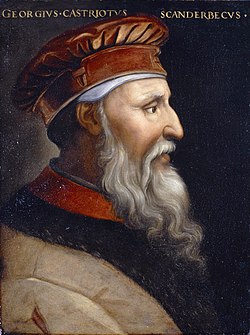
With the death of Skanderbeg on 17 January 1468, the Albanian resistance began to fall. The league was led afterward by Lekë Dukagjini, but the last Albanian strongholds were conquered in 1479 with the Siege of Shkodër.
Image source: Skanderbeg
1500 - 1860
% complete
Over the centuries the Rumelia Eyalet was reduced through administrative reforms until by the nineteenth century it consisted of central Albania and the north-western part of present-day North Macedonia, with its capital at Manastir (present-day Bitola).
1762 - 1878
% complete
During the Bulgarian National Revival (1762–1878), many Bulgarians from Vardar Macedonia supported the creation of Bulgarian cultural, educational and religious institutions, including the Bulgarian Exarchate.
Image source: Bulgarian National Revival
1867
% complete
Rumelia Eyalet was abolished in 1867, and the territory subsequently became part of the provinces of Manastir Vilayet, Kosovo Vilayet and Salonica Vilayet until the end of Ottoman rule in 1912.
Image source: Manastir vilayet
1878
% complete
The valley of the river Vardar was ruled by the Ottoman Empire prior to the First Balkan War of 1912, with the exception of a brief period in 1878 when it was liberated after the Russo-Turkish War and became part of Bulgaria.
Image source: Russo-Turkish War (1877–1878)
1893 - 1908
% complete
The Macedonian Struggle (1893–1908), a conflict over the region among various nationalist groups, remained inconclusive.
Image source: Macedonian Struggle
Oct 1912 - 1913
% complete
The region was captured by the Kingdom of Serbia during the First Balkan War of 1912 and annexed to Serbia under the Karađorđević dynasty in post-war peace treaties, except Strumica, part of Bulgaria between 1912 and 1919.
Image source: First Balkan War
1915 - 1918
% complete
The region was occupied by the Kingdom of Bulgaria between 1915 and 1918 during World War I.
Image source: Bulgarian occupation of Serbia (World War I)
1918
% complete
After World War I (1914–1918) the Slavs in Serbian Macedonia ('Vardar Macedonia') were regarded as southern Serbs and the language they spoke a southern Serbian dialect.
Image source: Vardar Macedonia
May 6, 1924
% complete
On May 6, 1924 the May Manifesto was signed by the Balkan Communist Federation, calling for an independent and unified Macedonia.
Image source: May Manifesto
Jan 6, 1929
% complete
King Alexander I Karađorđević committed a coup d'état, abolished the Vidovdan Constitution, and renamed the Kingdom of Serbs, Croats and Slovenes to the Kingdom of Yugoslavia.
Image source: 6 January Dictatorship
Oct 9, 1934
% complete
After growing popular resentment against his autocratic rule, King Alexander I was assassinated in France in 1934 by the Internal Macedonian Revolutionary Organization (IMRO).
Image source: Alexander I of Yugoslavia
Apr 1941 - 1944
% complete
During World War II, the Vardar Banovina was occupied between 1941 and 1944 by Italian-ruled Albania, which annexed the western regions, and pro-German Bulgaria, which occupied the remainder.
Image source: Vardar Banovina
1943
% complete
The resistance began to grow in the summer of 1943 with the capitulation of Italy and the Soviet victories over Nazi Germany.
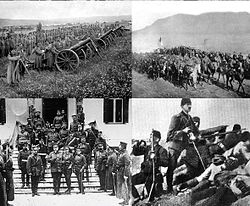
Image source: National Liberation Army (Macedonia)
Aug 18, 1943
% complete
The Mirče Acev Battalion, formed on August 18, 1943 on Mount Slavej between Ohrid and Kičevo, is officially celebrated today in North Macedonia as the Day of the Army of the Republic of North Macedonia.
Image source: Mirče Acev
Nov 1943
% complete
In November 1943, the second session of AVNOJ recognized the Macedonians as a separate nation for the first time.
Image source: Anti-Fascist Council for the National Liberation of Yugoslavia
Nov 11, 1943 - Feb 26, 1944
% complete
The 1st Macedonian Kosovo Shock Brigade was formed on 11 November 1943, the 2nd Macedonian Shock Brigade on 22 December 1943, and the 3rd Macedonian Shock Brigade on 26 February 1944 near Kumanovo.
1944 - Apr 1945
% complete
From 8,000 partisans in summer 1944 until final operations in April 1945, the National Liberation Army of Macedonia grew to three corps, seven divisions and thirty brigades, totaling 100,000 regular soldiers.
1944 - 1946
% complete
When the former Vardar province was established in 1944, most of its territory became a separate republic while northernmost parts remained with Serbia. In 1946 it gained federal status as the 'People's Republic of Macedonia' within SFR Yugoslavia.
Image source: Socialist Republic of Macedonia
1944
% complete
The Macedonian language was codified in 1944 from the Slavic dialect spoken around Veles.
Image source: Macedonian language
1963
% complete
In the 1963 Constitution of Yugoslavia the republic was slightly renamed to bring it in line with other Yugoslav republics, becoming the Socialist Republic of Macedonia.
1963
% complete
Following the earthquake, a major urban and architectural reconstruction plan — the urban master-plan of Skopje 1963, designed with international assistance — was implemented.
Image source: Skopje 2014
Jul 26, 1963
% complete
A 6.1 magnitude earthquake struck Skopje on July 26, 1963, killing over 1,070 people, injuring 3,000–4,000, and leaving more than 200,000 homeless.
Image source: 1963 Skopje earthquake
1990
% complete
In 1990, the form of government peacefully changed from socialist state to parliamentary democracy.
Image source: North Macedonia
Nov 11, 1990 - Dec 9, 1990
% complete
The first multi-party elections in the Socialist Republic of Macedonia were held on 11 and 25 November and 9 December 1990.
Image source: 1994 Macedonian general election
Jan 31, 1991
% complete
After the collective presidency led by Vladimir Mitkov was dissolved, Kiro Gligorov became the first democratically elected president of the Republic of Macedonia on 31 January 1991.
Image source: Kiro Gligorov
Jun 7, 1991
% complete
On 16 April 1991 parliament adopted an amendment removing 'Socialist' from the official name, and on 7 June the new name 'Republic of Macedonia' was officially established.
Sep 8, 1991
% complete
On 8 September 1991, the country held an independence referendum where 95.26% voted for independence from Yugoslavia, under the name Republic of Macedonia. The Declaration of Independence was formally adopted on 25 September 1991.
Image source: 1991 Macedonian independence referendum
Nov 17, 1991
% complete
A new Constitution of the Republic of Macedonia was adopted on 17 November 1991. Discontent over lack of recognition of Albanian collective rights led Nevzat Halili to declare a Republic of Ilirida in 1992 and again in 2014.
Apr 8, 1993
% complete
To compromise amid the naming dispute with Greece, the country was admitted to the United Nations on 8 April 1993 under the provisional name 'the former Yugoslav Republic of Macedonia'.
Image source: United Nations Security Council Resolution 817
Feb 1994 - Sep 1995
% complete
Greece imposed a trade blockade in February 1994. Sanctions were lifted in September 1995 after Macedonia changed its flag and aspects of its constitution perceived as granting intervention rights in other countries.
Image source: Macedonia naming dispute
1999
% complete
In 1999, the Kosovo War led to 340,000 Albanian refugees from Kosovo fleeing into the Republic of Macedonia, disrupting normal life and threatening the balance between Macedonians and Albanians.
Image source: Kosovo War
2001 - Aug 2001
% complete
In spring 2001, ethnic Albanian insurgents calling themselves the National Liberation Army took up arms in the north and northwest. In August 2001, 3,500 NATO soldiers conducted Operation Essential Harvest to retrieve weapons under the Ohrid Agreement.
Image source: 2001 insurgency in Macedonia
Feb 26, 2004
% complete
President Boris Trajkovski died in a plane crash near Mostar, Bosnia and Herzegovina, on 26 February 2004.
Image source: Boris Trajkovski
Mar 2004 - Dec 17, 2005
% complete
In March 2004 the country applied for EU membership, and on 17 December 2005 was listed as an accession candidate. Proceedings were delayed by Greece and later by Bulgaria over historical disputes.
Image source: Accession of North Macedonia to the European Union
May 9, 2015 - May 10, 2015
% complete
Shootouts erupted on 9–10 May 2015 during a raid between Macedonian police and an armed group identifying itself as the National Liberation Army; 30 militants were arrested and charged with terrorism.
Image source: 2015 Kumanovo clashes
Jun 2017
% complete
In June 2017, Zoran Zaev of the Social Democratic Union of Macedonia became Prime Minister six months after early elections.
Image source: Zoran Zaev
Jun 2018 - Feb 12, 2019
% complete
In June 2018, Greece and Macedonia agreed to rename the latter Republic of North Macedonia. The agreement came into effect on 12 February 2019, ending the naming dispute.
Image source: Prespa Agreement
May 2019
% complete
Stevo Pendarovski of SDSM was sworn in as North Macedonia's new president in May 2019.
Image source: Stevo Pendarovski
Jul 15, 2020
% complete
Early parliamentary elections took place on 15 July 2020.
Image source: 2020 North Macedonian parliamentary election
Dec 2020 - 2022
% complete
Bulgaria effectively blocked accession negotiations in December 2020, citing disputes over history and language. A French proposal agreed in 2022 required constitutional changes that SDSM couldn't secure with a two-thirds majority.
Oct 2021 - Jan 16, 2022
% complete
Zoran Zaev announced his resignation after party losses in October 2021 local elections. Dimitar Kovačevski succeeded him as SDSM leader on 12 December 2021 and was sworn in as Prime Minister on 16 January 2022.
Image source: Dimitar Kovačevski
2024
% complete
In the 2024 elections, unrest over failed EU accession led to victory for conservative VMRO-DPMNE, with new Prime Minister Hristijan Mickoski refusing to appease the French proposal or Bulgarian demands until ethnic Macedonians in Bulgaria gain equal minority representation.
Image source: Hristijan Mickoski
Or browse the full history timeline directory, with more than 2,000 topics.
This History of North Macedonia timeline was generated with the help of AI, using information found on the internet.
We work hard to keep these timelines accurate, but mistakes do get through. If you spot one, email us at [email protected] and we'll fix it for future visitors.
Generate yours with AI or build it from scratch, for free.
Export your timeline, add your own events, edit or remove AI-generated events, and much more
No credit card required.
Cancel anytime.
Cancel anytime.
You can create an unlimited number of timelines with up to 10 events on each one, customize how they look, export them to PDF, PNG, PowerPoint, CSV, and Excel, and share them with a link. Paid plans raise the event limit and add features like spreadsheet imports and collaborators.
Yes. You can cancel your subscription from your account page at any time, and you will not be charged again. Your subscription stays active for the rest of the period you already paid for.
Yes. We will email you a reminder before the annual renewal, and we will also email you a receipt.
Yes. You can email us within 15 days of any payment, and we will issue you a full refund.
Check out our pricing docs or send us an email anytime: [email protected].