-
Use Cases
-
Resources
-
Pricing
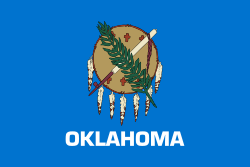
The history of Oklahoma traces thousands of years of Native American habitation, followed by its designation as Indian Territory, the forced relocation of tribes along the Trail of Tears, rapid settlement during land runs, oil boom prosperity, and eventual statehood as the 46th U.S. state. More Less
1541
% complete
Spanish explorer Francisco Vázquez de Coronado led an expedition north from Mexico in search of the fabled Seven Cities of Gold. His route carried him across the Oklahoma panhandle, making him one of the first Europeans to set foot in the region that would later become Oklahoma.
Image source: Francisco Vázquez de Coronado
May 28, 1830
% complete
Signed into law by President Andrew Jackson, the Indian Removal Act authorized the federal government to negotiate treaties exchanging Native American lands east of the Mississippi River for lands west of the river, in what was then called Indian Territory — much of which is now Oklahoma.
Image source: Indian Removal Act
1831 - 1833
% complete
The Choctaw became the first of the Five Civilized Tribes to sign a removal treaty and relocate westward. Thousands of Choctaw people endured disease, starvation, and exposure during the journey to Indian Territory, with many dying along the way.
Image source: Choctaw Trail of Tears
1836 - 1842
% complete
The Muscogee (Creek) and Seminole nations were removed from their southeastern homelands to Indian Territory. The Seminoles resisted fiercely during the Second Seminole War before many were ultimately relocated, joining the Chickasaw and Choctaw as settled tribes in the region.
Image source: Muscogee
1838 - 1839
% complete
Following the Treaty of New Echota, approximately 16,000 Cherokees were forcibly removed from their homelands in the southeastern United States. Roughly 4,000 died during the grueling march west to Indian Territory in present-day northeastern Oklahoma.
Image source: Trail of Tears
1839 - 1856
% complete
After removal, the Cherokee, Choctaw, Chickasaw, Creek, and Seminole nations rebuilt their societies in Indian Territory, establishing constitutional governments, schools, courts, and thriving agricultural communities throughout the eastern half of present-day Oklahoma.
Image source: Five Civilized Tribes
Oct 21, 1867
% complete
The United States signed treaties at Medicine Lodge, Kansas, with the Kiowa, Comanche, Apache, Cheyenne, and Arapaho nations, assigning them reservation lands in the southern plains of what is now western Oklahoma and marking a major shift in federal Indian policy.
Image source: Medicine Lodge Treaty
1874 - 1875
% complete
The U.S. Army launched a series of campaigns against the Comanche, Kiowa, Cheyenne, and Arapaho to force them onto reservations in Indian Territory. The war ended traditional nomadic life on the southern plains and confined the tribes to lands in western Oklahoma.
Image source: Red River War
Jul 9, 2020
% complete
In McGirt v. Oklahoma, the U.S. Supreme Court ruled that the Muscogee (Creek) Nation's reservation was never disestablished, affirming that much of eastern Oklahoma lies within tribal reservation boundaries for purposes of federal criminal jurisdiction — a landmark victory for tribal sovereignty.
Image source: McGirt v. Oklahoma
Apr 30, 1803
% complete
The United States purchased the Louisiana Territory from France, bringing most of present-day Oklahoma under American sovereignty. The acquisition opened the region for American exploration and eventually for the relocation of eastern Native American tribes.
Image source: Louisiana Purchase
1804 - 1806
% complete
Following the Louisiana Purchase, the Lewis and Clark Expedition charted the northern portions of the new territory. Their journey inspired subsequent explorers, including those who mapped the Red, Arkansas, and Canadian rivers flowing through present-day Oklahoma.
Image source: Lewis and Clark Expedition
1861 - 1865
% complete
During the American Civil War, the Five Civilized Tribes were forced to choose sides, with many signing treaties with the Confederacy. Battles such as Honey Springs and Cabin Creek were fought on Oklahoma soil, and the war devastated tribal communities and economies.
Image source: Indian Territory in the American Civil War
Jan 8, 1869
% complete
Established during the Indian Wars in southwestern Indian Territory, Fort Sill became a key military post. It later housed Apache leader Geronimo as a prisoner and remains an active Army installation famous for its field artillery school.
Image source: Fort Sill
May 2, 1890
% complete
Congress passed the Organic Act, formally creating Oklahoma Territory out of the western lands not assigned to the Five Civilized Tribes. Guthrie served as the territorial capital, and the act laid the groundwork for future statehood.
Image source: Oklahoma Territory
1898 - 1907
% complete
The Dawes Commission compiled rolls of citizens of the Cherokee, Choctaw, Chickasaw, Creek, and Seminole nations to allocate individual land allotments. The resulting Dawes Rolls remain crucial documents for tribal citizenship today.
Image source: Dawes Rolls
Jun 28, 1898
% complete
The Curtis Act extended the Dawes Act to the Five Civilized Tribes, abolishing tribal courts and mandating allotment of communal lands. This dismantled much of the tribes' sovereign infrastructure and paved the way for single statehood.
Image source: Curtis Act of 1898
Nov 16, 1907
% complete
Oklahoma Territory and Indian Territory were combined and admitted to the Union as the state of Oklahoma. Charles N. Haskell was inaugurated as the first governor, and Guthrie served briefly as the capital before it moved to Oklahoma City in 1910.
Image source: Oklahoma
Apr 22, 1889
% complete
At high noon on April 22, 1889, thousands of settlers rushed into the Unassigned Lands of central Indian Territory to claim homesteads. Cities such as Oklahoma City and Guthrie sprang up almost overnight, with populations of thousands within hours.
Image source: Land Rush of 1889
Apr 19, 1892
% complete
The Cheyenne-Arapaho Reservation was opened to non-Native settlement via land run, adding over three million acres to Oklahoma Territory and creating new towns including Enid and Weatherford.
Image source: Land run
Sep 16, 1893
% complete
The largest land run in history opened the Cherokee Outlet to settlement. More than 100,000 participants raced to claim roughly seven million acres, founding cities such as Ponca City, Enid, and Woodward.
Image source: Land Run of 1893
Aug 6, 1901
% complete
Surplus lands of the Kiowa, Comanche, and Apache reservation in southwest Oklahoma were opened to settlement through a lottery rather than a run, reflecting changing methods of distributing tribal lands after allotment policies took hold.
Image source: Comanche
Nov 22, 1905
% complete
The discovery of the Glen Pool field near Tulsa triggered an enormous oil boom that made Oklahoma one of the world's leading petroleum producers and transformed Tulsa into the 'Oil Capital of the World.'
Image source: Glenn Pool Oil Reserve
Aug 3, 1917
% complete
Tenant farmers and socialists in southeastern Oklahoma rose up in opposition to World War I conscription. The brief but notable uprising reflected deep agrarian discontent and was quickly suppressed by authorities.
Image source: Green Corn Rebellion
Jun 1, 1921
% complete
A white mob attacked the prosperous Black neighborhood of Greenwood in Tulsa, known as 'Black Wall Street.' Hundreds were killed, thousands left homeless, and thirty-five blocks were destroyed, making it one of the worst incidents of racial violence in American history.
Image source: Tulsa race massacre
1930 - 1936
% complete
Severe drought and poor farming practices turned Oklahoma's panhandle into the epicenter of the Dust Bowl. Massive dust storms destroyed crops and livelihoods, driving hundreds of thousands of 'Okies' to migrate west, many to California.
Image source: Dust Bowl
Aug 15, 1935
% complete
Cherokee humorist, actor, and social commentator Will Rogers, Oklahoma's most beloved celebrity, died in an aviation accident in Alaska. His wit and folksy wisdom had made him one of the most famous Americans of his era.
Image source: Will Rogers
1940
% complete
The Pensacola Dam on the Grand River, completed in 1940 as part of Depression-era public works, provided hydroelectric power and helped modernize rural northeastern Oklahoma while creating Grand Lake o' the Cherokees.
Image source: Pensacola Dam
1941 - 1945
% complete
Hundreds of thousands of Oklahomans served in World War II, and the state hosted major training bases and airfields. Wartime demand for oil and agriculture pulled Oklahoma's economy out of the Great Depression.
Image source: World War II casualties
1971
% complete
The completion of the McClellan-Kerr Arkansas River Navigation System made Tulsa's Port of Catoosa the most inland ice-free port in the United States, linking Oklahoma commerce directly to international markets via the Mississippi River.
Image source: McClellan–Kerr Arkansas River Navigation System
Apr 19, 1995
% complete
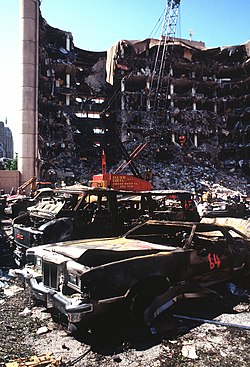
A domestic terrorist truck bomb destroyed the Alfred P. Murrah Federal Building in downtown Oklahoma City, killing 168 people and injuring hundreds more. It remained the deadliest terrorist attack on U.S. soil until September 11, 2001, and spurred sweeping changes in federal building security.
Image source: Oklahoma City bombing
Or browse the full history timeline directory, with more than 2,000 topics.
This History of Oklahoma timeline was generated with the help of AI, using information found on the internet.
We work hard to keep these timelines accurate, but mistakes do get through. If you spot one, email us at [email protected] and we'll fix it for future visitors.
Generate yours with AI or build it from scratch, for free.
Export your timeline, add your own events, edit or remove AI-generated events, and much more
No credit card required.
Cancel anytime.
Cancel anytime.
You can create an unlimited number of timelines with up to 10 events on each one, customize how they look, export them to PDF, PNG, PowerPoint, CSV, and Excel, and share them with a link. Paid plans raise the event limit and add features like spreadsheet imports and collaborators.
Yes. You can cancel your subscription from your account page at any time, and you will not be charged again. Your subscription stays active for the rest of the period you already paid for.
Yes. We will email you a reminder before the annual renewal, and we will also email you a receipt.
Yes. You can email us within 15 days of any payment, and we will issue you a full refund.
Check out our pricing docs or send us an email anytime: [email protected].