-
Use Cases
-
Resources
-
Pricing
Oregon's history spans thousands of years of Indigenous habitation before European exploration, the fur trade era, the Oregon Trail migration of the 1840s, and its path to becoming the 33rd U.S. state in 1859. The state grew through timber, agriculture, fishing, and later technology, shaping a unique Pacific Northwest identity. More Less
5677 BC
% complete
Mount Mazama, once the tallest mountain in the region at 11,000 feet, suffered a massive volcanic eruption approximately 5677 B.C. The eruption was estimated to have been 42 times more powerful than the 1980 eruption of Mount St. Helens.
Image source: Mount Mazama
1500
% complete
By the 16th century, Oregon was home to many Native American groups, including the Bannock, Chasta, Chinook, Kalapuya, Klamath, Molalla, Nez Perce, Takelma, and Umpqua peoples.
Image source: Indigenous peoples of the Northwest Plateau
Jan 26, 1700
% complete
The 1700 Cascadia earthquake resulted from a rupture at the Cascadia subduction zone along the coast of the Pacific Northwest, producing one of the largest seismic events known in the region's history.
Image source: 1700 Cascadia earthquake
1543
% complete
The Spanish exploration team led by Juan Rodríguez Cabrillo sighted southern Oregon off the Pacific coast in 1543, marking the first European sighting of the Oregon coastline.
Image source: Juan Rodríguez Cabrillo
1565
% complete
Spanish explorers found a way to explore the Pacific coast as early as 1565, sending vessels northeast from the Philippines and riding the Kuroshio Current in a sweeping circular route across the northern part of the Pacific.
Image source: Manila galleon
1592
% complete
In 1592, Juan de Fuca undertook detailed mapping and studies of ocean currents along the Pacific coast of North America.
Image source: Juan de Fuca
1707
% complete
Nehalem Indian tales recount strangers and the discovery of items like chunks of beeswax and a lidded silver vase, likely connected to the 1707 wreck of the San Francisco Xavier on the Oregon coast.
Image source: Beeswax wreck
1774
% complete
Exploration was retaken routinely in 1774, starting with the expedition of frigate Santiago by Juan José Pérez Hernández. Juan Pérez explored the coast of the Pacific Northwest north to British Columbia.
Image source: Spanish expeditions to the Pacific Northwest
1775
% complete
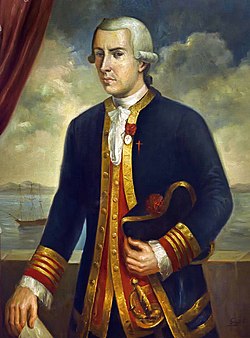
In 1775 another Spanish expedition, under Juan Francisco de la Bodega y Quadra and Bruno de Heceta, explored the Pacific Northwest coastline.
Image source: Bruno de Heceta
1778
% complete
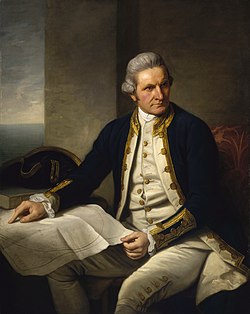
British explorer James Cook explored the Oregon Coast in 1778 in search of the Northwest Passage, extending European exploration of the region.
Image source: James Cook
1788 - 1792
% complete
American sea captain Robert Gray entered Tillamook Bay in 1788 and later explored the mouth of the Columbia River in 1792, advancing American claims to the region.
Image source: Robert Gray (sea captain)
1805 - 1806
% complete
Exploration by Lewis and Clark (1805–1806) and later the United Kingdom's David Thompson, who extensively explored the Columbia River from 1807 to 1811, publicized the abundance of fur-bearing animals in the area.
Image source: Lewis and Clark Expedition
1810 - 1812
% complete
The Astor Expedition of 1810–1812, financed by American businessman John Jacob Astor, brought fur traders to the future site of Astoria by both land and sea.
Image source: John Jacob Astor
Oct 1813
% complete
At risk of being captured by the British during the War of 1812, Fort Astoria and all other Pacific Fur Company assets in the Oregon Country were sold to the Montreal-based North West Company in October 1813.
Image source: Fort Astoria
1818
% complete
Following the Anglo American Treaty of 1818, the Oregon Country was 'jointly occupied' by the United States and Great Britain, setting the stage for decades of shared control.
Image source: Treaty of 1818
1821
% complete
The North West Company dominated the region unchallenged from its 1813 acquisition of the Pacific Fur Company until 1821, when it was absorbed into the Hudson's Bay Company.
Image source: North West Company
1825
% complete
The Hudson's Bay Company expanded the system and during the 1820s and 1830s dominated the Pacific Northwest from its Columbia District headquarters at Fort Vancouver, built in 1825 by Chief Factor John McLoughlin across the Columbia from present-day Portland.
Image source: Fort Vancouver
Oct 29, 1830
% complete
On October 29, 1830, Jedediah Smith sent Secretary of War John H. Eaton a letter and map containing information gathered from 1824 to 1830 about his explorations into the Rockies, the South Pass, and the Pacific Northwest, recommending President Jackson terminate the Treaty of 1818.
Image source: Jedediah Smith
1833
% complete
Jason Lee was the first missionary, traveling in Nathaniel Jarvis Wyeth's party in 1833 and establishing the Oregon Mission in the Willamette Valley; the Whitmans and Spaldings arrived in 1836, establishing the Whitman Mission east of the Cascades.
Image source: Jason Lee (missionary)
1839
% complete
In 1839 the Peoria Party embarked for Oregon from Illinois, an early organized emigration to the Oregon Country.
Image source: Peoria Party
1841
% complete
In 1841, wealthy master trapper and entrepreneur Ewing Young died without a will, and there was no system to probate his estate, highlighting the need for government in the settlement.
Image source: Ewing Young
1842
% complete
Babcock chaired two meetings in 1842 at Champoeg to discuss wolves and other animals of contemporary concern, precursors to the all-citizen meeting of 1843.
Image source: Champoeg Meetings
1843
% complete
An all-citizen meeting in 1843 instituted a provisional government headed by an executive committee made up of David Hill, Alanson Beers, and Joseph Gale.
Image source: Provisional Government of Oregon
1842
% complete
The Oregon Trail brought many new settlers to the region starting in 1842–1843, after the United States agreed to jointly settle the Oregon Country with the United Kingdom.
Image source: Oregon Trail
Jun 1844
% complete
The infamous 'Lash Law,' requiring that blacks in Oregon be whipped twice a year until they quit the territory, passed in June 1844. It was deemed too harsh and reduced to forced labor in December 1844.
Image source: Oregon black exclusion laws
1846
% complete
The Barlow Road became the final leg of the Oregon Trail after its construction in 1846, and the Santiam Wagon Road would later cut through the central part of the mountains.
Image source: Barlow Road
Jun 1846
% complete
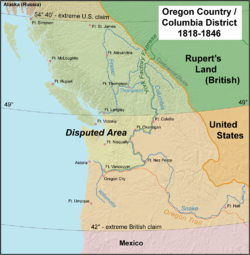
The dispute over the Oregon boundary, friendly at first, escalated into the threat of war before being resolved amicably in 1846 by splitting the region 50-50 between Britain and the U.S., ending joint occupation.
Image source: Oregon Treaty
1848 - 1853
% complete
The Oregon Territory was officially organized in 1848, established by the United States Congress two years after sovereignty over the southern portion of the region was established by the Oregon Treaty of June 1846.
Image source: Oregon Territory
1849 - 1854
% complete
Another law, passed in 1849, prohibited Black immigration into the territory. The law was repealed in 1854, though an exclusion clause was incorporated into the Oregon constitution in 1857.
1850
% complete
Settlement increased because of the Donation Land Claim Act of 1850, in conjunction with the forced relocation of the native population to Indian reservations.
Image source: Donation Land Claim Act
1853
% complete
The northern and eastern portions of the Oregon Territory were separated in 1853, becoming the new Washington Territory, which would become the 42nd state in 1889; the eastern portion later became the Idaho Territory in 1863.
Image source: Washington Territory
Nov 9, 1857
% complete
On November 9, 1857, the Oregon Territory's electorate, consisting of white men above age 21, voted 7,195 (69.25%) for and 3,195 (30.75%) against adopting the Constitution of Oregon, which included a Black exclusion clause.
Image source: Constitution of Oregon
Feb 14, 1859
% complete
Oregon was admitted to the Union on February 14, 1859, becoming the 33rd state of the United States.
Image source: Oregon
Oct 21, 1861
% complete
Oregon Senator Edward Dickinson Baker was killed leading Union troops at the Battle of Ball's Bluff on October 21, 1861.
Image source: Edward D. Baker
1862 - 1951
% complete
A law adopted by the state in 1862 required all ethnic minorities to pay a $5 annual tax, and interracial marriage was prohibited by law from approximately 1861 until 1951.
Image source: History of Oregon
1862 - Jun 1865
% complete
During the Civil War, immigrants clashed with the Paiute, Shoshone and Bannock tribes in Oregon, Idaho and Nevada. Oregon raised the 1st Oregon Cavalry, activated in 1862 and serving until June 1865.
Image source: 1st Oregon Cavalry Regiment
1864 - 1868
% complete
During the Civil War, immigrants continued to clash with the Paiute, Shoshone and Bannock tribes in Oregon, Idaho and Nevada until relations degenerated into the bloody Snake War of 1864–1868. The 1st Oregon Volunteer Infantry Regiment, formed in 1864, saw its last company mustered out in July 1867.
1898
% complete
The most influential figure of Oregon's progressive movement was William U'Ren, a highly energetic activist and leader of the Direct Legislation League and the Nonpartisan Direct Legislation League of Oregon from 1898.
Image source: William Simon U'Ren
1902
% complete
In 1902, Oregon approved a system of direct legislation by the state's citizens by way of initiative and referendum, known as the Oregon System, and in 1908 also empowered its citizens to recall public officials by ballot initiative.
Image source: Direct Legislation League
1903 - 1921
% complete
Democrats who promoted progressive policies included George Earle Chamberlain (governor 1903 to 1909 and U.S. senator 1909 to 1921), Oswald West (governor 1911 to 1915), and Harry Lane (senator 1913–1917).
Image source: George E. Chamberlain
1907 - 1912
% complete
Senator Jonathan Bourne served in the Senate in 1907–1913. In 1908 he led the attempt to persuade Theodore Roosevelt to run for a third term; Roosevelt declined. Bourne served as president of the National Republican Progressive League in 1911–1912, but was not renominated in 1912.
Image source: Jonathan Bourne Jr.
1908
% complete
New York City muckraker Lincoln Steffens was surprised when he visited in 1908 to discover that Oregon had more fundamental legislation than any other state except Oklahoma, enacting laws enabling its people to govern themselves.
Image source: Lincoln Steffens
1916
% complete
The exclusion clause incorporated into the Oregon constitution in 1857 stood multiple repeal attempts until finally being repealed by a narrow margin in 1916.
1933 - 1937
% complete
Industrial expansion began in earnest following the construction of the Bonneville Dam in 1933–1937 on the Columbia River, bringing cheap hydroelectric power to the region.
Image source: Bonneville Dam
1957
% complete
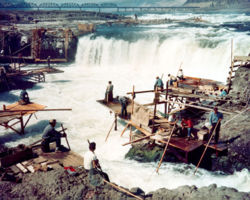
The historic Celilo Falls rapids were submerged in 1957 with the construction of The Dalles Dam on the Columbia River, dramatically altering the river and Native fishing traditions.
Image source: The Dalles Dam
1994
% complete
A 1994 report from an Oregon Supreme Court task force found minorities more likely to be arrested, charged, convicted, incarcerated and on probation than similarly situated non-minorities, pointing out problems of institutional racism.
Image source: Racism in Oregon
2000
% complete
In the 21st century, state ballots often include right-wing proposals such as anti-gay and pro-religious measures side by side with politically liberal issues like drug decriminalization, demonstrating the wide spectrum of political values in the state.
Image source: Politics of Oregon
Feb 28, 2020
% complete
A state of emergency related to COVID-19 was declared for the state of Oregon on February 28, 2020. By early March, universities and K–12 schools closed statewide and began providing online instruction.
Jul 1, 2020
% complete
By the end of June 2020, Governor Kate Brown announced that face masks would be required indoors, effective July 1.
May 14, 2021
% complete
By May 14, 2021, 31 of Oregon's 36 counties had met OHA requirements to enter the first phase of a three-phase process to reopen businesses.
Sep 1, 2022
% complete
As of September 1, 2022, 77.3% of Oregon's adult population had completed the primary COVID-19 vaccination series.
Or browse the full history timeline directory, with more than 2,000 topics.
This History of Oregon timeline was generated with the help of AI, using information found on the internet.
We work hard to keep these timelines accurate, but mistakes do get through. If you spot one, email us at [email protected] and we'll fix it for future visitors.
Generate yours with AI or build it from scratch, for free.
Export your timeline, add your own events, edit or remove AI-generated events, and much more
No credit card required.
Cancel anytime.
Cancel anytime.
You can create an unlimited number of timelines with up to 10 events on each one, customize how they look, export them to PDF, PNG, PowerPoint, CSV, and Excel, and share them with a link. Paid plans raise the event limit and add features like spreadsheet imports and collaborators.
Yes. You can cancel your subscription from your account page at any time, and you will not be charged again. Your subscription stays active for the rest of the period you already paid for.
Yes. We will email you a reminder before the annual renewal, and we will also email you a receipt.
Yes. You can email us within 15 days of any payment, and we will issue you a full refund.
Check out our pricing docs or send us an email anytime: [email protected].