-
Use Cases
-
Resources
-
Pricing
The Oregon Trail was a roughly 2,000-mile overland route connecting the Missouri River to Oregon's Willamette Valley. Used primarily between 1841 and 1869, it carried hundreds of thousands of settlers, farmers, and fortune-seekers westward in covered wagons, playing a pivotal role in America's westward expansion before being superseded by the transcontinental railroad. More Less
May 14, 1804
% complete
Meriwether Lewis and William Clark led the Corps of Discovery westward from Camp Dubois near St. Louis, tasked by President Thomas Jefferson with exploring the Louisiana Purchase and finding a route to the Pacific Ocean. Their journey helped map much of the territory that later emigrants would cross on the Oregon Trail.
Image source: Lewis and Clark Expedition
Nov 7, 1805
% complete
After eighteen months of arduous travel, the Corps of Discovery sighted the Pacific Ocean near the mouth of the Columbia River, proving that an overland route to the West Coast was possible and inspiring future American expansion toward Oregon.
Mar 22, 1811
% complete
Fur traders sent by John Jacob Astor's Pacific Fur Company arrived overland at the mouth of the Columbia River and founded Fort Astoria, the first permanent American settlement on the Pacific coast and an early proof that wagons could traverse parts of the route.
Image source: Astoria, Oregon
Oct 1812
% complete
While returning east from Astoria, Robert Stuart's party discovered South Pass in present-day Wyoming, a broad, gentle gap through the Rocky Mountains. This discovery became the key gateway for nearly all Oregon Trail emigrants.
Image source: South Pass (Wyoming)
1825 - 1840
% complete
Annual fur trade gatherings held at locations along the future trail route, such as the Green River valley, brought together trappers, Native Americans, and merchants. These rendezvous established supply networks and knowledge of trails that later emigrants relied upon.
Image source: Rocky Mountain Rendezvous
1826 - 1829
% complete
Fur trader Jedediah Smith made pioneering journeys across the Great Basin, the Sierra Nevada, and the Southwest, dramatically expanding geographic knowledge of the American West and helping blaze routes that would influence later wagon roads.
Image source: Jedediah Smith
1832 - 1835
% complete
Captain Benjamin Bonneville led a fur-trading expedition that took wagons as far as South Pass and explored routes into Oregon, providing valuable maps and reports that encouraged later emigration to the Willamette Valley.
Image source: Benjamin Bonneville
1832 - 1833
% complete
Boston entrepreneur Nathaniel Wyeth attempted to establish a fur trading operation in the Oregon Country, leading one of the earliest parties of wagons along the route to Fort Vancouver and demonstrating the feasibility of wagon travel to Oregon.
Image source: Nathaniel Jarvis Wyeth
1836
% complete
Missionaries Marcus and Narcissa Whitman traveled with a small party of wagons as far as Fort Boise, proving that wheeled vehicles could make the journey. Narcissa Whitman became one of the first white women to cross the continent, and her letters inspired other emigrants.
Image source: Marcus Whitman
1836
% complete
The Whitmans established their mission at Waiilatpu near present-day Walla Walla, Washington. The mission became a vital rest stop and source of aid for thousands of Oregon Trail emigrants over the following decade.
Image source: Whitman Mission National Historic Site
1841
% complete
The Bidwell-Bartleson Party left Independence, Missouri, bound for California, while other settlers headed for Oregon. This marked the beginning of organized mass migration over the trail, with roughly 70 people making the journey that year.
Image source: Oregon Trail
May 22, 1843
% complete
Roughly 900 to 1,000 emigrants departed Independence, Missouri, in what became known as the Great Migration. Led partly by Marcus Whitman, this massive wagon train proved that families could successfully settle in the Willamette Valley, opening the floodgates for future migration.
Jan 24, 1848 - 1855
% complete
The discovery of gold at Sutter's Mill triggered a massive surge of westward travelers. Tens of thousands of Forty-Niners used the eastern portions of the Oregon Trail before branching south, straining resources along the route but also improving its infrastructure.
Image source: California Gold Rush
1850
% complete
Around 50,000 emigrants traveled west in 1850, one of the heaviest years of traffic on the trail. The sheer volume of travelers strained grass, water, and firewood supplies, forcing later emigrants to depart earlier or take alternate routes.
Apr 3, 1860 - Oct 26, 1861
% complete
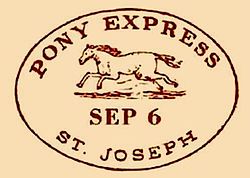
The Pony Express carried mail between St. Joseph, Missouri, and Sacramento, California, using relay stations along routes that paralleled the Oregon Trail. Though short-lived, it demonstrated the growing connectivity between East and West.
Image source: Pony Express
May 20, 1862
% complete
The Homestead Act offered 160 acres of free land to settlers who farmed it for five years, spurring continued migration along the Oregon Trail and other western routes even as railroads began to change travel patterns.
Image source: Homestead Acts
May 1846 - Apr 1847
% complete
The Donner-Reed Party took an untested shortcut called Hastings Cutoff and became trapped by snow in the Sierra Nevada. Of the 87 members, about half died, and some survivors resorted to cannibalism. The disaster became a cautionary tale for all westward emigrants.
Image source: Donner Party
1849
% complete
Originally a fur trading post purchased by the U.S. Army in 1849, Fort Laramie in Wyoming became one of the most important resupply and rest stops on the Oregon Trail, offering provisions, repairs, mail service, and medical care to passing emigrants.
Image source: Fort Laramie National Historic Site
1849 - 1854
% complete
Outbreaks of Asiatic cholera, carried by emigrants traveling up the Missouri River, killed thousands of travelers between 1849 and 1854. The disease, spread through contaminated water, was the deadliest hazard on the trail, striking suddenly and killing victims within hours.
Nov 29, 1847
% complete
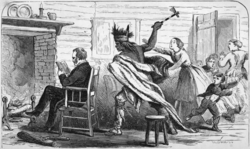
Cayuse warriors killed Marcus and Narcissa Whitman and eleven others at the Waiilatpu mission, blaming them for a devastating measles outbreak. The killings triggered violent reprisals and heightened tensions between emigrants and Native peoples across the region.
Image source: Whitman massacre
Sep 17, 1851
% complete
U.S. officials negotiated with Plains tribes including the Lakota, Cheyenne, and Arapaho, establishing tribal territories and promising safe passage for emigrants in exchange for annuities. The treaty aimed to reduce conflict along the heavily traveled trail corridors.
Image source: Treaty of Fort Laramie (1851)
Jul 1, 1862
% complete
Congress authorized construction of a transcontinental railroad, which would eventually render wagon travel obsolete. Railroads followed many of the same corridors surveyed by Oregon Trail emigrants and fur traders.
Image source: Pacific Railroad Acts
May 10, 1869
% complete
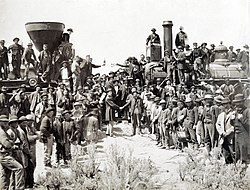
The Union Pacific and Central Pacific railroads met at Promontory Summit, Utah, completing the nation's first transcontinental railroad. Train travel quickly replaced the months-long wagon journey, and Oregon Trail traffic declined sharply thereafter.
Image source: First transcontinental railroad
1880 - 1899
% complete
By the 1880s and 1890s, only scattered wagon trains still made the journey, often using the trail to reach railroad hubs. An estimated 300,000 to 400,000 people had traveled the Oregon Trail during its roughly two decades of peak use.
1906
% complete
Ezra Meeker, who had crossed the trail in 1852, retraced the route by ox-drawn wagon to raise awareness of its history. He spent decades marking the trail with monuments and lobbying for preservation, becoming the trail's most famous champion.
Image source: Ezra Meeker
1928
% complete
Building on Ezra Meeker's efforts, the Oregon Trail Memorial Association was established to commemorate the trail, erect monuments, and promote historical education about the great westward migration.
1971
% complete
Created by Don Rawitsch and colleagues at Carleton College, The Oregon Trail educational computer game simulated the emigrant journey. Widely distributed in schools through the 1980s and 1990s, it introduced generations of children to the trail's history and hardships.
Image source: The Oregon Trail (1971 video game)
Nov 10, 1978
% complete
Congress designated the Oregon Trail as a National Historic Trail, placing it under National Park Service administration. This recognition protected remaining ruts, landmarks, and sites along the roughly 2,170-mile route.
Image source: Oregon Trail
1992
% complete
Located atop Flagstaff Hill near Baker City, Oregon, the interpretive center opened to educate visitors about the emigrant experience, featuring exhibits, living history demonstrations, and views of preserved trail ruts.
Image source: National Historic Oregon Trail Interpretive Center
2020
% complete
More than 150 years after the last major migrations, wagon ruts carved by hundreds of thousands of wheels remain visible at sites such as Guernsey, Wyoming, and Independence Rock, serving as enduring physical testimony to one of America's greatest migrations.
Or browse the full history timeline directory, with more than 2,000 topics.
This Oregon Trail timeline was generated with the help of AI, using information found on the internet.
We work hard to keep these timelines accurate, but mistakes do get through. If you spot one, email us at [email protected] and we'll fix it for future visitors.
Generate yours with AI or build it from scratch, for free.
Export your timeline, add your own events, edit or remove AI-generated events, and much more
No credit card required.
Cancel anytime.
Cancel anytime.
You can create an unlimited number of timelines with up to 10 events on each one, customize how they look, export them to PDF, PNG, PowerPoint, CSV, and Excel, and share them with a link. Paid plans raise the event limit and add features like spreadsheet imports and collaborators.
Yes. You can cancel your subscription from your account page at any time, and you will not be charged again. Your subscription stays active for the rest of the period you already paid for.
Yes. We will email you a reminder before the annual renewal, and we will also email you a receipt.
Yes. You can email us within 15 days of any payment, and we will issue you a full refund.
Check out our pricing docs or send us an email anytime: [email protected].