-
Use Cases
-
Resources
-
Pricing
The Missouri Compromise was a pivotal agreement passed by the U.S. Congress in 1820 that regulated slavery in the western territories. It admitted Missouri as a slave state and Maine as a free state while prohibiting slavery north of the 36°30′ parallel, temporarily preserving the balance of power between free and slave states. More Less
1776
The Declaration of Independence was grounded on the claim that liberty and equality were linked together as universal human rights, setting an ideological standard that would later clash with the institution of slavery during the Missouri crisis.
Image source: United States Declaration of Independence

1787
The Revolutionary generation formed a government of limited powers in 1787 to embody the principles of the Declaration but 'burdened with the one legacy that defied the principles of 1776': human bondage. The constitutional compromise provided for two senators per state regardless of population.
Image source: Constitutional Convention (United States)

1787
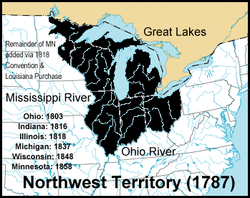
Slaveholders co-operated in authorizing the Northwest Ordinance in 1787. From a constitutional standpoint, it later served as an important example for the Missouri Compromise of congressional exclusion of slavery from US territory.
Image source: Northwest Ordinance
1790 - 1815
With the introduction of the cotton gin in the 1790s through 1815, with the vast increase in international demand for cotton, slave-based agriculture underwent an immense revival that spread the institution westward to the Mississippi River.
Image source: Cotton gin

1803
President Thomas Jefferson wielded federal executive power to double the size of the United States through the Louisiana Purchase, deviating from Jeffersonian strictures on limited central government. The treaty's Article 3 extended the rights of US citizens to all inhabitants of the new territory, including protection of property in slaves.
Image source: Louisiana Purchase

1804
In 1804, Congress limited the further introduction of enslaved men and women to those introduced by actual settlers, heightening concerns that it intended to extend some sort of prohibition on slavery's growth across the river.
Image source: Missouri Compromise

1805
White Missourians objected to restrictions on slavery, and in 1805 Congress withdrew them. The final version of the 1805 territorial ordinance omitted all references to slavery, so slavery existed legally in Missouri by force of local law and territorial statute rather than by ordinance.
1812
In 1812, Louisiana, a major cotton producer and the first state carved from the Louisiana Purchase, entered the Union as a slave state.
Image source: Louisiana
1817 - 1825
The Era of Good Feelings, closely associated with President James Monroe's administration, was characterized by the dissolution of national political identities. With Federalists discredited by the Hartford Convention, Democratic-Republicans adopted key Federalist economic programs like the Tariff of 1816 and the Second Bank of the United States.
Image source: Era of Good Feelings

1815 - 1819
After the War of 1812, Missouri Territory experienced rapid settlement led by slaveholding planters. Southern planters immigrated with their chattel, and the slave population rose from 3,101 in 1810 to 10,000 in 1820. By 1819, the population approached the threshold for statehood.
Image source: Missouri Territory

This Missouri Compromise timeline was generated with the help of AI, using information found on the internet.
We work hard to keep these timelines accurate, but mistakes do get through. If you spot one, email us at [email protected] and we'll fix it for future visitors.
Generate yours with AI or build it from scratch, for free.