
-
Use Cases
-
Resources
-
Pricing
The Compromise of 1850 was a package of five separate bills passed by the U.S. Congress in September 1850, designed to defuse sectional conflict between slave and free states following the Mexican-American War. Crafted largely by Senator Henry Clay and steered through by Stephen A. Douglas, it admitted California as a free state, allowed popular sovereignty in New Mexico and Utah territories, settled Texas boundary disputes, abolished the slave trade in Washington, D.C., and enacted a stricter Fugitive Slave Act. While it temporarily preserved the Union, it intensified debates over slavery and set the stage for future crises. More Less
1830
% complete
Disputes around fugitive slaves had grown since 1830 in part due to improving means of transportation, as the enslaved used roads, railroads, and ships to escape.
Image source: Fugitive Slave Act of 1850
1836
% complete
The Republic of Texas declared its independence from Mexico following the Texas Revolution of 1836. Partly because Texas had been settled by a large number of Americans, there was a very strong sentiment in both Texas and the United States for the annexation of Texas by the United States.
Image source: Texas Revolution
Apr 21, 1836
% complete
The independent Republic of Texas won the decisive Battle of San Jacinto against Mexico and captured Mexican president Antonio Lopez de Santa Anna, securing Texas independence.
Image source: Battle of San Jacinto
1841
% complete
Many New Mexican leaders opposed joining Texas primarily because Texas's capital lay hundreds of miles away and because Texas and New Mexico had a history of conflict dating back to the 1841 Santa Fe Expedition.
Image source: Texan Santa Fe Expedition
Dec 29, 1845
% complete
In December 1845, President James K. Polk oversaw the annexation of the Republic of Texas by the United States, which became the nation's 28th state.
Image source: Texas annexation
Mar 1846
% complete
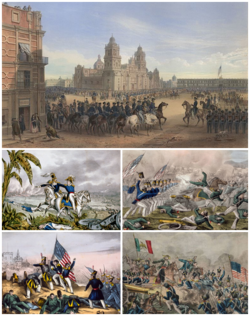
In March 1846, a skirmish broke out on the northern side of the Rio Grande, ending in the death or capture of dozens of American soldiers, helping spark the Mexican–American War (1846–1848).
Image source: Mexican–American War
Aug 1846
% complete
In August 1846, Polk asked Congress for an appropriation that he hoped to use as a down payment for the purchase of California in a treaty with Mexico.
Image source: James K. Polk
Aug 1846 - Feb 1847
% complete
The Wilmot Proviso, seeking to bar slavery from territory gained from Mexico, passed the House in August 1846 and February 1847, but not the Senate, foreshadowing sectional battles over new territories.
Image source: Wilmot Proviso
Sep 1847
% complete
In September 1847, an American army under the command of General Winfield Scott captured the Mexican capital in the Battle for Mexico City, effectively deciding the war.
Image source: Battle for Mexico City
1848
% complete
Near the end of Polk's term in 1848, news reached Washington that gold had been discovered in California, dramatically accelerating migration and demands for territorial organization.
Image source: California Gold Rush
1849
% complete
In response to growing demand for a better, more representative government, a Constitutional Convention was held in 1849 in Monterey.
Image source: California Constitutional Conventions
Oct 1849
% complete
In October 1849, a California constitutional convention unanimously agreed to join the Union—and to ban slavery within their borders.
Image source: Compromise of 1850
Nov 1848
% complete
Polk decided not to seek re-election in the 1848 presidential election, and the election was won by the Whig ticket of Zachary Taylor and Millard Fillmore. When Taylor was elected president in 1848, the issue of slavery in the territories was not yet apparent.
Image source: 1848 United States presidential election
1849
% complete
Tensions accelerated quickly in the fall of 1849, setting the stage for an exhausting congressional session dominated by sectional disputes.
Mar 4, 1849 - Jul 1850
% complete
Zachary Taylor served as president from March 1849 to July 1850, proposing two free states during his term before his death in office.
Dec 1849
% complete
In his December 1849 State of the Union report, Taylor endorsed California's and New Mexico's applications for statehood, recommending that Congress approve them as written and 'should abstain from the introduction of those exciting topics of a sectional character'.
Image source: Zachary Taylor
Dec 1849 - Jan 1850
% complete
Changing Texas's borders was proposed by Senator Thomas Hart Benton in December 1849 or January 1850, one of several proposals for resolving boundary disputes.
Image source: Thomas Hart Benton (politician)
Dec 1849
% complete
The issue of California would play a central role in the exhausting 1849 speaker dispute in the House of Representatives.
Jan 29, 1850
% complete
On January 29, 1850, Senator Henry Clay introduced a plan which combined the major issues under discussion. In early 1850, Clay proposed a package of eight bills that would settle most of the pressing issues before Congress.
Image source: Henry Clay
Feb 1850
% complete
Two southern states were proposed by Senator John Bell, with the assent of Texas, in February 1850, as an alternative solution to the Texas boundary question.
Image source: John Bell (Tennessee politician)
Jun 1850
% complete
While some delegates preached secession, the moderates ruled and proposed a series of compromises, including extending the dividing line designated by the Missouri Compromise of 1820 to the Pacific Coast. That line was again proposed by the Nashville Convention of June 1850.
Image source: Nashville Convention
Jul 1850
% complete
Taylor died in July 1850 and was succeeded by Vice President Fillmore, who had privately come to support Clay's proposal, giving the compromise crucial executive support.
Image source: Millard Fillmore
1850
% complete
The first draft of the Compromise of 1850 had Texas's northwestern boundary be a straight, diagonal line from the Rio Grande 20 miles north of El Paso to the Red River at the 100th meridian west, the southwestern corner of today's Oklahoma.
1850
% complete
The general solution transferred much territory claimed by Texas to the federal government; organized the Territory of New Mexico and the Territory of Utah, allowed to locally determine slave or free status; added California as a free state; adopted the severe Fugitive Slave Law; and abolished the slave trade in the District of Columbia. Because the Constitution does not permit Congress unilaterally to reduce a state's territory, the Texas portion took the form of an offer to the Texas State Legislature.
1850
% complete
Not all accepted the Compromise of 1850. Potter argues that the Compromise of 1850 was not actually a compromise at all, and its consequences led to a breakdown in the spirit of compromise in the Antebellum period.
Aug 1850 - Sep 1850
% complete
Douglas, with the support of President Millard Fillmore, guided the compromise through Congress. It centered on how to handle slavery in recently acquired territories from the Mexican–American War (1846–1848).
Image source: Stephen A. Douglas
Sep 1850
% complete
The Compromise of 1850 was a package of five separate bills passed by the United States Congress in September 1850 that temporarily defused tensions between slave and free states during the years leading up to the American Civil War.
Sep 1850
% complete
Passage of the Compromise of 1850 caused celebration in Washington and elsewhere, with crowds shouting, 'The Union is saved!' Fillmore described it as a 'final settlement' of sectional issues, though the future of slavery in New Mexico and Utah remained unclear.
Sep 18, 1850
% complete
The president quickly signed each bill into law save for the Fugitive Slave Act of 1850; he ultimately signed that law as well after Attorney General Crittenden assured him that the law was constitutional. Enacted September 18, 1850, it is informally known as the Fugitive Slave Law.
Sep 18, 1850
% complete
The Fugitive Slave Law bolstered the Fugitive Slave Act of 1793. Any federal marshal or other official who did not arrest an alleged runaway slave was liable to a fine of $1,000 (equivalent to $38,700 in 2025).
Nov 1850
% complete
Though some in Texas still favored sending a military expedition into New Mexico, in November 1850, the state legislature voted to accept the compromise, transferring considerable territory claimed by Texas to the federal government.
1854
% complete
The issue of slavery in the territories would be re-opened by the Kansas–Nebraska Act (1854), implemented using popular sovereignty, giving rise to the violence of the 'Bleeding Kansas' period. Still, the Compromise of 1850 played a major role in postponing the Civil War.
Or browse the full history timeline directory, with more than 2,000 topics.
This Compromise of 1850 timeline was generated with the help of AI, using information found on the internet.
We work hard to keep these timelines accurate, but mistakes do get through. If you spot one, email us at [email protected] and we'll fix it for future visitors.
Generate yours with AI or build it from scratch, for free.
Export your timeline, add your own events, edit or remove AI-generated events, and much more
No credit card required.
Cancel anytime.
Cancel anytime.
You can create an unlimited number of timelines with up to 10 events on each one, customize how they look, export them to PDF, PNG, PowerPoint, CSV, and Excel, and share them with a link. Paid plans raise the event limit and add features like spreadsheet imports and collaborators.
Yes. You can cancel your subscription from your account page at any time, and you will not be charged again. Your subscription stays active for the rest of the period you already paid for.
Yes. We will email you a reminder before the annual renewal, and we will also email you a receipt.
Yes. You can email us within 15 days of any payment, and we will issue you a full refund.
Check out our pricing docs or send us an email anytime: [email protected].