
-
Use Cases
-
Resources
-
Pricing
The Fugitive Slave Act of 1850 required federal authorities and citizens to assist in capturing and returning people who had escaped slavery, provoking widespread resistance in the North and deepening sectional conflict. More Less
Build a timeline like this one in minutes, for free. Start Yours →
1787
Article 4, Section 2, Clause 3 of the United States Constitution required the return of enslaved people who escaped from one state to another, providing the constitutional basis for federal fugitive-slave legislation.
1793 - 1850
The 1793 act addressed enslaved people who escaped to free states without their enslavers' consent and established a federal mechanism for their recovery.
Image source: Fugitive Slave Act of 1793

1793
Congress enacted the earlier Fugitive Slave Act to enforce the constitutional requirement that escaped slaves be returned to their enslavers.
1842
The Supreme Court ruled that states were not required to aid in the hunting or recapture of enslaved people, significantly weakening the practical enforcement of the 1793 law.
Image source: Prigg v. Pennsylvania

1843
By 1843, several hundred enslaved people per year were successfully escaping to the North, making slavery increasingly unstable in the border states.
Image source: Fugitive slave laws in the United States

1840 - 1847
After 1840, Cass County's Black population grew as families were attracted by resistance to discriminatory laws, supportive Quakers, and inexpensive land.
1847 - 1849
Planters from Bourbon and Boone Counties, Kentucky, led raids into Cass County to recapture escaped slaves.
Image source: Cass County, Michigan

1849
The Kentucky-led attacks failed. Their failure contributed to Southern demands for a stronger federal fugitive-slave law in 1850.
1850 - 1860
The Fugitive Slave Act had major effects on the Underground Railroad, often discouraging escapes because the risks of capture and forced return increased.
Image source: Underground Railroad
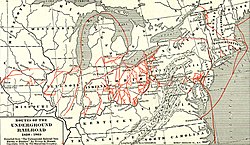
1850 - 1860
A study found that slave prices rose across the South after 1850, with prices in border states increasing 15% to 30% more than in states farther south, indicating that the act altered the chances of successful escape.
Build a timeline like this one in minutes, for free. Start Yours →
This Fugitive Slave Act of 1850 timeline was generated with the help of AI, using information found on the internet.
We work hard to keep these timelines accurate, but mistakes do get through. If you spot one, email us at [email protected] and we'll fix it for future visitors.
Generate yours with AI or build it from scratch, for free.


