-
Use Cases
-
Resources
-
Pricing
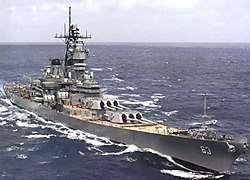
The USS Missouri (BB-63), nicknamed 'Mighty Mo,' is an Iowa-class battleship of the United States Navy best known as the site where Japan formally surrendered on September 2, 1945, ending World War II. Commissioned in 1944, she served in World War II, the Korean War, and Operation Desert Storm before being decommissioned in 1992. Today, the USS Missouri is preserved as a museum ship at Pearl Harbor, Hawaii. More Less
Jun 12, 1940
% complete
The United States Navy ordered the Iowa-class battleship USS Missouri (BB-63) as part of the massive naval expansion program preceding America's entry into World War II. She would become the fourth ship named after the state of Missouri.
Image source: USS Missouri (BB-63)
Jan 6, 1941
% complete
Construction of the USS Missouri began when her keel was laid at the New York Naval Shipyard in Brooklyn. The ship was one of the largest battleships ever built by the United States, designed to displace over 45,000 tons.
Jan 29, 1944
% complete
The Missouri was launched with great ceremony at the Brooklyn Navy Yard. Mary Margaret Truman, daughter of Senator Harry S. Truman, christened the ship, breaking a bottle of champagne across her bow.
Jun 11, 1944
% complete
Captain William M. Callaghan placed the Missouri in commission at the Brooklyn Navy Yard. After shakedown training and trials, the battleship departed for the Pacific theater to join the war against Japan.
Jan 13, 1945
% complete
After transiting the Panama Canal and training off San Diego, the Missouri reached Ulithi Atoll and joined Admiral Marc Mitscher's Task Force 58, becoming part of the fast carrier task forces striking Japan.
Feb 16, 1945 - Mar 3, 1945
% complete
The Missouri screened carriers during massive air raids on Tokyo and supported the invasion of Iwo Jima with shore bombardment, providing anti-aircraft protection for the fast carrier task force.
Image source: Bombing of Tokyo
Apr 11, 1945
% complete
During operations off Okinawa, a kamikaze struck the Missouri's starboard side but caused minimal damage and no serious casualties among her crew. The ship continued operations, bombarding Japanese positions on Okinawa.
Jul 14, 1945
% complete
The Missouri joined other battleships in shelling industrial facilities around Muroran, Hokkaido, and later Hitachi on Honshu, delivering some of the first direct gunfire strikes on the Japanese home islands from capital ships.
Aug 15, 1945
% complete
Emperor Hirohito announced Japan's acceptance of Allied surrender terms via radio broadcast. The Missouri was anchored in Tokyo Bay preparing to host the formal surrender ceremony that would end World War II.
Image source: Surrender of Japan
Sep 2, 1945
% complete
In a ceremony lasting just over twenty minutes, Japanese representatives including Foreign Minister Mamoru Shigemitsu and General Yoshijiro Umezu signed the Instrument of Surrender aboard the Missouri in Tokyo Bay, formally ending World War II. General Douglas MacArthur presided, and Fleet Admiral Chester Nimitz represented the United States.
Oct 23, 1945
% complete
Following the surrender ceremony and service in Japanese waters, the Missouri returned to New York City, where President Harry Truman boarded her for Navy Day celebrations before she underwent overhaul.
Sep 1947
% complete
President Harry Truman, whose home state gave the battleship her name, sailed aboard the Missouri to Rio de Janeiro for the Inter-American Conference, highlighting the special bond between Truman and his favorite battleship.
Feb 26, 1955
% complete
With the post-Korean War drawdown, the Missouri was decommissioned at Bremerton, Washington, joining the Pacific Reserve Fleet where she would remain moored for nearly thirty years as a symbol of American sea power.
1981
% complete
As part of the Reagan administration's plan to build a 600-ship Navy, Congress approved the modernization and reactivation of all four Iowa-class battleships, including the Missouri, to counter Soviet naval expansion.
Image source: Iowa-class battleship
May 1984
% complete
The Missouri underwent an extensive refit that removed some older anti-aircraft guns and added Tomahawk and Harpoon missile launchers, Phalanx CIWS mounts, and updated electronics while preserving her nine 16-inch guns.
1986 - 1987
% complete
On her first deployment since recommissioning, the Missouri became the first battleship to circumnavigate the globe since Theodore Roosevelt's Great White Fleet, visiting ports including Australia and Hawaii.
May 10, 1986
% complete
The recommissioning ceremony at Long Beach drew thousands, including President Ronald Reagan. Now fitted with modern missiles alongside her massive guns, the 'Mighty Mo' rejoined the fleet for a new era.
Jul 1987
% complete
Deployed to the Persian Gulf region amid the Tanker War phase of the Iran-Iraq conflict, the Missouri helped protect shipping lanes, demonstrating US commitment to keeping the Strait of Hormuz open.
Image source: Operation Earnest Will
Jan 17, 1950
% complete
While en route from Norfolk, the Missouri ran hard aground on a shoal in Thimble Shoal Channel near Hampton Roads, Virginia. Refloating efforts took nearly three weeks, making national headlines before she was freed on February 1, 1950.
Image source: 1950 USS Missouri grounding
Sep 1950
% complete
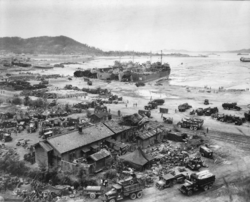
After North Korea invaded South Korea in June 1950, the Missouri was dispatched to Korean waters, arriving in mid-September 1950 to provide gunfire support for United Nations forces fighting along the peninsula.
Image source: Korean War
Sep 19, 1950 - Mar 1951
% complete
The Missouri screened carrier operations and delivered heavy bombardments against North Korean targets, supporting the Inchon landings and later operations along Korea's eastern coast, earning multiple battle stars.
Image source: Battle of Inchon
Sep 1952 - Mar 1953
% complete
The Missouri returned to Korean waters for a second tour, conducting gun strikes against railway lines, supply depots, and coastal targets until the armistice was signed in July 1953, then returned home.
Aug 2, 1990
% complete
Iraq's invasion of Kuwait led the United States and coalition allies to launch Operation Desert Shield. The Missouri was ordered to deploy to the Persian Gulf as part of the growing military buildup.
Image source: Gulf War
Nov 1990
% complete
The Missouri took station in the northern Persian Gulf with her sister Wisconsin, ready to support coalition operations against Iraqi forces occupying Kuwait.
Jan 17, 1991
% complete
In the opening hours of the Gulf War air campaign, the Missouri fired Tomahawk cruise missiles at targets in occupied Kuwait, marking the first combat use of her modernized missile systems.
Feb 1991 - Feb 28, 1991
% complete
The Missouri's 16-inch guns pounded Iraqi artillery, bunkers, and command posts in occupied Kuwait, including support around the Battle of Khafji. Her fire missions helped pave the way for the ground offensive, and Iraq even attempted an attack on her using Silkworm missiles that were intercepted or fell short.
Image source: Battle of Khafji
Feb 28, 1991
% complete
A ceasefire ended the Gulf War after a swift coalition victory liberated Kuwait. The Missouri returned to the United States having proven the enduring value of battleships in modern warfare.
1992 - 2012
% complete
Even before and after opening as a museum, the Missouri appeared in popular culture, most notably in the film Battleship (2012), cementing her status as an iconic symbol of American naval history.
Image source: USS Missouri (BB-63)
Mar 31, 1992
% complete
With the Cold War over and defense budgets shrinking, the Missouri was decommissioned at Long Beach, ending her active service career. She was stricken from the Naval Vessel Register in 1995.
May 4, 1998
% complete
Secretary of the Navy John Dalton transferred ownership of the Missouri to the USS Missouri Memorial Association, which prepared to make Pearl Harbor, Hawaii, her permanent home beside the sunken USS Arizona.
May 23, 1998 - Jun 22, 1998
% complete
Towed from Bremerton across the Pacific Ocean, the Mighty Mo arrived at Pearl Harbor, Hawaii, where she would be berthed at Ford Island, just yards from the wreck of the USS Arizona, bookending America's involvement in World War II.
Jan 29, 1999
% complete
Exactly 55 years after her launch, the USS Missouri opened as a museum at Pearl Harbor. Visitors can now stand on the spot where Japan surrendered in 1945, making the site one of Hawaii's most visited memorials.
Or browse the full history timeline directory, with more than 2,000 topics.
This USS Missouri timeline was generated with the help of AI, using information found on the internet.
We work hard to keep these timelines accurate, but mistakes do get through. If you spot one, email us at [email protected] and we'll fix it for future visitors.
Generate yours with AI or build it from scratch, for free.
Export your timeline, add your own events, edit or remove AI-generated events, and much more
No credit card required.
Cancel anytime.
Cancel anytime.
You can create an unlimited number of timelines with up to 10 events on each one, customize how they look, export them to PDF, PNG, PowerPoint, CSV, and Excel, and share them with a link. Paid plans raise the event limit and add features like spreadsheet imports and collaborators.
Yes. You can cancel your subscription from your account page at any time, and you will not be charged again. Your subscription stays active for the rest of the period you already paid for.
Yes. We will email you a reminder before the annual renewal, and we will also email you a receipt.
Yes. You can email us within 15 days of any payment, and we will issue you a full refund.
Check out our pricing docs or send us an email anytime: [email protected].