-
Use Cases
-
Resources
-
Pricing
The USS Arizona (BB-39) was a Pennsylvania-class battleship of the United States Navy, launched in 1915. It served in World War I and interwar years before being destroyed during the Japanese attack on Pearl Harbor on December 7, 1941, killing 1,177 crew members—the greatest loss of life on any U.S. warship. The wreck remains at Pearl Harbor beneath the USS Arizona Memorial, a national historic landmark honoring those who died. More Less
Mar 16, 1914
% complete
The keel of battleship number 39 (hull number: BB-39) was laid on the morning of March 16, 1914 at the Brooklyn Navy Yard, with Assistant Secretary of the Navy Franklin Delano Roosevelt in attendance.
Image source: USS Arizona (BB-39)
Jun 15, 1914
% complete
Testing in mid-1914 revealed that the ship's underwater torpedo defense system could withstand 300 pounds (140 kg) of TNT.
Jun 19, 1915
% complete
Arizona was launched on June 19, 1915, making it about fifteen months from keel-laying to launch.
Oct 17, 1916
% complete
Arizona was commissioned into the Navy on October 17, 1916, with Captain John McDonald in command.
Nov 10, 1916
% complete
Arizona departed New York on November 10, 1916 after the crew had cleaned the ship and the propulsion system had been tested at the dock.
Apr 3, 1917
% complete
Arizona left the yard on April 3, 1917; three days later the United States declared war on Germany. The ship remained stateside during World War I.
Dec 1917
% complete
Four coal-fired American dreadnoughts were sent across the Atlantic in December 1917 as Battleship Division Nine, but Arizona was not among them, remaining stateside during World War I.
Jul 1918
% complete
Life for Arizona's crew was not all training: the race-boat team from Arizona won the Battenberg Cup in July 1918 by beating the team from Nevada by three lengths over the three-mile course.
Image source: Battenberg Cup
Nov 11, 1918
% complete
The fighting ended on November 11, 1918 with an armistice. A week later, Arizona left the United States for the United Kingdom, arriving on November 30, 1918.
Image source: Armistice of 11 November 1918
Dec 13, 1918
% complete
On December 13, 1918, Arizona joined nine battleships and twenty-eight destroyers escorting President Woodrow Wilson aboard the ocean liner George Washington into Brest on his journey to the Paris Peace Conference.
Image source: Paris Peace Conference (1919–1920)
Jan 22, 1919 - Feb 8, 1919
% complete
Arizona sailed from New York for Hampton Roads on January 22, 1919; she continued south to Guantanamo Bay on February 4 and arrived four days later.
May 14, 1919 - Jul 15, 1919
% complete
In mid-1919, Arizona was deployed to represent American interests during the Greco-Turkish War, protecting American lives and property in the region.
Image source: Greco-Turkish War (1919–1922)
Jun 1919
% complete
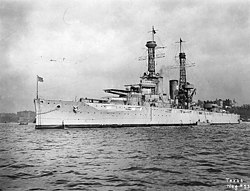
During this time, Arizona was fitted with a flying-off platform similar to the one given to Texas in March 1919, allowing her to launch aircraft.
Image source: USS Texas (BB-35)
Jan 1920
% complete
Work was completed in January 1920 and the battleship sailed south to Guantanamo Bay for crew training. In August she became the flagship of Battleship Division Seven, though it was only later in 1920 that she was refitted as an admiral's flagship.
Jan 1921
% complete
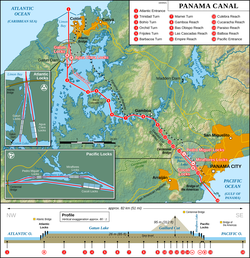
In company with six battleships and eighteen destroyers, Arizona was sent south again to transit the Panama Canal in January 1921.
Image source: Panama Canal
Sep 1921 - 1940
% complete
After Chase returned to Peru in the summer of 1921, Arizona began operating from her new home port of San Pedro, Los Angeles, where she was based until 1940.
Image source: San Pedro, Los Angeles
Jul 27, 1923
% complete
On July 27, 1923 the ship, under new command, participated in fleet activities as the annual Fleet Problems, which began in 1923, simulated large fleet actions across the Pacific.
Apr 12, 1924
% complete
Sometime in early March 1924 a prostitute named Madeline Blair stowed away aboard Arizona, trading sex for a free voyage to San Pedro until she was discovered on April 12 while the ship was anchored in Balboa, Panama.
Sep 1924
% complete
Despite her age, Arizona managed to reach 21.5 knots (39.8 km/h; 24.7 mph) during a full-power trial in September 1924.
Jan 1925
% complete
The first two Fleet Problems simulated an attack on the Panama Canal from the west, while in 1925 they attempted to defend the Hawaiian Islands, testing American naval strategy.
Image source: Fleet problem
May 1929 - Mar 1, 1931
% complete
Four months after Fleet Problem IX in January 1929, Arizona underwent comprehensive modernization at the Norfolk Navy Yard, lasting until early 1931.
Mar 19, 1931
% complete
On March 19, 1931, even before Arizona was put through post-modernization sea trials, she hosted President Herbert Hoover for a brief vacation in the Caribbean.
Image source: Herbert Hoover
Feb 1932
% complete
In February 1932, Arizona participated in Grand Joint Exercise No. 4, which simulated a carrier attack on Pearl Harbor — a rehearsal eerily prescient of events to come.
Image source: USS Lexington (CV-2)
Mar 10, 1933
% complete
After returning from Fleet Problem XIV, Arizona was anchored in San Pedro when an earthquake struck nearby Long Beach, California on March 10, 1933. She provided relief support including medical facilities and supplies.
Image source: 1933 Long Beach earthquake
Jan 1, 1934 - Mar 31, 1934
% complete
In early 1934, Arizona and her crew were filmed for the James Cagney/Warner Brothers film Here Comes the Navy, which made extensive use of exterior footage and on-board location shots.
Image source: Here Comes the Navy
Mar 4, 1935
% complete
Pettengill relieved Bryant on March 4, 1935, and two months later the ship participated in Fleet Problem XVI off Hawaii.
1936 - 1938
% complete
Budget cuts led to significant periods in port from 1936 to 1938. In Fiscal Year 1936–37, the ship was anchored for 267 days; the following year she was in port for 255 days.
May 1936
% complete
Arizona made a port visit to Balboa in May 1936 during Fleet Problem XVII, continuing her interwar training cycle.
Jan 2, 1937 - Apr 13, 1937
% complete
On January 2, 1937, Rear Admiral John Greenslade assumed command of Battleship Division Two from Bloch and transferred his flag to the battleship Maryland on April 13.
Image source: USS Maryland (BB-46)
Sep 17, 1938
% complete
Captain Isaac Kidd assumed command of the ship on September 17, 1938, later rising to rear admiral commanding Battleship Division One aboard Arizona.
Image source: Isaac C. Kidd
May 27, 1939
% complete
Nimitz was relieved on May 27, 1939 by Rear Admiral Russell Willson, who took over as commander of Battleship Division One aboard Arizona.
Image source: Chester W. Nimitz
Feb 5, 1940
% complete
Captain Train assumed command of the ship on February 5, 1940, as tensions in the Pacific continued to rise.
Image source: Franklin Van Valkenburgh
Apr 1940
% complete
In April 1940, the Pacific Fleet's home port was moved from California to Pearl Harbor, Hawaii, as a deterrent to Japanese imperialism. Arizona's last fleet problem was held off Hawaii around this time.
Image source: United States Pacific Fleet
Oct 1940 - Jan 1941
% complete
Arizona was overhauled at the Puget Sound Navy Yard in Bremerton, Washington, from October 1940 to January 1941, receiving updated equipment before returning to Hawaii.
Image source: Puget Sound Naval Shipyard
Jan 23, 1941
% complete
Her last flag change-of-command occurred on January 23, 1941, when Willson was relieved by Rear Admiral Isaac Kidd.
Feb 5, 1941
% complete
Captain Franklin Van Valkenburgh relieved Train on February 5, 1941, becoming the ship's final commanding officer.
Oct 22, 1941
% complete
On October 22, 1941, during an exercise taking place in heavy fog, Arizona was hit in the bow by the Oklahoma, requiring repairs before returning to duty.
Image source: USS Oklahoma (BB-37)
Dec 7, 1941
% complete
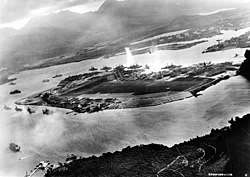
Shortly before 08:00 local time on December 7, 1941, Japanese aircraft from six carriers struck the Pacific Fleet at Pearl Harbor. Arizona was hit by several air-dropped armor-piercing bombs, one detonating her forward magazine and sinking her with the loss of over 1,100 men.
Image source: Attack on Pearl Harbor
Dec 29, 1941
% complete
Arizona was placed 'in ordinary' (temporarily out of service) at Pearl Harbor on December 29, 1941, and was stricken from the Naval Vessel Register on December 1, 1942.
1944
% complete
A 1944 Navy Bureau of Ships report suggested that a hatch leading to the black powder magazine was left open, possibly with flammable materials stocked nearby, contributing to the catastrophic explosion.
1942 - 1944
% complete
Her surviving superstructure was scrapped in 1942, and her main armament was salvaged over the next year and a half. Guns from Turret II were straightened, relined, and installed on Nevada in the fall of 1944.
Aug 1945
% complete
Battery Pennsylvania fired its guns for the first and last time on V-J Day in August 1945 during training, while the nearby Battery Arizona was never completed.
Image source: List of Pennsylvania units in the American Civil War
Mar 7, 1950
% complete
On March 7, 1950, Admiral Arthur W. Radford ordered that the American flag be flown over the submerged wreck of Arizona, beginning the tradition of honoring those lost there.
Image source: Arthur W. Radford
1962
% complete
A push by President Dwight D. Eisenhower and support following Elvis Presley's benefit concert resulted in the designation of the wreck as a national shrine in 1962, with the USS Arizona Memorial dedicated above it.
Image source: USS Arizona Memorial
Oct 15, 1966
% complete
The national memorial was administratively listed on the National Register of Historic Places on October 15, 1966.
Image source: National Register of Historic Places
Dec 7, 1987
% complete
The three-foot-tall (90 cm) bronze trophy on a black marble base was provided to the Navy by the citizens of the state of Arizona on December 7, 1987, honoring the ship's memory.
May 5, 1989
% complete
The ship herself was designated a National Historic Landmark on May 5, 1989, recognizing her significance in American history.
Image source: National Historic Landmark
2004
% complete
In 2004, the US Navy and the National Park Service oversaw a comprehensive computerized mapping of the hull, being careful to honor its role as a war grave.
2020
% complete
As of 2020, the bell is no longer rung due to the risk of damaging it, ending a long tradition of commemoration aboard the memorial.
Apr 2024
% complete
The last survivor of Arizona, Lou Conter, died in April 2024 at the age of 102, marking the passing of the final living link to the ship's tragic sinking.
Image source: Lou Conter
Or browse the full history timeline directory, with more than 2,000 topics.
This USS Arizona timeline was generated with the help of AI, using information found on the internet.
We work hard to keep these timelines accurate, but mistakes do get through. If you spot one, email us at [email protected] and we'll fix it for future visitors.
Generate yours with AI or build it from scratch, for free.
Export your timeline, add your own events, edit or remove AI-generated events, and much more
No credit card required.
Cancel anytime.
Cancel anytime.
You can create an unlimited number of timelines with up to 10 events on each one, customize how they look, export them to PDF, PNG, PowerPoint, CSV, and Excel, and share them with a link. Paid plans raise the event limit and add features like spreadsheet imports and collaborators.
Yes. You can cancel your subscription from your account page at any time, and you will not be charged again. Your subscription stays active for the rest of the period you already paid for.
Yes. We will email you a reminder before the annual renewal, and we will also email you a receipt.
Yes. You can email us within 15 days of any payment, and we will issue you a full refund.
Check out our pricing docs or send us an email anytime: [email protected].