-
Use Cases
-
Resources
-
Pricing
The Monroe Doctrine was a cornerstone of American foreign policy, first articulated by President James Monroe in 1823. It declared that the Western Hemisphere was off-limits to further European colonization and that any European interference in the Americas would be viewed as an act of aggression. Over time, the doctrine shaped U.S. relations with Latin America, influenced later policies like the Roosevelt Corollary, and remains a significant element in discussions of hemispheric diplomacy. More Less
1783
% completado
According to historian Samuel Eliot Morison, as early as 1783 the United States adopted the policy of isolation and announced its intention to keep out of Europe, laying the groundwork for what would later become the Monroe Doctrine.
Image source: Monroe Doctrine
1814 - 1815
% completado
The victorious European powers that emerged from the Congress of Vienna (1814–1815) raised American fears that they would revive monarchical government in the Americas.
Image source: Congress of Vienna
1815
% completado
As the Napoleonic Wars came to an end, Prussia, Austria, and Russia formed the Holy Alliance to defend monarchism, heightening American concerns about European intervention in the Western Hemisphere.
Image source: Holy Alliance
1821
% completado
The Russian Ukase of 1821 asserted Russian rights to the Pacific Northwest and forbade non-Russian ships from approaching the coast, serving as an immediate provocation for the Monroe Doctrine.
Dec 2, 1823
% completado
President James Monroe first articulated the doctrine on December 2, 1823, during his seventh annual State of the Union Address to Congress. It was not named after him until 1850. The US government did not issue a joint statement with Britain due to the recent War of 1812.
1850
% completado
Although first articulated by President James Monroe in 1823, the policy was not referred to by name as the 'Monroe Doctrine' until 1850.
1826
% completado
In 1826, Simón Bolívar called upon his Congress of Panama to host the first 'Pan-American' meeting, reflecting growing hemispheric cooperation among newly independent Latin American states.
Image source: Congress of Panama
1829
% completado
In Spanish America, royalist guerrillas continued the war in several countries, and Spain attempted to retake Mexico in 1829, testing the resolve behind the Monroe Doctrine.
1833
% completado
In early 1833, the British reasserted their sovereignty over the Falkland Islands, thus violating the Monroe Doctrine.
Image source: Reassertion of British sovereignty over the Falkland Islands (1833)
1838 - 1850
% completado
From 1838 to 1850, the Río de la Plata of Argentina was blockaded first by the French navy and then by the British and French navies. Historian Herring wrote that US inaction 'confirmed Latin American and especially Argentine suspicions of the United States.'
Image source: Anglo-French blockade of the Río de la Plata
Dec 2, 1845
% completado
On December 2, 1845, U.S. President James K. Polk reaffirmed and expanded the Monroe Doctrine in his annual message to Congress, warning European powers against further colonization in the Americas.
Image source: James K. Polk
1861
% completado
In 1861, Dominican military commander and royalist politician Pedro Santana signed a pact with the Spanish Crown and reverted the Dominican nation to colonial status.
Image source: Pedro Santana
Mar 18, 1861
% completado
On March 18, 1861, the Spanish annexation of the Dominican Republic was announced, a direct challenge to the Monroe Doctrine's prohibition of European recolonization in the Americas.
Image source: Spanish annexation of the Dominican Republic
1862 - 1867
% completado
In 1862, French forces under Napoleon III invaded and conquered Mexico, giving control to the puppet monarch Maximilian I. This second French intervention in Mexico was a notable instance of the doctrine being ignored during the 19th century.
Image source: Second French intervention in Mexico
1862
% completado
In 1862, the remaining British colonies within modern-day Belize were merged into a single crown colony known as British Honduras, a continued British presence in Central America despite the Monroe Doctrine.
Image source: British Honduras
1865
% completado
In 1865, Spain occupied the Chincha Islands off Peru in violation of the Monroe Doctrine, prompting conflict with Peru and its allies.
Image source: Chincha Islands War
1865
% completado
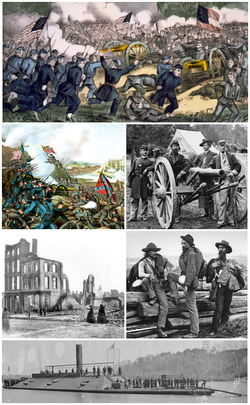
The American Civil War ended in 1865, and following the war the United States reasserted the Monroe Doctrine, pressuring Spain to withdraw from the Dominican Republic and the Chincha Islands.
Image source: American Civil War
1870
% completado
In 1870, the Monroe Doctrine was expanded under the proclamation that 'hereafter no territory on this continent shall be regarded as subject to transfer to a European power.' Grant invoked the doctrine in his failed attempt to annex the Dominican Republic.
Image source: Ulysses S. Grant
1889 - 1890
% completado
Secretary of State James G. Blaine, who served under Presidents Garfield and Harrison, arranged and led the First International Conference of American States in 1889 as part of his hemispheric policy.
Image source: First International Conference of American States
1895
% completado
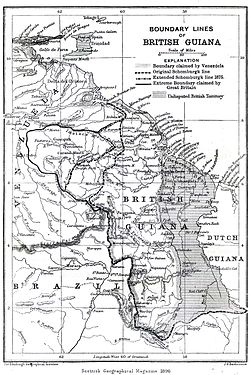
The Venezuelan crisis of 1895 became 'one of the most momentous episodes in the history of Anglo-American relations.' Venezuela sought to involve the U.S. in its border dispute with Britain over the Essequibo region.
Image source: Venezuelan crisis of 1895
1895 - 1933
% completado
President Grover Cleveland, through Secretary of State Richard Olney, cited the doctrine in 1895, threatening strong action against Britain if it failed to arbitrate its dispute with Venezuela. The Olney interpretation was defunct by 1933.
Oct 1897
% completado
German chancellor Otto von Bismarck did not accept the U.S. definition of the Monroe Doctrine and its claimed hegemony in the hemisphere, calling the doctrine an 'uncommon insolence' in October 1897.
Image source: Otto von Bismarck
Oct 3, 1899
% completado
Sitting in Paris, the Tribunal of Arbitration finalized its decision on October 3, 1899. The Venezuelans were keenly disappointed with the outcome but abided by the award.
1902 - 1903
% completado
The Venezuela crisis of 1902–1903 showed the world that the United States itself could successfully enforce the doctrine, a pivotal moment in American foreign policy. Britain, Germany, and Italy had blockaded Venezuela over unpaid foreign debts.
Image source: Venezuelan crisis of 1902–1903
1904
% completado
Instead of relying on European powers, Roosevelt added the Roosevelt Corollary to the Monroe Doctrine in 1904, asserting the right of the United States to intervene in Latin American nations. Before becoming president, Roosevelt had proclaimed the doctrine's rationale in supporting intervention in Cuba in 1898.
Image source: Roosevelt Corollary
1904 - 1935
% completado
The early decades of the 20th century saw numerous U.S. interventions in Latin America, including military presence in Cuba, Honduras, Panama, Haiti (1915–1935), the Dominican Republic (1916–1924), and Nicaragua (1912–1925 and 1926–1933).
Image source: Banana Wars
Aug 2, 1912
% completado
On August 2, 1912, the U.S. Senate passed a resolution in response to a reported attempt by a Japan-backed private company to acquire Magdalena Bay in Baja California Sur, extending the doctrine against non-European powers.
1898
% completado
Only Cuba and Puerto Rico remained under Spanish rule until the Spanish–American War in 1898. After 1898, the Monroe Doctrine was reinterpreted by lawyers and intellectuals as promoting multilateralism and non-intervention.
Image source: Spanish–American War
1902
% completado
In 1902, Canadian prime minister Wilfrid Laurier acknowledged that the Monroe Doctrine was essential to his country's protection.
Image source: Wilfrid Laurier
Dec 29, 1902
% completado
The Drago Doctrine was announced on December 29, 1902, by Argentine foreign minister Luis María Drago, opposing armed debt collection in Latin America in response to the European blockade of Venezuela.
Image source: Drago Doctrine
Dec 17, 1928
% completado
The Clark Memorandum, written on December 17, 1928, by President Calvin Coolidge's undersecretary of state J. Reuben Clark, repudiated the Roosevelt Corollary. It was officially released in 1930 by the Hoover administration.
1933
% completado
In 1933, under President Franklin D. Roosevelt, the United States embraced the Good Neighbor Policy, renouncing armed intervention in Latin America and marking a shift away from unilateral enforcement of the Monroe Doctrine.
Image source: Good Neighbor policy
1940
% completado
A 1940 national survey found that 81% of Americans supported defending Canada; 75% Mexico and Central America; 69% South America; 66% the West Indies; and 59% Greenland.
Dec 1941
% completado
The December 1941 conquest of Saint Pierre and Miquelon by Free French forces from Vichy France control was seen as a violation of the Monroe Doctrine by Secretary of State Cordell Hull.
Image source: Saint-Pierre, Saint Pierre and Miquelon
1948
% completado
Control of the Monroe Doctrine shifted to the multilateral Organization of American States (OAS), founded in 1948, reflecting the postwar move toward collective hemispheric security.
Image source: Organization of American States
1948
% completado
The US military remained in Greenland after World War II, and by 1948 Denmark abandoned attempts to persuade the US to leave. A 1951 treaty gave the US a significant role in Greenland's defense; as of 2025 the US Space Force maintains Pituffik Space Base there.
Image source: Pituffik Space Base
1953 - 1959
% completado
When the Cuban Revolution (1953–1959) established a communist government with ties to the Soviet Union, it was argued that the Monroe Doctrine should be invoked to prevent the spread of Soviet-backed communism in Latin America.
Image source: Cuban Revolution
1954
% completado
In 1954, Secretary of State John Foster Dulles invoked the Monroe Doctrine at the 10th Pan-American Conference in Caracas, denouncing the intervention of Soviet communism in Guatemala.
Image source: John Foster Dulles
1962
% completado
During the Cuban Missile Crisis in 1962, President John F. Kennedy cited the Monroe Doctrine as grounds for the United States' confrontation with the Soviet Union over the installation of Soviet ballistic missiles on Cuban soil.
Image source: Cuban Missile Crisis
1984
% completado
CIA director Robert Gates vigorously defended the Contra operation in Nicaragua in 1984, arguing that eschewing U.S. action would cede the hemisphere to Soviet influence, invoking the spirit of the Monroe Doctrine.
Image source: Robert Gates
Nov 2013
% completado
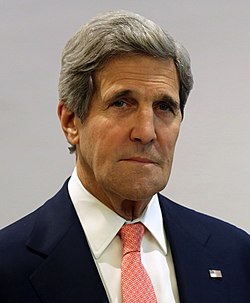
Secretary of State John Kerry told the Organization of American States in November 2013 that the 'era of the Monroe Doctrine is over,' calling for mutual partnership with other countries in the Americas.
Image source: John Kerry
Aug 2017
% completado
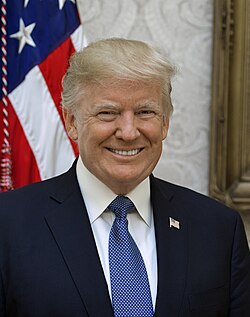
President Donald Trump implied potential use of the doctrine in August 2017 when he mentioned the possibility of military intervention in Venezuela, after CIA director Mike Pompeo blamed the nation's deterioration on Iranian- and Russian-backed groups.
Image source: Donald Trump
Feb 2018
% completado
In February 2018, Secretary of State Rex Tillerson praised the Monroe Doctrine as 'clearly… a success', warning of 'imperial' Chinese trade ambitions and touting the United States as the region's preferred trade partner.
Image source: Rex Tillerson
Sep 2018
% completado
Trump reiterated his commitment to the implementation of the Monroe Doctrine at the 73rd UN General Assembly in 2018, after Pompeo replaced Tillerson as Secretary of State in May 2018.
Jan 26, 2019
% completado
Russia accused the United States of implementing the Monroe Doctrine for what Russia perceived as such at the 8,452nd emergency meeting of the UN Security Council on January 26, 2019.
Image source: United Nations Security Council
2025
% completado
The final draft of the 2025 National Security Strategy called upon the United States to 'reassert and enforce the Monroe Doctrine to restore American pre-eminence in the Western Hemisphere,' announcing the 'Trump Corollary' to the doctrine.
Image source: National Security Strategy (United States)
Jan 2026
% completado
Following the capture of Venezuelan President Nicolás Maduro in a January 2026 raid, Trump claimed the action was an application of the Monroe Doctrine, stylizing it as the 'Donroe Doctrine' and declaring that 'American dominance in the Western Hemisphere will never be questioned again.'
Image source: Nicolás Maduro
Or browse the full history timeline directory, with more than 2,000 topics.
This Monroe Doctrine timeline was generated with the help of AI, using information found on the internet.
We work hard to keep these timelines accurate, but mistakes do get through. If you spot one, email us at [email protected] and we'll fix it for future visitors.
Generate yours with AI or build it from scratch, for free.
Export your timeline, add your own events, edit or remove AI-generated events, and much more
No credit card required.
Cancel anytime.
Cancel anytime.
You can create an unlimited number of timelines with up to 10 events on each one, customize how they look, export them to PDF, PNG, PowerPoint, CSV, and Excel, and share them with a link. Paid plans raise the event limit and add features like spreadsheet imports and collaborators.
Yes. You can cancel your subscription from your account page at any time, and you will not be charged again. Your subscription stays active for the rest of the period you already paid for.
Yes. We will email you a reminder before the annual renewal, and we will also email you a receipt.
Yes. You can email us within 15 days of any payment, and we will issue you a full refund.
Check out our pricing docs or send us an email anytime: [email protected].