-
Use Cases
-
Resources
-
Pricing
James Monroe (1758-1831) was the fifth President of the United States, serving from 1817 to 1825. A Founding Father, Revolutionary War veteran, and the last president of the Virginia dynasty, he is best known for the Monroe Doctrine of 1823, which warned European powers against further colonization in the Americas. His presidency, often called the Era of Good Feelings, was marked by national unity, westward expansion, and major diplomatic achievements. More Less
Apr 28, 1758
% complete
James Monroe was born in Westmoreland County, Virginia, to Spence Monroe and Elizabeth Jones. He grew up on a modest plantation, the son of a carpenter-planter family, and would go on to become the fifth President of the United States.
Image source: James Monroe
1774
% complete
Monroe entered the College of William & Mary in Williamsburg, Virginia. His studies were interrupted by the Revolutionary War, but his time there exposed him to revolutionary politics and ideas circulating among Virginia's patriot elite.
Dec 26, 1776
% complete
As a lieutenant under General George Washington, Monroe crossed the Delaware River and fought at the Battle of Trenton, where he was severely wounded by a musket ball in the shoulder while leading a charge against the Hessian garrison.
Image source: Battle of Trenton
1780
% complete
After leaving military service, Monroe studied law in Fredericksburg under the mentorship of Governor Thomas Jefferson, beginning a lifelong friendship and political alliance that would shape both men's careers.
Image source: Thomas Jefferson
1782
% complete
Monroe began his political career by winning election to the Virginia House of Delegates, where he served for one year before moving on to national political bodies during the formative period of American independence.
Image source: Virginia House of Delegates
Nov 3, 1783 - Nov 7, 1786
% complete
Monroe served three terms in the Congress of the Confederation, sitting in Annapolis, Trenton, and New York City. There he advocated for western expansion and helped negotiate navigation rights on the Mississippi River.
Image source: Congress of the Confederation
Feb 16, 1786
% complete
Monroe married Elizabeth Kortright, the daughter of a wealthy New York merchant, at Trinity Church in Manhattan. The couple had two daughters who survived to adulthood: Eliza and Maria Hester.
Image source: Elizabeth Monroe
1790 - 1794
% complete
Monroe was appointed and then elected as U.S. Senator from Virginia, becoming a leader of the emerging Democratic-Republican Party alongside James Madison and opposing the Federalist policies of Alexander Hamilton.
Image source: United States Senate
1799 - 1802
% complete
Elected by the Virginia General Assembly, Monroe served as Governor of Virginia, supporting Jefferson's candidacy in the election of 1800 and strengthening the Democratic-Republican Party's organization in the state.
Image source: Governor of Virginia
1811
% complete
Monroe returned to Virginia politics, serving briefly as governor again before being called into federal service by President Madison amid rising tensions with Britain.
May 11, 1794 - 1796
% complete
President Washington appointed Monroe as Minister Plenipotentiary to France. A sympathizer of the French Revolution, Monroe secured the release of Thomas Paine from prison, though his pro-French stance led Washington to recall him in 1796.
1797
% complete
Monroe published a lengthy defense of his conduct in France, criticizing the Federalist administration's foreign policy toward France. The work cemented his reputation as a committed member of the Democratic-Republican opposition.
Image source: The View
1803 - 1808
% complete
Jefferson appointed Monroe Minister to Britain, tasking him with securing a commercial treaty and resolving British impressment of American sailors. Negotiations ultimately failed to resolve the maritime disputes that led to the War of 1812.
Image source: List of ambassadors of the United States to the United Kingdom
Apr 12, 1803 - Apr 30, 1803
% complete
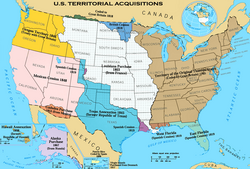
Sent by Jefferson to assist Robert Livingston in negotiations with Napoleon's France, Monroe arrived just in time to help secure the purchase of the entire Louisiana Territory, doubling the size of the United States for $15 million.
Image source: Louisiana Purchase
Apr 2, 1811 - Mar 3, 1817
% complete
President James Madison appointed Monroe Secretary of State, making him the central figure in managing American diplomacy through the period of escalating conflict with Britain that culminated in the War of 1812.
Image source: United States Secretary of State
Aug 24, 1814
% complete
British forces captured and burned Washington, D.C., including the White House, during the War of 1812. Monroe had warned of the British approach and rode out to survey the battlefield at Bladensburg before the capital fell.
Image source: Burning of Washington
Dec 24, 1814
% complete
American commissioners including Henry Clay and John Quincy Adams negotiated an armistice with Britain in Belgium, restoring prewar boundaries. As Secretary of State, Monroe oversaw the treaty's ratification and implementation.
Image source: Treaty of Ghent
Apr 28, 1817
% complete
Negotiated between Acting Secretary Richard Rush and British Minister Charles Bagot, this agreement demilitarized the Great Lakes and Lake Champlain, establishing a lasting peace between the United States and British North America.
Image source: Rush–Bagot Treaty
Oct 20, 1818
% complete
This Anglo-American convention established the 49th parallel as the border from Minnesota to the Rocky Mountains, granted joint occupation of the Oregon Country, and allowed Americans fishing rights off Newfoundland.
Image source: Treaty of 1818
Feb 22, 1819
% complete
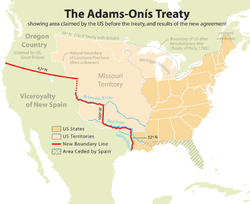
Secretary of State John Quincy Adams negotiated the transfer of Spanish Florida to the United States, along with a defined boundary extending to the Pacific, resolving long-standing territorial disputes with Spain.
Image source: Adams–Onís Treaty
1822
% complete
The Monroe administration formally recognized the newly independent nations of Latin America, including Argentina, Chile, Colombia, and Mexico, aligning the United States with the republican movements that had broken from Spanish colonial rule.
Dec 2, 1823
% complete
In his seventh annual message to Congress, Monroe declared that further European colonization or intervention in the Western Hemisphere would be viewed as acts of aggression requiring U.S. response. Drafted largely by Secretary Adams, it became a cornerstone of American foreign policy.
Mar 4, 1817
% complete
Monroe was inaugurated as the fifth President of the United States, succeeding James Madison. His inauguration marked the beginning of the Era of Good Feelings, a period of relative political harmony after the War of 1812.
Image source: First inauguration of James Monroe
Nov 1817 - 1819
% complete
During Monroe's presidency, General Andrew Jackson led military campaigns against Seminole Indians and Spanish-allied forces in Florida, seizing Spanish posts and effectively demonstrating Spain's inability to control the territory.
Image source: Seminole Wars
1819 - 1823
% complete
The first major peacetime financial crisis in the United States brought widespread bank failures, foreclosures, and unemployment. The Panic prompted debates over banking, debt relief, and federal economic policy that shaped the era's politics.
Image source: Panic of 1819
Mar 3, 1820
% complete
Congress resolved the Missouri crisis by admitting Missouri as a slave state and Maine as a free state while prohibiting slavery north of the 36°30' line in the Louisiana Territory. Monroe signed the compromise despite constitutional concerns.
Image source: Missouri Compromise
Oct 14, 1820
% complete
Monroe won re-election with all but one electoral vote; a New Hampshire elector cast his ballot for John Quincy Adams, reportedly to preserve George Washington's record as the only unanimously elected president.
Image source: 1820 United States presidential election
Aug 10, 1821
% complete
Following the acceptance of a proviso ensuring no restriction on citizens' rights based on religion or state origin, Monroe proclaimed Missouri's admission as the twenty-fourth state, completing the Missouri Compromise process.
Mar 3, 1825
% complete
Monroe left office after two terms, handing the presidency to John Quincy Adams. He retired to Oak Hill, his Virginia estate, having overseen national expansion, economic growth, and a unified single-party political landscape.
Image source: Presidency of James Monroe
Oct 5, 1829 - 1830
% complete
Despite failing health, Monroe served as president of Virginia's constitutional convention, which debated suffrage reform and representation between eastern planters and western settlers in the commonwealth.
Image source: Virginia Constitutional Convention of 1829–1830
Jul 4, 1831
% complete
Monroe died in New York City on Independence Day, the third president to die on July 4, following Thomas Jefferson and John Adams who died five years earlier. He was initially buried in New York and later reinterred at Hollywood Cemetery in Richmond, Virginia.
Image source: Death of Marilyn Monroe
Or browse the full history timeline directory, with more than 2,000 topics.
This James Monroe timeline was generated with the help of AI, using information found on the internet.
We work hard to keep these timelines accurate, but mistakes do get through. If you spot one, email us at [email protected] and we'll fix it for future visitors.
Generate yours with AI or build it from scratch, for free.
Export your timeline, add your own events, edit or remove AI-generated events, and much more
No credit card required.
Cancel anytime.
Cancel anytime.
You can create an unlimited number of timelines with up to 10 events on each one, customize how they look, export them to PDF, PNG, PowerPoint, CSV, and Excel, and share them with a link. Paid plans raise the event limit and add features like spreadsheet imports and collaborators.
Yes. You can cancel your subscription from your account page at any time, and you will not be charged again. Your subscription stays active for the rest of the period you already paid for.
Yes. We will email you a reminder before the annual renewal, and we will also email you a receipt.
Yes. You can email us within 15 days of any payment, and we will issue you a full refund.
Check out our pricing docs or send us an email anytime: [email protected].