-
Resources
-
Pricing
The history of puppetry traces how animated figures have been used for storytelling, ritual, education, satire, and entertainment across cultures and centuries. More Less
Build a timeline like this one in minutes, for free. Start Yours →
Part of our collection of performing arts history timelines.
3000 BCE
Some forms of puppetry may have originated as long ago as 3000 BCE, making puppetry one of the world's oldest theatrical arts.
2500 BCE
Archaeologists unearthed a terracotta doll dating to 2500 BCE whose detachable head could be manipulated by a string, providing early evidence of puppet technology.
Image source: Puppetry
2000 BCE
Evidence indicates that string-operated wooden figures were used in Egypt as early as 2000 BCE, including figures manipulated to perform the action of kneading bread.
2000 BCE
Some scholars trace puppetry in India back 4000 years. In Sanskrit theatre, the main character was known as Sutradhara, meaning “holder of strings.”
1000 BCE
China has a puppetry history dating back about 3000 years, including pi-yung xi, the theatre of lantern shadows, now commonly called Chinese shadow theatre.
500 BCE
Puppetry was first recorded in the 5th century BCE in Ancient Greece. The works of Herodotus and Xenophon contain some of the oldest written records of the art.
300 BCE
According to Beth Osnes, the Indian shadow-puppet theatre tradition called tholu bommalata dates back to the 3rd century BCE.
200 BCE - 200
Puppets are described in the Mahabharata, Tamil Sangam literature, the Edicts of Ashoka, and other works dating from the late centuries BCE through the early centuries CE.
960 - 1279
During the Song dynasty, puppets performed for all social classes, including the imperial courts, although puppeteers were generally regarded as belonging to a lower social stratum.
1000
Puppets were known in Iran much earlier than 1000, with glove and string puppets initially serving as the principal forms.
1517
One theory holds that shadow theatre entered Anatolia from Egypt and reached Ottoman palaces after Yavuz Sultan Selim conquered Egypt in 1517.
1700 - 1900
New genres of Iranian puppetry emerged during the Qajar era as Turkish influences spread through the region.
1780
The probable origin of Burmese marionettes is placed around 1780, during the reign of King Singu Min. Their introduction is credited to U Thaw, the Minister of Royal Entertainment.
300 BCE
By the 3rd century BCE, Greek puppet plays appeared at the Theatre of Dionysus on the Acropolis, connecting puppetry with a major civic theatre venue.
Image source: Theatre of Dionysus
1250
The Sicilian Opera dei pupi and cantastorie storytelling traditions are rooted in the Provençal troubadour tradition in Sicily during the reign of Frederick II in the first half of the 13th century.
1338 - 1344
Folio 54v of the Flemish manuscript Li romans du boin roi Alixandre, illuminated by the workshop of Jehan de Grise, provides a medieval European depiction associated with puppetry.
1500
Traditional British Punch and Judy puppetry traces its roots to the 16th-century Italian commedia dell'arte tradition.
1519
Two puppeteers accompanied Hernán Cortés on his first journey to Mexico in 1519, carrying European puppetry into the Spanish colonial context.
Image source: Hernán Cortés
1700
During the 18th century, operas were specifically composed for marionette puppets, reflecting the development of specialized puppet theatre in Italy.
1750 - 1850
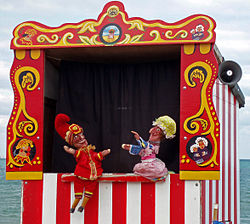
In the late 18th and early 19th centuries, the familiar British Punch and Judy show was performed in an easily transportable booth.
Image source: Punch and Judy
1797
After falling on hard times during the French Revolution, Laurent Mourguet began practicing dentistry in 1797, pulling teeth as was common in that period.
1800 - 1900
In the 19th century, Pietro Radillo made marionettes more complex, controlling individual body parts with as many as eight strings instead of only a rod and two strings.
1804
By 1804, Laurent Mourguet's puppet work had become successful enough for him to abandon dentistry and become a professional puppeteer who improvised topical scenarios for working-class audiences.
1808
Laurent Mourguet developed characters drawn from everyday Lyon life, including Gnafron, a wine-loving cobbler, and Guignol in 1808.
1855
Count Franz Pocci founded the Munich Marionette Theatre in 1855, an important institution in German puppet theatre.
1911 - 1912
Jindřich Veselý co-founded the Czech Association of Friends of Puppet Theatre in 1911 and advocated publication of Loutkář, the oldest specialist puppet-theatre magazine still published, in 1912.
1913
Professor Anton Aicher founded the Salzburg Marionette Theatre in 1913, establishing a major European institution devoted to marionette performance.
1920 - 1926
Josef Skupa created the puppet characters Spejbl and Hurvínek in 1920 and 1926, respectively, establishing a renowned Czech comic puppet pairing.
Image source: Spejbl and Hurvínek
1929
Jindřich Veselý played a key role in founding UNIMA, the International Puppetry Association, in 1929 and became its first president.
1930
Josef Skupa established the first modern professional Czech puppet theatre in 1930.
1943
Walter Oehmichen founded the Augsburg Marionette Theatre in 1943.
2000
Bernard Leismueller and Ralf Hechelmann founded the Lindau Marionette Opera in Lindau in 2000.
2016
Czech and Slovak puppetry was included on the UNESCO Intangible Cultural Heritage Lists in 2016.
1800 - 1900
During the 19th century, puppetry faced increasing competition from other popular theatrical forms, including vaudeville and music hall.
1810
Heinrich von Kleist wrote his essay On the Marionette Theatre in 1810, admiring the puppet's lack of self-consciousness and influencing later artistic thinking about puppetry.
1900 - 1930
In the early 20th century, the British Puppet and Model Theatre Guild helped instigate a resurgence of puppetry in Britain.
1946
Puppets began to be used extensively in animated films from 1946, expanding the medium beyond live theatrical performance.
1949
One of George Bernard Shaw's last plays, Shakes versus Shav, was written for and first performed by a puppet company in 1949.
1957 - 1969
From 1957 to 1969, Gerry Anderson produced television series starring marionettes, beginning with The Adventures of Twizzle and ending with The Secret Service.
Image source: Gerry Anderson
1983 - 1987
Gerry Anderson returned to puppetry with Terrahawks in 1983 and the unaired pilot Space Police in 1987.
1984 - 1996
The British television series Spitting Image used puppetry as a vehicle for political satire from 1984 to 1996.
1959 - 1999
Norman Hetherington's marionette Mr. Squiggle appeared on an Australian Broadcasting Commission television program from 1 July 1959 until 9 July 1999.
1966
John and Jackie Lewis founded Jeral Puppets in Sydney in 1966. The company performed regularly at Puppeteria Puppet Theatre and on tour.
1968
The International Puppet Festival has taken place annually in mid-September in Zagreb, Croatia, since 1968.
1977 - 2002
Melbourne's Handspan Theatre evolved from a small collective into a design-rich visual-theatre company and a center for innovative projects and multimedia collaborations.
May 28, 1977
Phillip Edmiston's Theatrestrings premiered the lavish marionette production The Grand Adventure in Nambour on 28 May 1977. Featuring 127 marionettes and costing A$120,000, it later toured Sydney, Melbourne, and Brisbane.
1981
Peter Wilson, Cathryn Robinson, and Beverley Campbell-Jackson founded Spare Parts Puppet Theatre in Fremantle in 1981. Its first project was a puppet adaptation of Christopher Marlowe's Doctor Faustus.
2018
Some of Phillip Edmiston's puppets were displayed in a special puppet exhibition at the Queensland Performing Arts Complex in 2018.
2020
The Puppet Festival Mississauga has taken place annually in March in Mississauga, Ontario, since 2020.
2021
Rob Irvin and teacher Chris Elkington formed Melbourne Puppet Kerfuffle in 2021 to tour schools and kindergartens with educational puppet shows based on curriculum topics.
Build a timeline like this one in minutes, for free. Start Yours →
Or browse the full history timeline directory, with more than 3,000 topics.
This History of Puppetry timeline was generated with the help of AI, using information found on the internet.
We work hard to keep these timelines accurate, but mistakes do get through. If you spot one, email us at [email protected] and we'll fix it for future visitors.
Generate yours with AI or build it from scratch, for free.
Export your timeline, add your own events, edit or remove AI-generated events, and much more
No credit card required.
15-day money-back guarantee.
You can create an unlimited number of timelines with up to 10 events on each one, customize how they look, export them to PDF, PNG, PowerPoint, CSV, and Excel, and share them with a link. Timelines made with Timeline Maker AI keep every event the generator created, and you can add up to 5 events of your own. Paid plans remove the event limit, add spreadsheet imports and hide Preceden's branding, and the higher-priced plan also adds collaborators, a custom logo and a custom domain.
Yes. You can cancel your subscription from your account page at any time, and you will not be charged again. Your subscription stays active for the rest of the period you already paid for.
Yes. We email you a reminder 15 days before your annual renewal, and we email you a receipt after every payment.
Yes. You can email us within 15 days of any payment, and we will issue you a full refund.
Check out our pricing docs or send us an email anytime: [email protected].