
-
Resources
-
Pricing
The history of the circus traces the development of organized public entertainment from ancient spectacles and medieval performers to the modern circus. It includes equestrian displays, acrobatics, clowns, sideshows, theatrical production, and the gradual shift toward animal-free performances. More Less
Build a timeline like this one in minutes, for free. Start Yours →
1700 - 1899
From the late eighteenth through the late nineteenth century, custom-made circus buildings were constructed, often from wood. They commonly featured tiered seating, a center ring, and sometimes a stage.
Image source: Circus
1700 - 1799
Astley adopted a ring diameter of about 42 feet as the minimum space in which an acrobatic rider could stand upright on a cantering horse while performing tricks. The dimension became a defining feature of the circus ring.
1742
Philip Astley, widely credited with originating the modern circus, was born in Newcastle-under-Lyme, England. He later became a cavalry officer and developed a performance format centered on equestrian skill.
Image source: Philip Astley
1768
Astley began performing exhibitions of trick horse riding in an open field called Ha'penny Hatch on the south side of the Thames River in England.
Apr 4, 1768
Astley established the first modern amphitheatre for displaying horse-riding tricks in Lambeth, London. The venue helped establish the setting and performance structure associated with the modern circus.
1770
Astley hired acrobats, tightrope walkers, jugglers, and a clown to fill pauses between equestrian acts. This combination of horse riding and varied performers created the format later named a circus.
1781
Joseph Grimaldi had his first major role as Little Clown in the pantomime The Triumph of Mirth; or, Harlequin's Wedding. He later became recognized as the first mainstream clown.
Image source: Joseph Grimaldi
Nov 4, 1782
Charles Dibdin opened the Royal Circus in London with the help of equestrian performer Charles Hughes. Dibdin is credited with coining the term circus.
1800 - 1979
The traditional or classical circus format developed in the latter part of the nineteenth century. A ringmaster introduced a sequence of choreographed acts set to music, and this remained the dominant format until the 1970s.
1700 - 1799
Beginning as far back as the early eighteenth century, exotic animals were transported to North America for display. Menageries became a popular form of entertainment and later became closely associated with traveling circuses.
Image source: Menagerie
1800 - 1899
A popular sideshow attraction from the early nineteenth century was the flea circus. Fleas were attached to props and viewed through a Fresnel lens.
1833
Isaac A. Van Amburgh entered a cage with several big cats. He is generally considered the first wild animal trainer in American circus history.
1780 - 1789
The future circus performer and entrepreneur John Bill Ricketts began his theatrical career with Hughes Royal Circus in London during the 1780s.
1782
Astley established the Amphithéâtre Anglais in Paris, the first purpose-built circus in France. It was followed by 18 other permanent circuses in cities across Europe.
1792
Ricketts traveled from England to establish his first circus in Philadelphia, helping transfer the emerging European circus tradition to the United States.
1793
Astley leased his Parisian circus to the Italian performer Antonio Franconi. Franconi became an important figure in the development of permanent circus institutions in France.
Apr 3, 1793
The first circus building in the United States opened in Philadelphia. Ricketts gave America's first complete circus performance there.
1800 - 1999
From the late nineteenth century through the first half of the twentieth century, traveling circuses were a major form of spectator entertainment in the United States. Their arrival in a city attracted considerable public attention.
1800 - 1899
Large touring tents known as big tops were introduced in the mid-nineteenth century. Touring circuses increasingly superseded static venues because tents could be transported and erected in new locations.
1800 - 1820
During the first two decades of the nineteenth century, the Circus of Pepin and Breschard toured from Montreal to Havana. The company built circus theaters in many of the cities it visited.
1825
Joshuah Purdy Brown became the first circus owner identified with using a large canvas tent for circus performances, helping establish the touring big-top format.
1826
The first circus took place under a canvas big top in 1826. Canvas tents later enabled circuses to move more easily between towns and replace many static venues.
1838
Equestrian Thomas Taplin Cooke returned to England from the United States with a circus tent, contributing to the spread of the touring tent format in Britain.
1838 - 1840
William Batty's circus traveled from Newcastle to Edinburgh and then to Portsmouth and Southampton. Its itinerary exemplified the growing importance of mobile circus companies.
1866
Soullier became the first circus owner to introduce Chinese acrobatics to the European circus after returning from travels in 1866. Tourniaire later introduced the art to Ranga, where it became extremely popular.
1897 - 1902
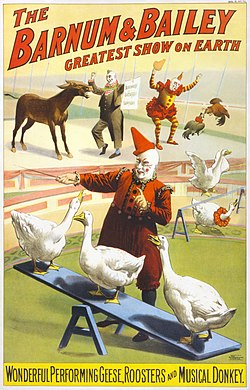
After the 1881 merger involving James Anthony Bailey and James L. Hutchinson, and following P. T. Barnum's death in 1891, the circus toured Europe as Barnum & Bailey's Greatest Show on Earth from 1897 to 1902. Its large scale, circus trains, tents, zoological exhibition, and freak show influenced European circus owners.
Image source: Ringling Bros. and Barnum & Bailey Circus
1900 - 1999
The combination of multiple circus acts, large tents, circus trains, zoological exhibitions, and sideshow attractions developed by major American circuses was adopted by European circuses at the turn of the twentieth century.
1919
Lenin, head of Soviet Russia, expressed a wish for the circus to become “the people's art-form,” with facilities and cultural status comparable to theater, opera, and ballet.
1927
The State University of Circus and Variety Arts, commonly known as the Moscow Circus School, was established in 1927. Performers were trained using methods developed from the Soviet gymnastics program.
1900 - 1999
The title of clown refers to role functions and performance skills rather than simply the red nose and exaggerated face paint popularized through twentieth-century mass media.
Image source: Clown
1974
The International Circus Festival of Monte-Carlo has been held in Monaco since 1974. It was the first of many international awards and festivals recognizing circus performers.
1975
The Pickle Family Circus was founded in San Francisco in 1975. It became an early pioneer of the new circus movement.
1977
Circus Oz was formed in Australia in 1977 from the earlier groups SoapBox Circus, founded in 1976, and New Circus, founded in 1973.
1980 - 1989
Le Cirque Imaginaire was founded and directed by Victoria Chaplin, daughter of Charlie Chaplin. The troupe was later renamed Le Cirque Invisible.
1984 - 1986
Ra-Ra Zoo in London, Nofit State Circus from Wales, Cirque du Soleil in Quebec, and Cirque Plume in France were founded in 1984. Archaos followed in France in 1986, helping establish new circus as a major genre.
1987
Circus Smirkus was founded in Vermont in 1987 by Rob Mermin. It became one of the notable troupes associated with the developing contemporary circus movement.
1990 - 1999
The West African Circus Baobab emerged in the late 1990s, contributing African performance traditions and perspectives to the international contemporary circus field.
1993
Cirque Éloize was founded in Quebec in 1993 and became one of the prominent companies associated with contemporary circus.
1995
The contemporary circus genre is largely considered to have begun with Le Cri du Caméléon, an ensemble performance by the graduating class of France's Centre National des Arts du Cirque. It was directed by Joseph Nadj.
1995
Sweden's Cirkus Cirkör was founded in 1995, adding a major Scandinavian company to the international contemporary circus movement.
1998
Teatro ZinZanni was founded in Seattle in 1998. The company combined circus performance with theater, comedy, music, and dinner-show traditions.
2000 - 2099
Some commentators use the term 21st Century Circus to encompass the many circus styles available in the present day. The concept reflects the genre's continuing evolution beyond the traditional format.
2000 - 2099
21st Century Circus continues to develop variations on circus tradition while absorbing new skills, techniques, stylistic influences from other art forms, and technological developments.
2000 - 2099
For aesthetic or economic reasons, contemporary circus productions may be staged in theaters rather than in large outdoor tents. This reflects the flexibility of modern circus presentation.
2002
Montreal's Les 7 doigts de la main was founded in 2002 and became a significant contemporary circus company known for integrating acrobatics with theatrical storytelling.
2009
By 2009, Cirque du Soleil's estimated annual revenue exceeded US$810 million. Its productions had been seen by nearly 90 million spectators in more than 200 cities across five continents.
Image source: Cirque du Soleil
Build a timeline like this one in minutes, for free. Start Yours →
Or browse the full history timeline directory, with more than 2,500 topics.
This History of the Circus timeline was generated with the help of AI, using information found on the internet.
We work hard to keep these timelines accurate, but mistakes do get through. If you spot one, email us at [email protected] and we'll fix it for future visitors.
Generate yours with AI or build it from scratch, for free.
Export your timeline, add your own events, edit or remove AI-generated events, and much more
No credit card required.
15-day money-back guarantee.
You can create an unlimited number of timelines with up to 10 events on each one, customize how they look, export them to PDF, PNG, PowerPoint, CSV, and Excel, and share them with a link. Timelines made with Timeline Maker AI keep every event the generator created, and you can add up to 5 events of your own. Paid plans remove the event limit, add spreadsheet imports and hide Preceden's branding, and the higher-priced plan also adds collaborators, a custom logo and a custom domain.
Yes. You can cancel your subscription from your account page at any time, and you will not be charged again. Your subscription stays active for the rest of the period you already paid for.
Yes. We email you a reminder 15 days before your annual renewal, and we email you a receipt after every payment.
Yes. You can email us within 15 days of any payment, and we will issue you a full refund.
Check out our pricing docs or send us an email anytime: [email protected].