-
Resources
-
Pricing
The history of saddles traces how people developed increasingly secure, comfortable, and specialized equipment for riding horses across different cultures and eras. More Less
Build a timeline like this one in minutes, for free. Start Yours →
1874
The story is set on the American frontier in 1874, where a railroad under construction must be rerouted through Rock Ridge to avoid quicksand.
1874
The railroad's proposed route through Rock Ridge drives the film's central conflict, allowing land speculation, racial prejudice, and Western conventions to become targets of satire.
1969
Ishmael Reed's 1969 novel Yellow Back Radio Broke-Down was a satirical treatment of the traditional Western. It has been cited as an important precursor or influence on Blazing Saddles, a connection Reed himself made.
Image source: Yellow Back Radio Broke-Down
1971
Andrew Bergman developed the story that became Blazing Saddles, framing a comic Western in which a railroad project threatens the town of Rock Ridge.
1972
By 2013, accounts acknowledged that Mel Brooks had abandoned plans for Richard Pryor to star by early 1972. The later claim that Pryor was uninsurable because of a drug arrest was reportedly spread by Brooks after Pryor's death in 2005.
1972
Mel Brooks was attracted to the project's deliberately anachronistic style, describing it as 1974 talk and expressions happening in the 1874 Old West. He purchased the film rights from Andrew Bergman.
1972
The proposed title Tex X was rejected because it could be mistaken for an X-rated film.
1972
Black Bart was considered as a title, referencing the nineteenth-century white highwayman Black Bart, but it was ultimately rejected.
1972
Purple Sage was another proposed title for the film that did not become the final title.
Image source: Blazing Saddles
Mar 6, 1973
Principal photography on Blazing Saddles began on March 6, 1973.
May 1973
Filming wrapped in early May 1973, completing the principal photography phase.
1974
The movie became a historically large box-office hit despite being released early in the year.
1974
I'm Tired also draws on Dietrich's performance of Falling in Love Again (Can't Help It) from The Blue Angel.
Image source: The Blue Angel
1974
The musical number I'm Tired pays homage to and parodies Marlene Dietrich's performance of Cole Porter's I'm the Laziest Gal in Town in Alfred Hitchcock's 1950 film Stage Fright.
1974
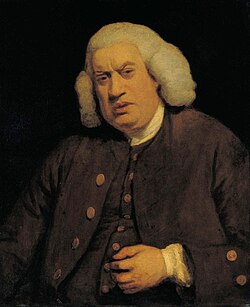
The reference to Dr. Samuel Johnson invokes the eighteenth-century English writer and lexicographer.
Image source: Samuel Johnson
1974
1974
The film's Howard Johnson reference points to the now-defunct Howard Johnson's restaurant chain.
Image source: Howard Johnson's
1974
The name Olson Johnson references the vaudeville comedy team Olsen and Johnson.
Image source: Olsen and Johnson
1974
The film refers to Le Pétomane, the stage name of Joseph Pujol, a nineteenth-century French performer known as a professional flatulist.
Image source: Le Pétomane
Feb 7, 1974
The world premiere took place at the Pickwick Drive-In Theater in Burbank. Two hundred fifty invited guests, including Gene Wilder and Cleavon Little, watched the film on horseback.
Feb 7, 1974
Warner Bros. released Blazing Saddles on February 7, 1974. The film was directed by Mel Brooks and co-written by Brooks, Andrew Bergman, Richard Pryor, Norman Steinberg, and Alan Uger.
1976
The 1976 reissue earned an additional $10.5 million.
1979
A further reissue in 1979 earned another $8 million.
Jun 1974
Four months after the film's release, retired film star Hedy Lamarr sued Warner Communications and Mel Brooks for $10 million, alleging that the running joke involving her name invaded her privacy and was unauthorized.
Image source: Hedy Lamarr
1980
Blazing Saddles was released on VHS several times, extending its availability beyond theatrical and reissue runs.
1997
The film received its first DVD release in 1997 after several VHS editions.
2000
Blazing Saddles was ranked number six on the American Film Institute's 100 Years...100 Laughs list.
2004
Warner Bros. released a 30th Anniversary Special Edition DVD in 2004. Today praised the film for skewering racial prejudice while remaining funny after three decades.
2006
A Blu-ray version of Blazing Saddles was released in 2006.
2006
In 2006, the Library of Congress deemed Blazing Saddles culturally, historically, or aesthetically significant and selected it for preservation in the National Film Registry.
Image source: National Film Registry
2012
In 2012, Mel Brooks said that a contemporary remake would leave out the N-word, reflecting changing standards around the film's racial language.
2014
A 40th anniversary Blu-ray set was released in 2014.
2014
NPR wrote in 2014 that, four decades after its production, Blazing Saddles remained a biting satire of racism while criticizing its treatment of gays and women as lacking self-awareness.
Nov 4, 2024
For the film's 50th anniversary, Warner Bros. restored Blazing Saddles in 4K and released it on Ultra HD Blu-ray on November 4, 2024.
1988
The 1988 animated television film The Good, the Bad, and Huckleberry Hound continued the tradition of parodying Western conventions.
Image source: The Good, the Bad, and Huckleberry Hound
2011
In 2011, Supernatural's sixth-season episode The French Mistake referenced the genre-defining fourth-wall-breaking scene from Blazing Saddles.
Sep 2017
In September 2017, Mel Brooks indicated that he wanted to create a stage version of Blazing Saddles in the future.
2022
The 2022 animated film Paws of Fury: The Legend of Hank, starring Michael Cera, Samuel L. Jackson, Michelle Yeoh, and Ricky Gervais, was described as a loose remake of Blazing Saddles and was originally titled Blazing Samurai.
Image source: Paws of Fury: The Legend of Hank
Build a timeline like this one in minutes, for free. Start Yours →
Or browse the full history timeline directory, with more than 2,500 topics.
This History of Saddles timeline was generated with the help of AI, using information found on the internet.
We work hard to keep these timelines accurate, but mistakes do get through. If you spot one, email us at [email protected] and we'll fix it for future visitors.
Generate yours with AI or build it from scratch, for free.
Export your timeline, add your own events, edit or remove AI-generated events, and much more
No credit card required.
15-day money-back guarantee.
You can create an unlimited number of timelines with up to 10 events on each one, customize how they look, export them to PDF, PNG, PowerPoint, CSV, and Excel, and share them with a link. Timelines made with Timeline Maker AI keep every event the generator created, and you can add up to 5 events of your own. Paid plans remove the event limit, add spreadsheet imports and hide Preceden's branding, and the higher-priced plan also adds collaborators, a custom logo and a custom domain.
Yes. You can cancel your subscription from your account page at any time, and you will not be charged again. Your subscription stays active for the rest of the period you already paid for.
Yes. We email you a reminder 15 days before your annual renewal, and we email you a receipt after every payment.
Yes. You can email us within 15 days of any payment, and we will issue you a full refund.
Check out our pricing docs or send us an email anytime: [email protected].