-
Use Cases
-
Resources
-
Pricing
The history of science fiction traces the evolution of a literary genre that explores imaginative and futuristic concepts such as space travel, time travel, artificial intelligence, and alien life. Beginning with early works like Mary Shelley's Frankenstein, the genre developed through the pulp magazine era, the Golden Age of science fiction, the New Wave movement, and into contemporary cyberpunk and speculative fiction, reflecting humanity's changing relationship with technology and the future. More Less
1608
% complete
Johannes Kepler wrote 'Somnium' (The Dream), a story about a journey to the Moon that used real astronomical knowledge to imagine lunar conditions. Published posthumously in 1634, it is frequently regarded as the first work of serious scientific science fiction.
Image source: Somnium (novel)
1657
% complete
French writer Cyrano de Bergerac's posthumously published novel imagined a trip to the Moon using inventive propulsion methods. It combined satire with speculative science and influenced later space-travel fiction for centuries.
Image source: Cyrano de Bergerac
Jan 1, 1818
% complete
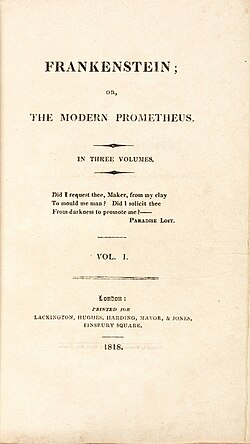
Mary Shelley's 'Frankenstein; or, The Modern Prometheus' was published anonymously in London. Often considered the first true science fiction novel, it explored the dangers of unchecked scientific ambition through Victor Frankenstein's creation of artificial life, raising enduring ethical questions about technology.
Image source: Frankenstein
Jun 1, 1835
% complete
Poe's short story about a balloon voyage to the Moon blended pseudo-scientific detail with humor and helped establish the American tradition of proto-science fiction, influencing writers like Jules Verne.
Image source: The Unparalleled Adventure of One Hans Pfaall
Jan 31, 1863
% complete
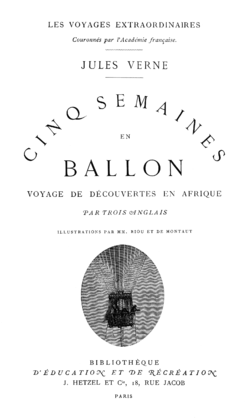
Jules Verne's first major success launched his 'Voyages extraordinaires' series. His rigorously researched adventure novels, including 'Twenty Thousand Leagues Under the Seas' (1870) and 'From the Earth to the Moon' (1865), established the 'scientific romance' tradition of hard, plausible speculation.
Image source: Five Weeks in a Balloon
May 7, 1895
% complete
Wells's novella popularized time travel as a literary concept and introduced the far-future species the Eloi and Morlocks. Wells went on to write 'The War of the Worlds' (1898) and other landmark works that shaped social science fiction.
Image source: The Time Machine
Apr 1, 1926
% complete
Gernsback launched the first magazine devoted exclusively to what he called 'scientifiction'. The pulp era it inaugurated brought genre fiction to mass audiences and gave rise to fandom, letter columns, and eventually organized conventions.
Image source: Amazing Stories
Jan 10, 1927
% complete
Lang's German expressionist masterpiece depicted a dystopian future city divided between wealthy elites and oppressed workers. Its imagery of robots and towering skyscrapers became iconic in science fiction cinema and influenced countless later films.
Image source: Metropolis (1927 film)
Aug 1, 1928
% complete
Serialized in 'Amazing Stories', Smith's novel pioneered the space opera subgenre, featuring interstellar travel, superweapons, and galactic conflict on a grand scale.
Jul 2, 1939 - Jul 3, 1939
% complete
NyCon I, held alongside the New York World's Fair, marked the birth of the annual Worldcon convention. It cemented a growing fan community and led to the establishment of the Hugo Awards in 1953.
Oct 1, 1937
% complete
Campbell's editorial vision demanded scientifically grounded stories with competent protagonists, launching the Golden Age of Science Fiction. He mentored writers including Isaac Asimov, Robert A. Heinlein, and Arthur C. Clarke.
Image source: John W. Campbell
May 1, 1942
% complete
Asimov's stories of a collapsing galactic empire and the science of psychohistory began serialization in 'Astounding'. The series became one of the most influential works in the genre's history.
Image source: Foundation (novel series)
Sep 1, 1947
% complete
Heinlein's first published novel launched his celebrated juveniles, bringing science fiction to young readers and helping expand the genre's audience after World War II.
Jun 8, 1949
% complete
Orwell's dystopian novel of totalitarian surveillance, Newspeak, and Big Brother became one of the most influential works of dystopian fiction, coining terms like 'Big Brother' and 'thoughtcrime' that entered everyday language.
Image source: Nineteen Eighty-Four
Sep 5, 1953
% complete
Named after Hugo Gernsback, the Hugo Awards were established as science fiction's leading fan-voted honors, recognizing excellence in the genre annually ever since.
Image source: Hugo Award
Oct 19, 1953
% complete
Bradbury's dystopian novel about book-burning firemen became a classic warning against censorship and anti-intellectualism, widely taught in schools worldwide.
Image source: Fahrenheit 451
Oct 4, 1957
% complete
The Soviet Union's launch of the first artificial satellite ignited public fascination with spaceflight, boosting interest in science fiction literature, film, and television during the Space Race era.
Image source: Sputnik 1
Aug 1, 1965
% complete
Herbert's epic of desert politics, ecology, and religion on the planet Arrakis became the best-selling science fiction novel of all time and a cornerstone of the genre.
Image source: Dune (novel)
Sep 8, 1966 - Jun 3, 1969
% complete
Gene Roddenberry's optimistic vision of a diverse starship crew exploring the galaxy became one of the most influential franchises in science fiction, inspiring generations of fans, scientists, and engineers.
Image source: Star Trek: The Original Series
Jan 1, 1968
% complete
Dick's novel questioning the boundary between human and machine inspired the film 'Blade Runner' (1982) and shaped cyberpunk's themes of identity, empathy, and simulated reality.
Image source: Do Androids Dream of Electric Sheep?
Apr 2, 1968
% complete
Kubrick and Arthur C. Clarke's collaboration redefined science fiction cinema with its realistic depiction of spaceflight, groundbreaking special effects, and philosophical meditation on human evolution and artificial intelligence.
Image source: 2001: A Space Odyssey
Mar 1, 1969
% complete
Le Guin's novel about an ambisexual society won both the Hugo and Nebula Awards and is considered a landmark in anthropological and feminist science fiction.
Image source: The Left Hand of Darkness
Jun 25, 1982
% complete
Ridley Scott's adaptation of Philip K. Dick's novel created a visually defining vision of dystopian neo-noir futures, profoundly influencing cyberpunk aesthetics in film, games, and design.
Image source: Blade Runner
Jul 1, 1984
% complete
Gibson's debut novel coined the term 'cyberspace' and defined the cyberpunk movement, winning the Hugo, Nebula, and Philip K. Dick Awards and influencing how culture imagines the internet.
Image source: Neuromancer
Jan 15, 1985
% complete
Card's military science fiction novel about a gifted child trained for interstellar war won the Hugo and Nebula Awards and became a modern classic of the genre.
Image source: Ender's Game
Jun 11, 1993
% complete
Steven Spielberg's adaptation of Michael Crichton's novel about cloned dinosaurs revolutionized computer-generated imagery in cinema and became a global phenomenon, revitalizing mainstream science fiction blockbusters.
Image source: Jurassic Park
Mar 31, 1999
% complete
The Wachowskis' film about simulated reality blended cyberpunk philosophy with innovative action choreography, becoming a cultural touchstone and influencing visual effects like bullet time.
Image source: The Matrix
Aug 22, 2015
% complete
Liu Cixin became the first Asian writer to win the Best Novel Hugo, marking a milestone in the globalization of science fiction and bringing Chinese SF to international prominence.
Image source: The Three-Body Problem (novel)
Nov 11, 2016
% complete
Denis Villeneuve's acclaimed adaptation of Chiang's novella about linguistics and alien contact earned eight Academy Award nominations and demonstrated the continued vitality of cerebral science fiction in cinema.
Image source: Arrival (film)
Or browse the full history timeline directory, with more than 2,000 topics.
This History of Science Fiction timeline was generated with the help of AI, using information found on the internet.
We work hard to keep these timelines accurate, but mistakes do get through. If you spot one, email us at [email protected] and we'll fix it for future visitors.
Generate yours with AI or build it from scratch, for free.
Export your timeline, add your own events, edit or remove AI-generated events, and much more
No credit card required.
Cancel anytime.
Cancel anytime.
You can create an unlimited number of timelines with up to 10 events on each one, customize how they look, export them to PDF, PNG, PowerPoint, CSV, and Excel, and share them with a link. Paid plans raise the event limit and add features like spreadsheet imports and collaborators.
Yes. You can cancel your subscription from your account page at any time, and you will not be charged again. Your subscription stays active for the rest of the period you already paid for.
Yes. We will email you a reminder before the annual renewal, and we will also email you a receipt.
Yes. You can email us within 15 days of any payment, and we will issue you a full refund.
Check out our pricing docs or send us an email anytime: [email protected].