-
Use Cases
-
Resources
-
Pricing
The history of search engines traces the evolution of tools that index and retrieve information on the internet. Beginning with early systems like Archie and Veronica in the early 1990s, the field saw the emergence of pioneering web search engines such as WebCrawler, Lycos, and AltaVista. Google's launch in 1998 revolutionized search with its PageRank algorithm, leading to decades of innovation including personalized results, mobile search, voice assistants, and AI-driven technologies that continue to shape how people access information online. More Less
1982
% complete
The first internet search engines predate the debut of the Web in December 1990: WHOIS user search dates back to 1982, providing one of the earliest ways for internet users to look up information about other users on the network.
1989
% complete
In 1989, the Knowbot Information Service multi-network user search was first implemented, allowing users to search across multiple networks for information about people, predating the World Wide Web itself.
Sep 10, 1990
% complete
Archie, the first well-documented search engine that searched content files, namely FTP files, debuted on September 10, 1990. It was created by Alan Emtage, a student at McGill University in Montreal, and is considered the first web search engine.
Image source: Archie (search engine)
1991
% complete
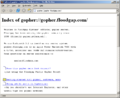
The rise of Gopher, created in 1991 by Mark McCahill at the University of Minnesota, led to two new search programs, Veronica and Jughead, expanding the tools available for finding information online.
Image source: Gopher (protocol)
Jan 1, 1991 - Sep 1, 1993
% complete
Before September 1993, the World Wide Web was entirely indexed by hand. One snapshot of the central list in 1992 remains, but as more and more web servers went online the central list could no longer keep up with growth.
Image source: Search engine
Jun 1, 1993 - Dec 31, 1995
% complete
In June 1993, Matthew Gray, then at MIT, produced what was probably the first web robot, the Perl-based World Wide Web Wanderer, and used it to generate an index called 'Wandex'. Its purpose was to measure the size of the World Wide Web, which it did until late 1995.
Sep 2, 1993
% complete
W3Catalog, the web's first primitive search engine, was released on September 2, 1993. In the summer of 1993 no search engine existed for the web, though numerous specialized catalogs were maintained by hand; W3Catalog formed the basis for automated searching of these catalogs.
Nov 1, 1993
% complete
In 1993, the University of Nevada System Computing Services group developed Veronica, a search program for Gopher sites that helped users find documents across Gopher servers.
Nov 1, 1993
% complete
The web's second search engine Aliweb appeared in November 1993. In response to the Wanderer, Martijn Koster created Archie-Like Indexing of the Web, or ALIWEB, allowing site owners to submit their own pages for indexing.
Dec 1, 1993
% complete
JumpStation, created in December 1993 by Jonathon Fletcher, used a web robot to find web pages and to build its index, and used a web form as the interface to its query program, pioneering the modern search engine interface.
Image source: JumpStation
1994
% complete
One of the first 'all text' crawler-based search engines was WebCrawler, which came out in 1994, allowing users to search for any word in any webpage rather than just page titles or manually submitted entries.
Image source: Web crawler
Feb 1, 1993
% complete
Excite, initially called Architext, was started by six Stanford undergraduates in February 1993. Their project was fully funded by mid-1993, laying the groundwork for what would become a major commercial search engine.
Jan 1, 1994
% complete
The first product from Yahoo!, founded by Jerry Yang and David Filo in January 1994, was a Web directory called Yahoo! Directory. In April 1994, the two Stanford PhD candidates had created some pages that became relatively popular.
Image source: Yahoo!
Jul 1, 1994
% complete
At Carnegie Mellon University during July 1994, Michael Mauldin, on leave from CMU, developed the Lycos search engine. Lycos launched in 1994 and became a major commercial endeavor.
Image source: Lycos
1995
% complete
Excite was the first serious commercial search engine, launching in 1995 after being started by six Stanford undergraduates in February 1993 under the name Architext.
1995
% complete
In 1995, a search function was added to Yahoo!, allowing users to search Yahoo! Directory rather than only browsing its hand-categorized listings.
1996
% complete
In 1996, Netscape was looking to give a single search engine an exclusive deal as the featured search engine on Netscape's web browser, highlighting the growing commercial value of search traffic.
Image source: Netscape Navigator
1996
% complete
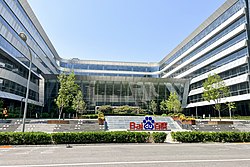
In 1996, Robin Li developed the RankDex site-scoring algorithm for search engines results page ranking and received a US patent for the technology. It was the first search engine that used hyperlinks to measure the quality of websites it was indexing, predating Google's very similar patent filed two years later in 1998.
Image source: Baidu
1998
% complete
Google adopted the idea of selling search terms in 1998 from a small search engine company named goto.com, a business model that would become central to Google's advertising revenue.
Image source: Go.com
Sep 1, 1998
% complete
Microsoft first launched MSN Search in the fall of 1998 using search results from Inktomi. In early 1999, the site began to display listings from Looksmart blended with results from Inktomi, and for a short time in 1999 it used results from AltaVista instead.
Mar 1, 2000
% complete
Many search engine companies were caught up in the dot-com bubble, a speculation-driven market boom that peaked in March 2000, dramatically affecting the fortunes of numerous search businesses.
Image source: Dot-com bubble
2001
% complete
In 2001 Excite and @Home went bankrupt following the collapse of the dot-com bubble, and InfoSpace bought Excite for $10 million, marking the end of one of the earliest major commercial search engines.
Image source: Excite (web portal)
2002
% complete
Yahoo! acquired Inktomi in 2002, gaining control of the search technology that had powered many search services including MSN Search and Yahoo!'s own search offerings.
Image source: Inktomi
2003
% complete
Yahoo! acquired Overture in 2003, which owned AlltheWeb and AltaVista, consolidating several pioneering search technologies under Yahoo!'s ownership.
Image source: Yahoo Native
2004
% complete
In 2004, Microsoft began a transition to its own search technology, powered by its own web crawler called msnbot, moving away from reliance on third-party providers like Inktomi and AltaVista.
Image source: Microsoft Bing
2004
% complete
Yahoo! switched to Google's search engine until 2004, when it launched its own search engine based on the combined technologies of its acquisitions of Inktomi and Overture.
Jun 1, 2009
% complete
Microsoft's rebranded search engine, Bing, was launched on June 1, 2009, replacing Live Search and marking Microsoft's most serious challenge to Google's dominance in search.
Image source: Microsoft Bing
Jul 29, 2009
% complete
On July 29, 2009, Yahoo! and Microsoft finalized a deal in which Yahoo! Search would be powered by Microsoft Bing technology, creating a combined competitor to Google in the search market.
2000
% complete
Around 2000, Google's search engine rose to prominence, beginning its ascent toward becoming the world's dominant search engine. By 2000, Yahoo! was also providing search services based on Inktomi's search engine.
2007
% complete
From 2007 the Google.com search engine has allowed users to filter by date by clicking 'Show search tools' in the leftmost column of the initial search results page, and then selecting the desired date range.
2011
% complete
Concern has been raised that search engines such as Google and Bing provide customized results based on the user's activity history, leading to what has been termed echo chambers or filter bubbles by Eli Pariser in 2011.
Image source: Filter bubble
2019
% complete
As of 2019, active search engine crawlers include those of Baidu, Bing, Brave, Google, DuckDuckGo, Gigablast, Mojeek, Sogou and Yandex, showing a diverse ecosystem of companies indexing the web.
Jan 1, 2022
% complete
As of January 2022, Google is by far the world's most used search engine, with a market share of 90%, while the world's other most used search engines were Bing at 4%, Yandex at 2%, and Yahoo! at 1%.
2024
% complete
In 2024, Google's dominance was ruled an illegal monopoly in a case brought by the US Department of Justice, a landmark antitrust decision challenging the company's grip on the search market.
Image source: United States v. Google LLC (2020)
May 1, 2025
% complete
May 2025 marked the first time in over a decade that Google's share has fallen below the 90% threshold. As of May 2025, according to StatCounter, Google held approximately 89–90% of worldwide search share, with Bing (~4%), Yandex (~2.5%), Yahoo! (~1.3%), DuckDuckGo (~0.8%), and Baidu (~0.7%) trailing far behind.
Image source: Google Search
2000
% complete
Li later used his RankDex technology for the Baidu search engine, which was founded by him in China and launched in 2000. Baidu went on to become the leading search engine in China.
2010
% complete
Google remains inaccessible in mainland China due to long-standing censorship issues, having exited the Chinese market in 2010 following disputes over censorship and cybersecurity, leaving Baidu as the dominant player there.
Sep 1, 2011
% complete
ImHalal came online in September 2011, offering a search engine tailored to Islamic values that filtered out content deemed haram for its users.
Image source: ImHalal
Jul 1, 2013
% complete
Halalgoogling came online in July 2013, another faith-oriented search engine designed to filter results according to Islamic guidelines.
Image source: Halalgoogling
2014
% complete
As of Kakao's merger with Daum in 2014, domestic search engines controlled almost all of the South Korean market, with local players dominating over foreign competitors like Google.
Image source: Kakao
2024
% complete
As of late 2023, search engine market shares in Russia and East Asia have remained relatively stable but with some notable shifts due to geopolitical and technological developments. In China, Baidu remains the leading search engine with a market share of about 59.3% as of early 2024.
2025
% complete
As of Kakao's spinoff of Daum in 2025, Daum's market share in South Korea had sunk below that of Google and Bing, reflecting the erosion of domestic search dominance in the country.
Image source: Daum (web portal)
Jul 1, 2026
% complete
In July 2026, Google overtook Naver's monthly active user count in South Korea, a symbolic milestone in the shift of the Korean search market away from domestic incumbents.
Image source: Naver
Or browse the full history timeline directory, with more than 2,000 topics.
This History of Search Engines timeline was generated with the help of AI, using information found on the internet.
We work hard to keep these timelines accurate, but mistakes do get through. If you spot one, email us at [email protected] and we'll fix it for future visitors.
Generate yours with AI or build it from scratch, for free.

Export your timeline, add your own events, edit or remove AI-generated events, and much more
No credit card required.
Cancel anytime.
Cancel anytime.
You can create an unlimited number of timelines with up to 10 events on each one, customize how they look, export them to PDF, PNG, PowerPoint, CSV, and Excel, and share them with a link. Paid plans raise the event limit and add features like spreadsheet imports and collaborators.
Yes. You can cancel your subscription from your account page at any time, and you will not be charged again. Your subscription stays active for the rest of the period you already paid for.
Yes. We will email you a reminder before the annual renewal, and we will also email you a receipt.
Yes. You can email us within 15 days of any payment, and we will issue you a full refund.
Check out our pricing docs or send us an email anytime: [email protected].