
-
Use Cases
-
Resources
-
Pricing
800 - 1099
Tapestry fragments found in Scandinavia date from the ninth century, and Norman and Anglo-Saxon embroidery is thought to have developed from this tradition. By the tenth century, wall-hangings were common, and contemporary English and Norman texts praised the skills of Anglo-Saxon seamstresses.
Image source: Bayeux Tapestry
900 - 1199
Wall-hangings were widespread by the tenth century. Mural paintings imitating draperies survive in France and Italy, while twelfth-century sources mention other wall-hangings in Normandy and France.
1000 - 1099
Twentieth-century scholarly analysis concluded that the tapestry was probably commissioned by William's half-brother, Bishop Odo of Bayeux. Odo became Earl of Kent and served as regent of England when William was absent in Normandy.
1000 - 1899
The canons of Bayeux Cathedral called the work the Telle du Conquest, or Cloth of the Conquest. Eighteenth-century sources used names such as Toilette de la Saint-Jean and Toilette du duc Guillaume, while nineteenth-century writers sometimes called it the Tapestry of Queen Matilda.
1064 - 1066
The embroidered cloth narrates events from the final years of Edward the Confessor's reign through the Battle of Hastings. It follows Harold Godwinson's activities in Normandy and William, Duke of Normandy's, conquest of the English throne.
Oct 14, 1066
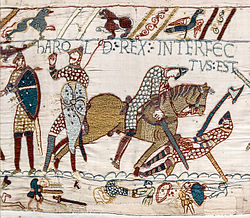
The Battle of Hastings took place on 14 October 1066, less than three weeks after the Battle of Stamford Bridge. The tapestry culminates in William's victory over Harold, although it does not provide the wider context of the earlier battle.
Image source: Battle of Hastings
1077
Andrew Norton concluded that the tapestry was designed specifically to be hung in Bayeux Cathedral and appeal to a Norman audience. He proposed that it was probably made for Bishop Odo's display at the cathedral's dedication in 1077.
1900 - 2012
The tapestry's origins have remained controversial. Howard B. Clarke proposed in 2012 that Scolland, abbot of St Augustine's Abbey in Canterbury, designed its narrative, while Christine Grainge suggested Lanfranc, Archbishop of Canterbury. Other scholars have proposed Saint-Florent Abbey in Saumur.
1476
The earliest known written reference to the tapestry appears in a 1476 inventory of the treasures of Bayeux Cathedral. The inventory shows that it was hung annually for the week of the Feast of St John the Baptist.
1562
The tapestry survived the Huguenot sack of Bayeux in 1562. The next certain reference to it dates from 1724, contributing to the uncertainty surrounding parts of its later history.
1700 - 1799
By the eighteenth century, critics often regarded the tapestry's artistry as crude or barbarous. Its unusual details, including red-and-yellow multicoloured horses, unsettled some contemporary observers.
1724 - 1800
A linen backing cloth was sewn onto the tapestry comparatively crudely in 1724. Around 1800, large numerals were written in ink on the backing to enumerate the scenes; those numbers remain commonly used for reference.
1728
By 1728, the tapestry was no longer displayed primarily for religious celebration. It was taken out of its chest and hung annually in Bayeux Cathedral mainly so that the textile could be aired.
1729 - 1730
Bernard de Montfaucon published drawings and a detailed description of the complete work in the first two volumes of Les Monuments de la Monarchie française. His documentation helped make the tapestry known to scholars.
1732 - 1767
The English antiquary Smart Lethieullier prepared the first detailed English account after seeing the tapestry while living in Paris in 1732–1733. His account was published in 1767 as an appendix to Andrew Ducarel's Anglo-Norman Antiquities.
1746
The antiquary William Stukeley briefly described the tapestry in English in his work Palaeographia Britannica, helping introduce it to an English-speaking scholarly audience.
1816 - 1823
The Society of Antiquaries of London commissioned Charles Stothard to visit Bayeux and create an accurate hand-coloured facsimile. His drawings were engraved by James Basire Jr. and published from 1819 to 1823, preserving a record made before nineteenth-century restoration.
1843
John Murray III's 1843 Hand-book for Travellers in France recommended a visit to the tapestry on the route through Bayeux. The guide helped lead John Ruskin to see it, and he called it the most interesting thing of its kind conceivable.
2007
In 2007, UNESCO admitted the Bayeux Tapestry to the Memory of the World International Register, recognizing it as globally important documentary heritage.
Image source: Memory of the World Programme
1792
In 1792, revolutionary authorities confiscated the tapestry as public property and intended to use it to cover military wagons. It narrowly escaped destruction during the upheaval.
1797
The tapestry was displayed in the Louvre in 1797, where it caused a sensation. Le Moniteur devoted its first two pages to reporting on the exhibition, an unusual amount of attention for a work normally treated as an antiquity.
1804
The tapestry inspired the one-act musical play La Tapisserie de la Reine Mathilde in 1804, demonstrating its growing cultural significance beyond antiquarian study.
1804
Because it was regarded as an antiquity rather than a conventional work of art, the tapestry was returned from Paris to Bayeux in 1804.
1842
By 1842, the tapestry was displayed in a purpose-built room in the Bibliothèque Publique, reflecting its rising status as a major historical and cultural attraction.
1870 - 1944
The tapestry required special storage in 1870 because of the threatened invasion of Normandy during the Franco-Prussian War. It was again safeguarded during the German occupation of France and the Normandy landings from 1939 to 1944.
1941
During the Nazi occupation of France, an Ahnenerbe research team removed fragments from the underside of the tapestry while studying Germany's supposed ancestral heritage.
Jun 27, 1944
On 27 June 1944, the Gestapo took the tapestry to the Louvre. Later, Heinrich Himmler ordered it moved to a place of safety, thought to be Berlin, but the order was not carried out before the liberation of Paris.
Nov 1944 - Dec 1944
After Paris was liberated on 25 August 1944, the tapestry was returned to public display at the Louvre between November and December. It was shown on a 70-metre picture rail in the Italian Primitives room.
Mar 1945 - Oct 1945
The tapestry was returned to Bayeux in March 1945. In October, it was placed on display in a glass showcase at the Hotel Doyen.
1983
Since 1983, the tapestry has been on permanent public display at the Séminaire de Bayeux, later associated with the Bayeux Tapestry Museum.
2018
In 2018, French President Emmanuel Macron announced that the Bayeux Tapestry would be loaned to Britain for public display. An initial 2022 exhibition plan did not materialise amid concerns about the tapestry's condition.
2023 - 2026
Fragments taken from the underside of the tapestry by a Nazi research team in 1941 were discovered in 2023. They were returned to Bayeux in 2026.
Aug 2025 - 2027
The Bayeux Tapestry Museum closed for renovation in August 2025. The closure enabled preparations for the tapestry's first journey outside France and for the museum's planned reopening.
Sep 19, 2025
On 19 September 2025, the tapestry was removed from its museum for the first time since 1983 as part of preparations for its loan to Britain.
Dec 2025
The UK government announced in December 2025 that the United Kingdom would be liable for covering up to £800 million in potential damage to the tapestry during its loan.
Jul 10, 2026
The tapestry arrived at the British Museum on 10 July 2026. This marked its first journey outside France in its recorded history.
Sep 10, 2026 - Jul 11, 2027
The British Museum opened its Bayeux Tapestry exhibition to the public on 10 September 2026. The exhibition was scheduled to run until 11 July 2027 and attracted intense demand, with tickets for its first four months selling out within 24 hours.
1885 - 1886
Through William Morris's collaboration with textile manufacturer Thomas Wardle, Wardle's wife Elizabeth created a full-size reproduction. Completed in 1886, it is now exhibited at Reading Museum and was digitised online in 2020.
1979 - 1999
Michael Linton created a replica over twenty years from 1.5 million small pieces of spring steel. The work comprised 32 sections and included a hypothetical final section extending to William's coronation.
1984 - 2025
The tapestry influenced Hayao Miyazaki's manga and film Nausicaä of the Valley of the Wind. It has also appeared in or inspired works including Tony Kushner's Angels in America, The Simpsons, a 2022 BBC documentary, and a 2025 Bethesda promotional remake for Doom: The Dark Ages.
1993
Scott McCloud cited the tapestry in his 1993 book Understanding Comics as an example of early sequential-narrative art. Bryan Talbot has described it as the first known British comic strip.
1994
Margaret ReVille completed a hand-painted, full-size replica commissioned by E. D. Wheeler. The work was donated to the University of West Georgia in Carrollton and acquired by the University of North Georgia in 2014.
1996
Ray Dugan of the University of Waterloo in Ontario completed a stitched replica of the Bayeux Tapestry in 1996.
2000 - Jun 2014
The Danish association Vikingegruppen Lindholm Høje began a replica in 2000 using the original sewing techniques. The work was completed in June 2014 and placed on permanent exhibition at Børglum Abbey in May 2015.
2012 - 2013
Embroiderers in Alderney collaborated with historian David Bates to reconstruct the tapestry's missing final panel. The resulting continuation showed events including William's coronation.
2013
In early 2013, 416 residents of Alderney completed a continuation of the tapestry. Their addition depicts William's coronation and the construction of the Tower of London.
Jan 2024
The Bayeux Museum acquired a Victorian replica from the estate auction of Rolling Stones drummer Charlie Watts for £16,000. The panoramic photographic copy, one of three known surviving Victorian replicas, had been displayed in Paris in 1906.
Or browse the full history timeline directory, with more than 2,500 topics.
This History of Tapestry timeline was generated with the help of AI, using information found on the internet.
We work hard to keep these timelines accurate, but mistakes do get through. If you spot one, email us at [email protected] and we'll fix it for future visitors.
Generate yours with AI or build it from scratch, for free.
Export your timeline, add your own events, edit or remove AI-generated events, and much more
No credit card required.
Cancel anytime.
Cancel anytime.
You can create an unlimited number of timelines with up to 10 events on each one, customize how they look, export them to PDF, PNG, PowerPoint, CSV, and Excel, and share them with a link. Paid plans raise the event limit and add features like spreadsheet imports and collaborators.
Yes. You can cancel your subscription from your account page at any time, and you will not be charged again. Your subscription stays active for the rest of the period you already paid for.
Yes. We will email you a reminder before the annual renewal, and we will also email you a receipt.
Yes. You can email us within 15 days of any payment, and we will issue you a full refund.
Check out our pricing docs or send us an email anytime: [email protected].