
-
Use Cases
-
Resources
-
Pricing
1609
John Smyth led an English Separatist congregation into exile in Amsterdam. There, the group moved toward believer’s baptism and congregational church government, helping establish the theological and organizational foundations of modern Baptist life.
1609
In Amsterdam, John Smyth’s congregation practiced baptism upon profession of faith rather than infant baptism. Although Smyth’s later views changed, this congregation is widely regarded as an important starting point for the English Baptist tradition.
1611
Thomas Helwys and several supporters returned from Amsterdam to England and established an early Baptist congregation. Helwys defended the right of religious conscience and challenged state control of the church.
1612
Thomas Helwys published this early Baptist defense of religious liberty. He argued that the king had authority over civil matters but not over the consciences of subjects, making the work a landmark in Baptist advocacy for religious freedom.
1612
The churches associated with Thomas Helwys developed into the General Baptist tradition. General Baptists emphasized human freedom to respond to God’s grace and held an Arminian understanding of salvation.
1638
Calvinistic, or Particular, Baptist congregations began appearing in England during the 1630s. They combined believer’s baptism and congregational polity with doctrines of particular redemption and predestination.
1644
Seven Particular Baptist churches issued the First London Baptist Confession. The document articulated Baptist convictions about Scripture, salvation, believer’s baptism, the Lord’s Supper, and the autonomy of local congregations.
1689
Particular Baptist churches adopted the Second London Baptist Confession, later known as the 1689 Baptist Confession of Faith. Adapted from the Westminster and Savoy confessions, it became a major statement of Reformed Baptist theology.
1689
The English Toleration Act of 1689 granted limited legal protection to Protestant Nonconformists, including Baptists. It did not create full religious equality, but it reduced persecution and allowed Baptist congregations to organize more openly.
1636
Roger Williams founded Providence as a refuge for religious dissenters. His advocacy of separation between civil government and religious institutions strongly influenced the development of Baptist arguments for liberty of conscience.
Image source: Roger Williams

1639
The First Baptist Church in America was organized in Providence, Rhode Island. Associated with Roger Williams and later John Clarke, it became a prominent center of Baptist worship and advocacy for separation of church and state.
Image source: First Baptist Church in America
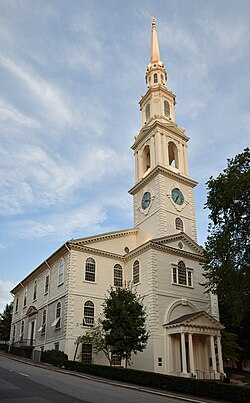
1639
Roger Williams and other religious dissenters helped establish Baptist worship in Providence and nearby Rhode Island. These communities provided an early base for Baptist ideas about believer’s baptism, church independence, and religious liberty in North America.
1663
John Clarke obtained a royal charter for Rhode Island and Providence Plantations. The charter protected broad religious liberty and helped secure a durable political environment for Baptist congregations.
1707
The Philadelphia Baptist Association was formed by churches in the Middle Colonies. It became one of the most influential Baptist associations in early American history and promoted cooperation, correspondence, and confessional Calvinist Baptist identity.
1734 - 1745
The First Great Awakening renewed evangelical religion across the American colonies. Its emphasis on conversion, preaching, and personal religious experience contributed to Baptist growth and encouraged the formation of new congregations.
Image source: First Great Awakening

1758
Shubal Stearns and other Separate Baptists organized the Sandy Creek Association in North Carolina. Its revivalistic style and missionary church-planting helped spread Baptist churches throughout the American South and frontier.
1770 - 1786
Virginia Baptists, including John Leland, campaigned against established religion and compulsory support for clergy. Their activism helped create the political conditions for Virginia’s statute for religious freedom and broader constitutional protections.
Image source: Virginia Statute for Religious Freedom

1787
Article VI of the United States Constitution prohibited religious tests for federal office. Baptist advocacy for religious liberty formed part of the wider dissenting Protestant pressure that supported this principle.
1791
The First Amendment prohibited Congress from establishing a religion and protected its free exercise. These guarantees reflected ideals long emphasized by Baptists, although their application was initially limited to the federal government.
Image source: First Amendment to the United States Constitution

1814
The General Missionary Convention of the Baptist Denomination in the United States of America, commonly called the Triennial Convention, was organized to coordinate Baptist missions. It became the first major national Baptist organization in the United States.
1832
The American Baptist Home Mission Society was formed to support evangelism, church planting, education, and social work within the United States. It became a major institution of Northern Baptist life.
1845
Southern Baptists formed the Southern Baptist Convention in Augusta, Georgia, after a dispute with the Triennial Convention over whether slaveholders could serve as missionaries. The new convention coordinated missions and later became the largest Baptist body in the United States.
Image source: Southern Baptist Convention

1880
African American Baptist leaders organized the National Baptist Convention in the United States. It became a major center of Black religious life, theological education, social advocacy, and missions.
Image source: National Baptist Convention, USA

1915
A division within the National Baptist Convention led to the formation of the National Baptist Convention of America. The new body continued the development of independent African American Baptist institutions and networks.
1922
Conservative Baptists organized the Baptist Bible Union amid disputes over modernist theology and denominational control. The movement later contributed to the formation of the General Association of Regular Baptist Churches.
1936
Baptist leaders established the Baptist Joint Committee for Religious Liberty to defend religious freedom and church-state separation. The organization has represented Baptist principles in public policy, education, and constitutional debates.
1954 - 1968
Baptist churches and leaders played significant roles in the United States civil rights movement. Martin Luther King Jr., Ralph Abernathy, and many local Baptist pastors used preaching, organizing, and nonviolent protest to challenge racial segregation and disenfranchisement.
Image source: Civil rights movement

Dec 5, 1955 - Dec 20, 1956
Martin Luther King Jr., pastor of Dexter Avenue Baptist Church, emerged as a national civil rights leader during the Montgomery bus boycott. The successful protest demonstrated the power of coordinated Black churches and nonviolent mass action.
Image source: Montgomery bus boycott

1991
Moderate and progressive Southern Baptists formed the Cooperative Baptist Fellowship after prolonged conflicts over theology, missions, and denominational governance. It developed its own mission partnerships, congregational networks, and educational ministries.
1793
William Carey sailed to India as a Baptist missionary, becoming a foundational figure in the modern Protestant missionary movement. His work emphasized Bible translation, education, printing, and indigenous Christian communities.
1800
William Carey, Joshua Marshman, and William Ward developed the Serampore mission in India. The mission produced translations, operated schools and a printing press, and trained Indian Christian leaders.
Image source: Serampore College

1821
Lott Carey, an African American Baptist missionary, helped establish a mission in Liberia. His work represented an important early example of Black-led international Baptist mission and challenged assumptions about missionary leadership.
1905
Baptists from many countries met in London and founded the Baptist World Alliance. The organization promoted fellowship, cooperation, religious liberty, evangelism, and international Baptist representation.
1950 - 2000
During the second half of the twentieth century, Baptist communities expanded rapidly across Africa and Asia through indigenous leadership, evangelism, church planting, education, and social ministries. The demographic center of global Baptist life increasingly moved beyond Europe and North America.
1988
The Baptist World Congress met in Atlanta, bringing together Baptist representatives from around the world. The gathering highlighted the international scale of Baptist Christianity and its continuing emphasis on fellowship, mission, and religious liberty.
Or browse the full history timeline directory, with more than 2,500 topics.
This Baptist History timeline was generated with the help of AI, using information found on the internet.
We work hard to keep these timelines accurate, but mistakes do get through. If you spot one, email us at [email protected] and we'll fix it for future visitors.
Generate yours with AI or build it from scratch, for free.
Export your timeline, add your own events, edit or remove AI-generated events, and much more
No credit card required.
Cancel anytime.
Cancel anytime.
You can create an unlimited number of timelines with up to 10 events on each one, customize how they look, export them to PDF, PNG, PowerPoint, CSV, and Excel, and share them with a link. Paid plans raise the event limit and add features like spreadsheet imports and collaborators.
Yes. You can cancel your subscription from your account page at any time, and you will not be charged again. Your subscription stays active for the rest of the period you already paid for.
Yes. We will email you a reminder before the annual renewal, and we will also email you a receipt.
Yes. You can email us within 15 days of any payment, and we will issue you a full refund.
Check out our pricing docs or send us an email anytime: [email protected].