-
Use Cases
-
Resources
-
Pricing
1763
Catherine the Great issued a manifesto inviting Europeans, except Jews and Muslims, to settle lands in New Russia and the Volga region. The invitation later became an important opportunity for Mennonites seeking land and religious security.
1772
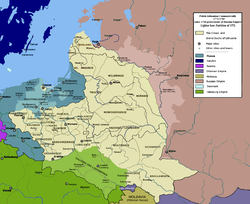
During the First Partition of Poland, most of the Vistula Delta was annexed by the Kingdom of Prussia. The change placed many Mennonite communities under a government whose military and educational policies increasingly challenged their privileges.
Image source: First Partition of Poland
1787
Deutsch-Michalin was founded near Machnovka. Families from the settlement later moved to nearby Volhynia, helping extend Mennonite settlement in the region.
1789
Delegates from the Vistula Delta negotiated an extension of Catherine the Great’s settlement invitation. In 1789, Crown Prince Paul signed a new agreement with the Mennonites.
1789
Mennonites from Prussia accepted the Russian invitation and established Chortitza on the Dnieper River. It became their first major colony in the Russian Empire, in territory northwest of the Sea of Azov.
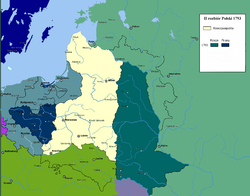
1793
The Second Partition of Poland brought the remainder of the Vistula Delta under Prussian control, further altering the political circumstances of Mennonite communities there.
Image source: Second Partition of Poland
1802
Many families from Deutsch-Michalin moved to nearby Volhynia in 1802, contributing to the spread of Mennonite settlement beyond the original colony.
1803 - 1860
Mennonites began arriving in the Molotschna region in 1803 and lived alongside the semi-nomadic Nogais until 1860, when the Nogai Tatars were displaced.
1804
A second and larger Russian Mennonite colony, Molotschna, was founded in 1804. It became one of the central communities of Russian Mennonite life.
1815
After Mazovia was annexed by Russia at the Congress of Vienna, the Mennonite settlements of Kazuń Nowy and Nowe Wymyśle on the Vistula came under Russian control.
Image source: Congress of Vienna
1815
Swiss Mennonites of Amish descent from Galicia settled near Dubno in Volhynia province, adding another Mennonite population to the Russian Empire.
1853
The Mennonite settlement of Trakt was founded in 1853 as part of the expansion of Mennonite communities in the Russian Empire.
1861
Alt-Samara was founded in 1861, distinguishing it from the later Neu Samara Colony and extending Mennonite settlement in the Russian Empire.
1786
After ascending the Prussian throne, Frederick William II imposed heavy fees on Mennonites in exchange for continuing their exemption from military service.
Image source: Frederick William II of Prussia
1859
In 1859, Joseph Höttmann, a former associate of Wüst, met with Mennonites to discuss problems within the main Mennonite body. These discussions helped initiate the Mennonite Brethren movement.
1860
A portion of Mennonites moved to Crimea in 1860, adopted baptism by immersion, and became known as the Krimmer Mennonite Brethren.
Jan 6, 1860
A growing group of dissenters presented a document to the elders of the Molotschna Mennonite Churches, formally breaking with the main church and declaring that the broader Mennonite brotherhood had decayed.
1870
Russian authorities announced a Russification plan in 1870 that was intended to end Mennonite special privileges by 1880, including protections associated with military service and education.
1871
Mennonite delegates traveled to Saint Petersburg in 1871 to meet with the czar and seek relief from the planned restrictions on their communities, appealing on religious grounds.
May 1874
Concerned that 40,000 industrious Mennonite farmers might leave Russia for North America, the Russian government sent Eduard Totleben to the colonies in May 1874.
1880
By 1880, the military service question for Mennonites who remained in Russia was resolved through a substitute four-year forestry service program for men of military age.
1882
Although Mennonites had generally remained congregational in organization, the General Conference of Mennonite Congregations in Russia was formed in 1882.
Image source: Mennonites
1905
After the Russian Revolution of 1905, Mennonites exercised their right to vote, marking a limited expansion of their formal political participation.
Image source: Russian Revolution of 1905
1914 - 1918
During World War I, approximately 5,000 Mennonite men served in forestry and hospital units. They also transported wounded people from battlefields to hospitals in Moscow and Ekaterinoslav.
Feb 1917
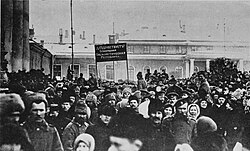
The February Revolution of 1917 created hopes among Mennonites that the new Russian Provisional Government would preserve their religious and communal freedoms.
Image source: February Revolution
1918
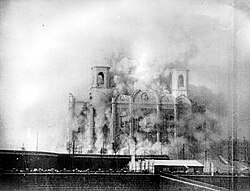
Beginning in 1918, religious freedoms were restricted in the Soviet Union, affecting Mennonite worship, institutions, education, and community life.
Image source: Persecution of Christians in the Soviet Union
1919
During the upheaval following the Russian Revolution, Mennonite self-defense militia forces were ultimately overwhelmed after Makhno’s anarchists aligned with the Red Army early in 1919.
Image source: Nestor Makhno
1929 - 1940
From 1929 to 1940, one in eight Mennonite men was removed, usually under political pretexts, to labor camps. Few returned or were heard from again.
Image source: Dekulakization
1937 - 1938
In 1937 and 1938, the NKVD carried out ethnically motivated purges of German descendants and German-language speakers, including Mennonites.
2000
The main branches of the former General Conference Mennonite Church split into Mennonite Church Canada, established in 2000, and Mennonite Church USA, established in 2002.
Image source: Mennonite Church Canada
2002
Mennonite Church USA was established in 2002 as one of the principal successor bodies to the former General Conference Mennonite Church.
Image source: Mennonite Church USA
2013
In 2013, the Mennonite Brethren church had approximately 24,400 baptized members.
1820
The Molotschna colony established a secondary school at Ohrloff and brought in a trained teacher from Prussia, strengthening formal Mennonite education.
1842
The Central School was started in Chortitza in 1842, becoming an important educational institution for Mennonite communities in the colony.
1860 - 1870
Population growth and pressure for additional farmland became serious problems by 1860. The resulting land shortage encouraged industrial development, internal migration, and later overseas emigration.
1860
The first large Mennonite foundry was established in Chortitza in 1860. Other firms followed, beginning a period of major Mennonite participation in Russian manufacturing.
1870
By 1870, approximately 9,000 individuals had immigrated to Russia. Population growth brought the Chortitza and Molotschna settlements to about 45,000 people.
1914
By 1914, forty daughter colonies had been established. They occupied nearly 12,000 square kilometers and had a combined population of approximately 100,000.
1873
A delegation of twelve Mennonites explored North America in 1873, seeking large tracts of fertile farmland as Russian policies threatened their established way of life.
1873
Winter wheat was introduced to Kansas in 1873. The crop was closely associated with Russian Mennonite agricultural migration to the American plains.
1874 - 1880
Between 1874 and 1880, approximately 10,000 Mennonites left South Russia for the United States and about 8,000 moved to Manitoba. Their settlement in the plains coincided with completion of the Transcontinental Railroad.
1920
In the summer of 1920, Mennonites from Molotschna sent a commission to North America to alert American Mennonites to the dire conditions in war-torn Ukraine.
1921
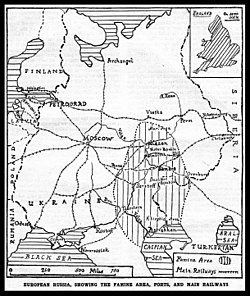
A year after the 1920 appeal, official permission was obtained from the Soviet government for relief work among Ukrainian villages affected by war and famine.
Image source: Russian famine of 1921–1922
1922 - 1925
Relief kitchens provided food to 25,000 people per day over three years beginning in 1922, with a peak of 40,000 servings during August of that year.
1922 - 1927
The more conservative Manitoba Mennonites left Canada after World War I. Most moved to Mexico between 1922 and 1927, while others moved to Paraguay in 1927.
1927
Mennonites from Canada formed Menno Colony in Paraguay in 1927, establishing one of the earliest major Latin American Mennonite settlements.
1930 - 1939
Mennonites from the Soviet Union fleeing starvation, religious persecution, and Stalinist collectivization formed the Fernheim and Friesland colonies in Paraguay during the 1930s.
1930
By 1930, approximately 21,000 Mennonites had arrived in Canada, with many traveling on credit provided by the Canadian Pacific Railway.
1932
Many Mennonite refugees remained displaced until the Nansen International Office for Refugees of the League of Nations arranged resettlement in Paraguay and Brazil in 1932.
1947
Neuland and Volendam colonies were founded in Paraguay in 1947 by Mennonites who had fled the Soviet Union at the end of World War II.
1954
Beginning in 1954, conservative Mennonites settled in eastern Bolivia, particularly in the Santa Cruz Department. By 2006, Bolivia had 41 Mennonite colonies.
1959
Old Colony Mennonites moved from Mexico to Belize in 1959, extending the Latin American Mennonite migration network.
1977
In 1977, Russian Mennonites from Mexico established a settlement in Gaines County, Texas, where they began farming and ranching.
1986
Old Colony Mennonites moved from Mexico to Argentina in 1986, continuing the movement of conservative Mennonite communities across Latin America.
1987 - 1993
About 100,000 people of Mennonite origin emigrated from the Soviet Union to Germany between 1987 and 1993. These migrants are commonly associated with the term Aussiedler.
2005
By 2005, Gaines County, Texas, where Russian Mennonites from Mexico had established farms and ranches, had become the number-one cotton- and peanut-producing county in Texas.
2006
By 2006, Bolivia contained 41 Mennonite colonies, reflecting the growth of conservative Mennonite settlement in the country.
2012 - 2017
The Mennonite population living in Mexico declined sharply during this period. At least 30,000 Mexican Mennonites were estimated to have immigrated to Canada between 2012 and 2017.
2014
In 2014, several hundred thousand Russian Mennonites were distributed across Germany, Mexico, Bolivia, Paraguay, Belize, Canada, the United States, Argentina, Peru, Colombia, Uruguay, and Brazil.
Or browse the full history timeline directory, with more than 2,500 topics.
This Mennonite History timeline was generated with the help of AI, using information found on the internet.
We work hard to keep these timelines accurate, but mistakes do get through. If you spot one, email us at [email protected] and we'll fix it for future visitors.
Generate yours with AI or build it from scratch, for free.
Export your timeline, add your own events, edit or remove AI-generated events, and much more
No credit card required.
Cancel anytime.
Cancel anytime.
You can create an unlimited number of timelines with up to 10 events on each one, customize how they look, export them to PDF, PNG, PowerPoint, CSV, and Excel, and share them with a link. Paid plans raise the event limit and add features like spreadsheet imports and collaborators.
Yes. You can cancel your subscription from your account page at any time, and you will not be charged again. Your subscription stays active for the rest of the period you already paid for.
Yes. We will email you a reminder before the annual renewal, and we will also email you a receipt.
Yes. You can email us within 15 days of any payment, and we will issue you a full refund.
Check out our pricing docs or send us an email anytime: [email protected].