-
Use Cases
-
Resources
-
Pricing
Mormonism is a religious movement founded by Joseph Smith in upstate New York in the early 19th century. Centered on the Book of Mormon and the belief in continuing revelation, the movement's largest denomination is The Church of Jesus Christ of Latter-day Saints (LDS Church). Key events include Smith's First Vision, the publication of the Book of Mormon in 1830, persecution and forced migrations from Missouri and Illinois, Brigham Young's leadership of the pioneer trek to Utah in 1847, the 1890 end of plural marriage, and the church's expansion into a global faith with millions of members. More Less
1820
% complete
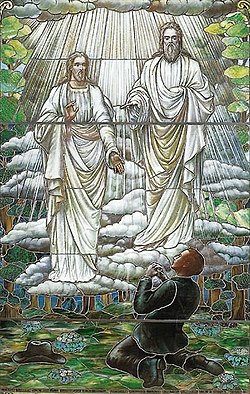
After reading the Epistle of James and praying about which denomination to join, Joseph Smith said he received a vision in the spring of 1820 in Upstate New York, an event that became foundational to Mormonism.
Image source: First Vision
1829
% complete
Smith began baptizing new converts in 1829, laying the groundwork for the formal organization of a new church the following year.
1830
% complete
Other than differences in leadership, Latter Day Saint groups most significantly differ in their stances on polygamy and Trinitarianism, which the LDS Church does not affirm—a defining doctrinal distinction since its founding.
1830
% complete
Mormons believe that God re-established the 1st-century early Christian church as found in the New Testament through the restoration of Joseph Smith, a core tenet of the faith.
Image source: Restorationism
1830
% complete
Smith formally organized the Church of Christ in 1830, establishing what would become the Latter Day Saint movement. The church has been subject of criticism since its founding by Joseph Smith.
Image source: Church of Christ (Latter Day Saints)
1915
% complete
This description of God represents the Mormon orthodoxy, formalized in 1915 based on earlier teachings, as traced in Widmer's study of the theological evolution of Mormonism from 1830 to 1915.
Image source: God in Mormonism
1823
% complete
In Upstate New York in 1823, Joseph Smith claimed to have had a vision in which the Angel Moroni told him about engraved golden plates buried in a nearby hill.
Image source: Angel Moroni
1827
% complete
According to Smith, he received subsequent instruction from Moroni and, four years after first seeing them, excavated the plates buried in a nearby hill, preparing to translate them into English.
Image source: Golden plates
Apr 1828
% complete
After obtaining the plates in 1827, Smith began dictating the text of the Book of Mormon in April 1828 with the assistance of Martin Harris and later Oliver Cowdery.
Jun 1829
% complete
After several interruptions, Smith completed the manuscript of the Book of Mormon in June 1829, claiming to have translated it from 'reformed Egyptian' into English.
1830
% complete
According to Smith, the Book of Mormon recounts the history of a tribe of Israelites led by the prophet Lehi who migrated from Jerusalem to the Americas in the 7th century BCE; these tribes are considered among the ancestors of pre-Columbian Native Americans.
1830
% complete
In 1830 Smith published the Book of Mormon, which he claimed to have translated from ancient writings found on golden plates. The text describes itself as a chronicle of early Indigenous peoples of the Americas and their dealings with God.
1831
% complete
The theology itself is not uniform; as early as 1831, various groups began splitting from the Church of Christ that Smith established, foreshadowing later divisions.
Image source: List of denominations in the Latter Day Saint movement
1844
% complete
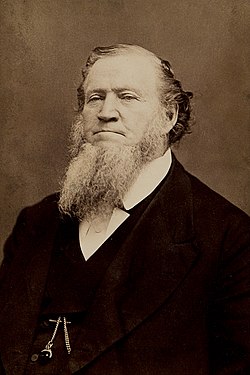
Following the succession crisis, Brigham Young led a major faction of the movement. A strain of theology going back to Brigham Young peaked with the early 20th-century writings of church leaders like B.H. Roberts.
Image source: Brigham Young
1844
% complete
Smith's death in 1844 precipitated a succession crisis that split the Latter Day Saint movement. Various groups most significantly differ in their stances on polygamy and Trinitarianism.
Image source: Succession crisis (Latter Day Saints)
1852 - 1890
% complete
Polygamy became the faith's most sensational characteristic during the 19th century, and vigorous opposition by the United States Congress threatened the church's existence as a legal institution.
1869
% complete
The Godbeites broke away from the LDS Church in the late 19th century on the basis of both political and religious liberalism, illustrating ongoing doctrinal diversity within Mormonism.
Image source: Godbeites
1890
% complete
In the 1890 Manifesto, church president Wilford Woodruff announced the official end of plural marriage. Under heavy pressure—Utah would not be accepted as a state if polygamy was practiced—the church formally and publicly renounced the practice.
Image source: 1890 Manifesto
1890
% complete
The Utah-based LDS Church banned polygamy in 1890, one of the key stances distinguishing it from other Latter Day Saint groups. Plural marriage remains controversial, with sympathizers and semi-secret practitioners outside the LDS Church.
1900
% complete
Fundamentalists initially broke from the LDS Church after plural marriage was discontinued around the beginning of the 20th century. They often believe in other doctrines taught by Brigham Young that the LDS Church has abandoned or repudiated.
Image source: Mormon fundamentalism
1985
% complete
In 1985 the Restoration Church of Jesus Christ broke away from the LDS Church as an LGBT-friendly denomination, demonstrating continued schism within the broader movement.
2010
% complete
The LGBT-friendly Restoration Church of Jesus Christ, which had broken away from the LDS Church in 1985, was formally dissolved in 2010.
1833
% complete
Settlers in Missouri expelled the Latter Day Saints from Jackson County in 1833, forcing them to flee to other parts of Missouri amid rising hostility.
Image source: 1838 Mormon War
1838
% complete
In 1838, fighting between the Missourians and Mormons resulted in the governor of Missouri issuing an 'extermination order' against the Mormons, forcing them to flee the state.
Image source: Mormon Extermination Order
1844
% complete
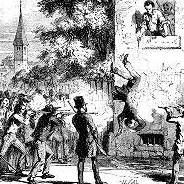
In 1844 Smith was killed by a mob, precipitating a succession crisis that split the Latter Day Saint movement after the death of its founder.
Image source: Killing of Joseph Smith
1900
% complete
Although such violence declined during the twentieth century, the religion's unique doctrinal views and practices still generate criticism, sometimes vehemently so.
Image source: Criticism of the Church of Jesus Christ of Latter-day Saints
1960 - 1990
% complete
During the latter half of the 20th century the LDS Church grew rapidly, going from about 1.7 million members in 1960 to around 7.7 million members in 1990.
1978
% complete
The exclusion of black men from the priesthood was abandoned by the LDS Church in 1978, ending a practice that had distinguished it from other denominations and been a source of criticism.
Image source: Black people and temple and priesthood policies (LDS Church)
2018
% complete
As a label, Mormonism has been applied to various aspects of the Latter Day Saint movement, although since 2018 there has been a push from the LDS Church to distance itself from this label.
2020
% complete
Growth since 1990 has slowed, and the church claimed a membership of 16 million in 2020, remaining the largest denomination within Mormonism.
Image source: The Church of Jesus Christ of Latter-day Saints in Utah
Or browse the full history timeline directory, with more than 2,000 topics.
This Mormonism timeline was generated with the help of AI, using information found on the internet.
We work hard to keep these timelines accurate, but mistakes do get through. If you spot one, email us at [email protected] and we'll fix it for future visitors.
Generate yours with AI or build it from scratch, for free.
Export your timeline, add your own events, edit or remove AI-generated events, and much more
No credit card required.
Cancel anytime.
Cancel anytime.
You can create an unlimited number of timelines with up to 10 events on each one, customize how they look, export them to PDF, PNG, PowerPoint, CSV, and Excel, and share them with a link. Paid plans raise the event limit and add features like spreadsheet imports and collaborators.
Yes. You can cancel your subscription from your account page at any time, and you will not be charged again. Your subscription stays active for the rest of the period you already paid for.
Yes. We will email you a reminder before the annual renewal, and we will also email you a receipt.
Yes. You can email us within 15 days of any payment, and we will issue you a full refund.
Check out our pricing docs or send us an email anytime: [email protected].