-
Use Cases
-
Resources
-
Pricing
100 - 2026
Many Christians have disputed whether Peter and his immediate successors possessed universally recognized supreme authority over all early churches. Orthodox perspectives have instead described the bishop of Rome as first among equals.
Image source: Papal primacy
325 - 787
The Catholic and Orthodox churches formed one Christian church through at least the first seven ecumenical councils, even as disagreements about authority and doctrine developed.
750 - 800
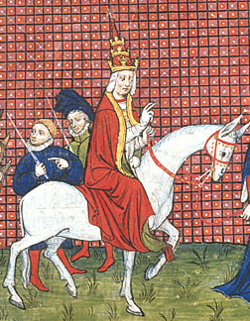
The Donation of Constantine, an eighth-century forgery, was used to enhance the prestige and authority of the popes and to place the papacy more centrally in the narrative of Constantinian Christianity.
Image source: Donation of Constantine
756 - 1870
Territory acquired by the papacy became the basis for the Papal States, over which the popes exercised temporal rule until their incorporation into the Kingdom of Italy in 1870.
Image source: Papal States
800 - 1870
For roughly eleven centuries, the history of Rome was closely intertwined with the history of the papacy, which was both a religious institution and a major temporal power.
904 - 964
The period from the installation of Pope Sergius III in 904 until the death of Pope John XII in 964 is often called the Saeculum obscurum, or dark age of the papacy.
1048 - 1257
Between 1048 and 1257, the papacy experienced sustained conflict with the leaders and churches of the Holy Roman Empire and the Byzantine Empire.
1048
When Henry III, Holy Roman Emperor, visited Rome in 1048, he found three rival claimants to the papacy amid the unprecedented actions associated with Pope Benedict IX.
Image source: Henry III, Holy Roman Emperor
1054
The formal split between the Catholic and Orthodox churches became associated with disputes over papal primacy and the addition of the Filioque to the Nicene Creed.
Image source: East–West Schism
1048 - 1122
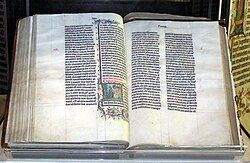
From 1048 onward, conflict between the papacy and the Holy Roman Empire centered especially on whether the pope or the emperor could appoint bishops within the empire.
Image source: Investiture Controversy
1059
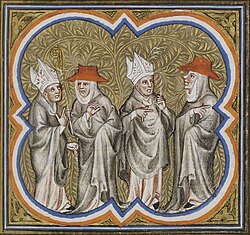
Pope Nicholas II promulgated In nomine Domini in 1059, limiting the principal suffrage in papal elections to the College of Cardinals and reshaping the process of choosing popes.
Image source: In nomine Domini
1077
In 1077, Henry IV traveled to Canossa to meet Pope Gregory VII. Although the encounter did not settle the broader Investiture Controversy, it became one of the most famous episodes in the struggle between pope and emperor.
Nov 1095 - Aug 1096
After the ten-day Council of Clermont, Urban II delivered a speech urging the Christian West to rescue the Christian East. The appeal became the rallying cry for the First Crusade, which began in August 1096.
Image source: First Crusade
Nov 1095
Pope Urban II convened the Council of Clermont in November 1095, seeking church reform, reunion, and support for the Byzantine Empire against the Seljuk Turks.
Image source: Council of Clermont
1122
The Concordat of Worms marked an agreement in which the emperor renounced the right to lay investiture, although disputes between emperors and popes over authority later resurfaced.
Image source: Concordat of Worms
1257 - 1309
Political instability in Italy forced the papal court to move among Viterbo, Orvieto, and Perugia. Innocent IV was exiled from Rome and Italy for six years, and nearly all thirteenth-century papal elections occurred outside Rome.
1309 - 1377
From 1309, seven successive French popes resided in Avignon rather than Rome. This period formed the final phase of the papal residence outside Rome, following earlier stays in Viterbo, Orvieto, and Perugia.
Image source: Avignon Papacy
1377
In 1377, Pope Gregory XI moved the papal residence back to Rome, where he died soon afterward.
Image source: Pope Gregory XI
1378 - 1417
From 1378 to 1417, parties within the Catholic Church divided their allegiance among competing claimants to the papal office. Catholic scholars commonly call this crisis the Western Schism or the great controversy of the antipopes.
Image source: Western Schism
1414 - 1417
The Council of Constance was convened in 1414 to resolve the competing papal claims. In March 1415, the Pisan antipope John XXIII fled in disguise, was captured, and was deposed in May.
Image source: Council of Constance
1417
The election of Martin V by the Council of Constance in 1417 finally resolved the Western Schism. Martin returned the papacy to Rome in 1420, beginning a period largely free from disputed papal claimants.
Image source: Pope Martin V
1493
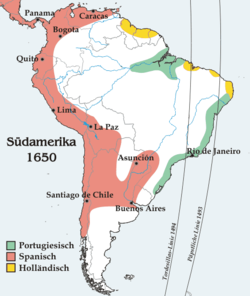
After Columbus's 1492 voyage upset relations between Portugal and Castile, Pope Alexander VI issued three bulls on May 3 and 4, 1493. The third, Inter caetera, awarded Spain the sole right to colonize most of the New World.
Image source: Inter caetera
1517 - 1580
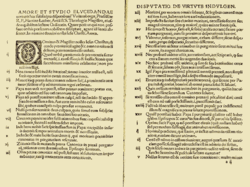
The Reformation challenged papal authority from 1517 through 1580. Martin Luther criticized practices such as indulgences and labeled the papacy as the Antichrist.
Image source: Reformation
1527
Diplomatic and military campaigns conducted during the pontificate of Pope Clement VII contributed to the Sack of Rome in 1527, a major crisis for the papacy and Renaissance Italy.
Image source: Sack of Rome (1527)
1545 - 1563
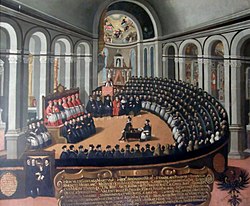
Led institutionally by Pope Paul III and other Catholic leaders, the Counter-Reformation responded to Protestant challenges. The Council of Trent reaffirmed Catholic doctrine and initiated reforms addressing corruption.
Image source: Council of Trent
1585 - 1590
The pontificate of Sixtus V opened the final stage of the Catholic Reformation and helped establish the characteristic Baroque Catholic culture of the early seventeenth century, emphasizing attraction over compulsion.
Image source: Pope Sixtus V
1669
The word nepotism entered the English language around 1669, originally referring specifically to the papal practice of creating cardinal-nephews.
1870
The Papal States were incorporated into the new Kingdom of Italy in 1870, ending the popes' centuries-long territorial rule and creating the Roman Question.
Image source: Capture of Rome
Jul 13, 1881
Pope Pius IX defended the freedom of the church amid Italian persecution and disputes over education, expropriation, church property, and legal restrictions. On July 13, 1881, anticlerical groups attempted to throw his deceased body into the Tiber.
Image source: Pope Pius IX
May 15, 1891
Pope Leo XIII's 1891 encyclical Rerum novarum addressed social inequality and social justice with papal authority. It began a line of Catholic social teaching later developed by Pius XI, Pius XII, John XXIII, Paul VI, and John Paul II.
Image source: Rerum novarum
Feb 11, 1929
Negotiations begun in 1926 between Italy and the Holy See culminated in the Lateran Pacts of 1929. Signed by Benito Mussolini for King Victor Emmanuel III and Cardinal Pietro Gasparri for Pope Pius XI, the agreements settled the Roman Question and recognized Vatican City.
Image source: Lateran Treaty
1931
Disagreements between the Fascist government and Pope Pius XI over restrictions on Catholic youth activities culminated in the 1931 papal letter Non abbiamo bisogno, which argued that one could not be both a Fascist and a Catholic.
Jul 20, 1933 - Sep 10, 1933
After Adolf Hitler became chancellor on January 30, 1933, negotiations produced a concordat between Nazi Germany and the Holy See. Eugenio Pacelli signed for the Vatican and Franz von Papen for Germany on July 20; it was ratified on September 10.
Image source: Reichskonkordat
Mar 21, 1937
After repeated Nazi violations of the Reichskonkordat, Pacelli helped prepare Pius XI's encyclical Mit brennender Sorge. Written in German and read in churches on Palm Sunday 1937, it condemned the elevation of race, people, or state to an idolatrous level.
Image source: Mit brennender Sorge
Sep 1, 1939
When Germany invaded Poland on September 1, 1939, the Vatican declared neutrality to avoid being drawn into the conflict and to reduce the danger of occupation by the Italian military.
1945 - 1955
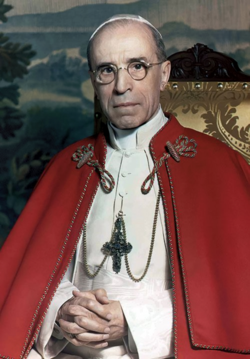
After World War II, approximately sixty million Catholics lived under Soviet-dominated regimes, while many priests and religious were killed or deported. In 1955, Pius XII established independent dioceses in several African, Asian, and European territories.
Image source: Pope Pius XII
Oct 11, 1962 - Dec 8, 1965
Pope John XXIII opened the Second Ecumenical Vatican Council on October 11, 1962. The council became a major event in modern Catholic history and concluded in December 1965.
Image source: Second Vatican Council
Dec 7, 1965
On December 7, 1965, Pope Paul VI and Ecumenical Patriarch Athenagoras I issued a Joint Catholic–Orthodox Declaration lifting the mutual excommunications that had been in force since the Great Schism of 1054.
Image source: Catholic–Eastern Orthodox relations
Aug 6, 1967
Pope Paul VI's motu proprio Pro Comperto Sane, issued on August 6, 1967, opened the Roman Curia to bishops from around the world.
1978
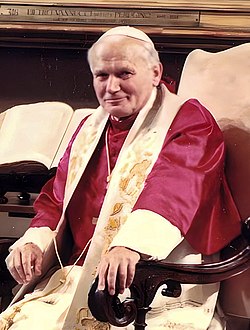
Following the 33-day pontificate of John Paul I, the election of John Paul II gave the church its first non-Italian pope since Pope Adrian VI in the sixteenth century.
Image source: Pope John Paul II
Apr 21, 1990
After the collapse of Communist regimes, John Paul II stated in Prague on April 21, 1990, that the claim to build a world without God had been shown to be an illusion.
2005
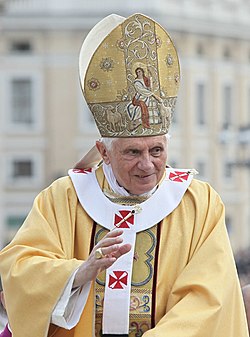
Pope Benedict XVI was elected in 2005, succeeding John Paul II and continuing the modern papacy into the twenty-first century.
Image source: Pope Benedict XVI
Feb 11, 2013 - Feb 28, 2013
On February 11, 2013, Pope Benedict XVI announced that he would resign on February 28, becoming the first pope in centuries to voluntarily relinquish the office.
Mar 13, 2013 - Apr 21, 2025
Pope Francis was elected on March 13, 2013. He was the first Jesuit pope and the first pope from the Americas, serving until his death in 2025.
Image source: Pope Francis
Apr 21, 2025
After apparently recovering from a serious illness, Pope Francis died following a stroke on April 21, 2025.
May 8, 2025
On May 8, 2025, an Augustinian and the first American pope was elected as Leo XIV. He also held Peruvian citizenship.
Image source: Pope Leo XIV
Or browse the full history timeline directory, with more than 2,500 topics.
This History of the Papacy timeline was generated with the help of AI, using information found on the internet.
We work hard to keep these timelines accurate, but mistakes do get through. If you spot one, email us at [email protected] and we'll fix it for future visitors.
Generate yours with AI or build it from scratch, for free.
Export your timeline, add your own events, edit or remove AI-generated events, and much more
No credit card required.
Cancel anytime.
Cancel anytime.
You can create an unlimited number of timelines with up to 10 events on each one, customize how they look, export them to PDF, PNG, PowerPoint, CSV, and Excel, and share them with a link. Paid plans raise the event limit and add features like spreadsheet imports and collaborators.
Yes. You can cancel your subscription from your account page at any time, and you will not be charged again. Your subscription stays active for the rest of the period you already paid for.
Yes. We will email you a reminder before the annual renewal, and we will also email you a receipt.
Yes. You can email us within 15 days of any payment, and we will issue you a full refund.
Check out our pricing docs or send us an email anytime: [email protected].