
-
Use Cases
-
Resources
-
Pricing
The Terminator is a science fiction media franchise created by director James Cameron, beginning with the 1984 film starring Arnold Schwarzenegger as a cyborg assassin sent from a post-apocalyptic future. The franchise has expanded into multiple sequels, a television series, comic books, and video games, becoming one of the most influential works in sci-fi cinema and shaping popular perceptions of artificial intelligence. More Less
1982
% complete
In Rome, Italy, during the release of Piranha II: The Spawning (1982), director James Cameron fell ill and had a fever dream about a metallic torso holding kitchen knives dragging itself from an explosion.
Image source: The Terminator
1982
% complete
Inspired by director John Carpenter, who had made the low-budget slasher film Halloween (1978), Cameron used his dream as a 'launching pad' to write a slasher-style science fiction film.
1982
% complete
Cameron devised the premise of the film from the fever dream he experienced during the release of Piranha II: The Spawning (1982), and developed the concept in collaboration with his friend William Wisher Jr.
1982
% complete
Cameron's influences included 1950s science fiction films, the 1960s fantasy television series The Outer Limits, and contemporary films such as The Driver (1978) and Mad Max 2 (1981).
1982
% complete
Cameron felt that the technology of the time was unable to create the liquid Terminator, and shelved the idea until the appearance of the T-1000 character in Terminator 2: Judgment Day (1991).
Oct 1, 1982 - Dec 31, 1982
% complete
In late 1982, Daly agreed to back the film with help from HBO and Orion.
Jan 1, 1983 - Mar 31, 1983
% complete
Filming for The Terminator was set to begin in early 1983 in Toronto, but was halted when producer Dino De Laurentiis applied an option in Schwarzenegger's contract that made him unavailable for nine months while filming Conan the Destroyer.
1983
% complete
During the waiting period, Cameron was contracted to write the script for Rambo: First Blood Part II, refined the Terminator script, and met with producers David Giler and Walter Hill to discuss a sequel to Alien, which became Aliens (1986).
1984
% complete
Brad Fiedel's score featured a main title theme in the unusual time signature of 13/16, which arose when he experimented with rhythms and accidentally created an incomplete loop on his sequencer; he liked its herky-jerky propulsiveness.
Mar 1984
% complete
The sequences set in 2029 and the stop-motion scenes were developed by Fantasy II, a special effects company headed by Gene Warren Jr.
Mar 1984
% complete
In March 1984, The Terminator began production in Los Angeles, with filming taking place mostly at night on location. Filming had been delayed because of Schwarzenegger's commitments to Conan the Destroyer (1984), during which Cameron found time to work on scripts for Rambo: First Blood Part II and Aliens (1986).
1984
% complete
A soundtrack to the film was released in 1984 which included the score by Brad Fiedel and the pop and rock songs used in the club scenes.
Oct 26, 1984
% complete
The Terminator premiered on October 26, 1984, introducing Arnold Schwarzenegger as the cybernetic assassin sent back in time from post-apocalyptic 2029 to 1984 Los Angeles to assassinate Sarah Connor, whose future son will save the world from Skynet.
Oct 26, 1984
% complete
Richard Corliss of Time magazine said that the film had plenty of tech-noir savvy to keep infidels and action fans satisfied, and Time placed The Terminator on its 10 Best list for 1984. Critics praised Schwarzenegger as perfectly cast in a machine-like portrayal requiring few lines of dialog.
Feb 21, 1985
% complete
Shaun Hutson wrote a novelization of the film which was published on February 21, 1985, by London-based Star Books (ISBN 0-352-31645-4).
May 1985
% complete
In the May 1985 issue of Cinefantastique, The Terminator was referred to as a film that manages to be both derivative and original at the same time, described as like a streamlined Dirty Harry movie with no exposition at all; just guns, guns and more guns.
Oct 1985
% complete
Randal Frakes and William Wisher wrote a different novelization of the film for Bantam/Spectra, published in October 1985 (ISBN 0-553-25317-4).
1986
% complete
Orion settled in 1986, gave Ellison an undisclosed amount of money, and added an acknowledgment credit to later prints of the film.
1991
% complete
In 1991, Richard Schickel of Entertainment Weekly reviewed the film, giving it an A rating, writing that what originally seemed a somewhat inflated, if generous and energetic, big picture, now seems quite a good little film.
2005
% complete
In 2005, Total Film named The Terminator the 72nd-best film ever made.
2008
% complete
In 2008, The Terminator was deemed culturally, historically, or aesthetically significant by the Library of Congress and selected for preservation in the United States National Film Registry.
2008
% complete
In 2008, Empire magazine selected The Terminator as one of The 500 Greatest Movies of All Time.
2008 - 2011
% complete
Authors Paul Meehan in Tech-Noir: The Fusion of Science Fiction and Film Noir (2008) and Emily E. Auger in Tech-Noir Film: A Theory of the Development of Popular Genres (2011) found that The Terminator belonged to and was the originator of the term tech-noir, though Frelik argued such films had no applicable reason to be understood as tech-noir rather than science fiction.
2010
% complete
In 2010, the Independent Film & Television Alliance selected The Terminator as one of the 30 Most Significant Independent Films of the last 30 years.
2015
% complete
In 2015, The Terminator was among the films included in the book 1001 Movies You Must See Before You Die.
1985
% complete
The Terminator was released on VHS and Betamax in 1985, bringing the film to home audiences.
Sep 1988
% complete
In September 1988, NOW Comics released a comic based on The Terminator.
1990
% complete
Dark Horse Comics published a comic in 1990 that took place 39 years after the events of the film.
1991
% complete
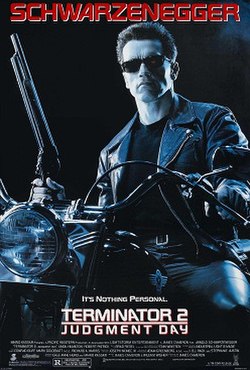
Terminator 2: Judgment Day (1991) was the first sequel to follow The Terminator, finally realizing Cameron's earlier liquid metal Terminator concept through the T-1000 character.
Image source: Terminator 2: Judgment Day
1991 - 1993
% complete
Several video games based on The Terminator were released between 1991 and 1993 for various Nintendo and Sega systems.
Mar 1995
% complete
In March 1995, The Terminator was released as a letterboxed edition on Laserdisc.
Sep 3, 1997
% complete
The film premiered on DVD through Image Entertainment on September 3, 1997.
Jan 23, 2001
% complete
On January 23, 2001, a Hong Kong VCD edition of the film was released online.
Oct 2, 2001
% complete
Through their acquisition of PolyGram Filmed Entertainment's pre-1996 film library catalogue, MGM Home Entertainment released a special edition of the film on October 2, 2001, which included documentaries, the script, and advertisements for the film.
Or browse the full history timeline directory, with more than 2,000 topics.
This History of Terminator timeline was generated with the help of AI, using information found on the internet.
We work hard to keep these timelines accurate, but mistakes do get through. If you spot one, email us at [email protected] and we'll fix it for future visitors.
Generate yours with AI or build it from scratch, for free.
Export your timeline, add your own events, edit or remove AI-generated events, and much more
No credit card required.
Cancel anytime.
Cancel anytime.
You can create an unlimited number of timelines with up to 10 events on each one, customize how they look, export them to PDF, PNG, PowerPoint, CSV, and Excel, and share them with a link. Paid plans raise the event limit and add features like spreadsheet imports and collaborators.
Yes. You can cancel your subscription from your account page at any time, and you will not be charged again. Your subscription stays active for the rest of the period you already paid for.
Yes. We will email you a reminder before the annual renewal, and we will also email you a receipt.
Yes. You can email us within 15 days of any payment, and we will issue you a full refund.
Check out our pricing docs or send us an email anytime: [email protected].