
-
Use Cases
-
Resources
-
Pricing
The Ashes is a historic Test cricket series played between England and Australia, first contested in 1882. Named after a satirical obituary mourning 'the death of English cricket,' the series has become one of sport's most celebrated rivalries, alternating between venues in both countries and producing legendary players and unforgettable moments for over 140 years. More Less
Mar 15, 1877 - Mar 19, 1877
% complete
Australia defeated England by 45 runs in the first ever Test match, played at the Melbourne Cricket Ground. This match laid the foundation for the Anglo-Australian cricket rivalry that would later become the Ashes.
Image source: Australia national cricket team
Aug 29, 1882
% complete
After Australia beat England at the Oval in August 1882, journalist Reginald Shirley Brooks published a mock obituary in The Sporting Times declaring that English cricket had died and 'the body will be cremated and the ashes taken to Australia', coining the term 'the Ashes'.
Image source: The Ashes
Dec 1882 - Mar 1883
% complete
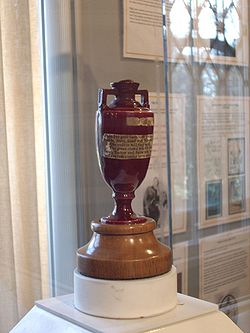
Honourable Ivo Bligh captained an English team to Australia with the declared aim of regaining the mythical Ashes. England won the three-match series 2–1, and Bligh was presented with an urn, reputedly containing the ashes of a bail or veil, now known as the Ashes urn.
Image source: Ivo Bligh, 8th Earl of Darnley
Jan 1883
% complete
Following his successful tour of Australia, Ivo Bligh was presented with a small terracotta urn by ladies including Florence Morphy, whom he later married. The urn became the symbolic trophy of the Ashes, though it never left Lord's after being donated there.
Image source: The Ashes urn
Jul 1884 - Aug 1884
% complete
Australia toured England in 1884 for the first officially recognised Ashes contest on English soil. England won the three-match series 1–0, beginning the tradition of regular biennial Ashes contests alternating between the two countries.
Aug 1893
% complete
Australia won the final Test at the Oval during their 1893 tour of England, securing their first Ashes series triumph in England and signalling their emergence as a serious rival on English soil.
Image source: Australian cricket team in England in 1893
Dec 1897 - Feb 1898
% complete
Under captain Joe Darling, Australia defeated England 4–1 in the 1897–98 Ashes series, one of the most dominant Australian performances of the nineteenth century and a showcase for players like Clem Hill and Hugh Trumble.
Image source: Joe Darling
Dec 1901 - Feb 1902
% complete
Australia, led by Clem Hill, retained the Ashes with a 4–1 series victory in 1901–02, cementing their dominance over England at the turn of the century.
Image source: Clem Hill
Jun 1921 - Aug 1921
% complete
Warwick Armstrong's powerful Australian side thrashed England 5–0 in the 1921 Ashes series in England, the first Ashes clean sweep, with Armstrong's side widely regarded as one of the greatest teams of the era.
Image source: 2025–26 Ashes series
Nov 1928 - Mar 1929
% complete
Despite the emergence of young Don Bradman, Australia lost 1–4 to England in 1928–29, though this series is remembered as Bradman's debut Ashes campaign where he scored his maiden Test century.
1930
% complete
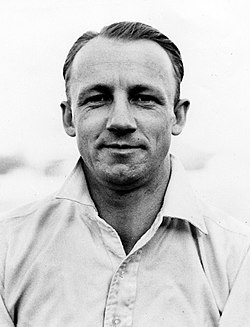
In the 1930 Ashes in England, 21-year-old Don Bradman scored 974 runs in seven innings at an average of 139.14, including 334 at Headingley, propelling Australia to a 2–1 series win and establishing him as cricket's greatest batsman.
Image source: Don Bradman
Nov 1932 - Mar 1933
% complete
Douglas Jardine led England to a 4–1 Ashes victory using 'Bodyline' fast bowling aimed at Don Bradman's body, causing diplomatic tension between Britain and Australia and leading to changes in the Laws of Cricket.
Image source: Bodyline
Dec 1936 - Feb 1937
% complete
After losing the first two Tests, Don Bradman inspired Australia to a 3–2 series win with a legendary 270 at Melbourne, the highest score by a captain batting at number seven, turning the series around dramatically.
Jun 1938 - Aug 1938
% complete
England drew the 1938 Ashes series 1–1, retaining the trophy, with Len Hutton scoring a then-record 364 at the Oval. The outbreak of World War II then halted Test cricket for seven years.
Jun 1948 - Aug 1948
% complete
Don Bradman led the unbeaten 'Invincibles' Australian side through England, winning the series 4–0. In his final Test innings at the Oval, Bradman was dismissed for a duck, finishing his career just 4 runs short of a 100 average.
Image source: 1948 Ashes series
Jul 26, 1956 - Jul 31, 1956
% complete
Off-spinner Jim Laker took 19 wickets for 90 runs against Australia at Old Trafford, still a world record, helping England win the 1956 Ashes 2–1 in a series dominated by spin bowling.
Image source: Jim Laker
Dec 1958 - Feb 1959
% complete
Richie Benaud's Australia side won 4–0 in 1958–59, ending a long spell without an Ashes win since 1934 and marking the start of a strong period of Australian dominance into the 1960s.
Dec 1960 - Feb 1961
% complete
The 1960–61 Ashes featured the famous first Tied Test at Brisbane, with Richie Benaud's Australia ultimately winning the series 2–1, showcasing thrilling cricket that revitalised public interest.
Nov 1970 - Feb 1971
% complete
Ray Illingworth's disciplined England side won the 1970–71 Ashes 2–0 in Australia, their first series victory there since 1954–55, built on tight bowling from John Snow and solid batting.
Nov 1974 - Feb 1975
% complete
The fearsome pace duo of Dennis Lillee and Jeff Thomson demolished England 4–1 in Australia, ushering in an era of aggressive fast bowling that defined 1970s cricket.
Jun 1981 - Sep 1981
% complete
Ian Botham produced one of cricket's great comebacks, with match-winning centuries and bowling spells at Headingley and elsewhere turning the series around as England won 3–1 under Mike Brearley.
Jun 1989 - Aug 1989
% complete
Allan Border's rebuilt Australia crushed England 4–0 in 1989, beginning a period of near-total Australian dominance in the Ashes that would last until 2005.
Jun 4, 1993
% complete
In his first Ashes delivery on English soil, Shane Warne bowled Mike Gatting with a prodigiously turning leg-break at Old Trafford, a moment regarded as one of the most famous in cricket history and heralding Warne's legendary Ashes career.
Image source: Ball of the Century
Nov 1998 - Aug 2001
% complete
Under Steve Waugh, Australia won consecutive Ashes series including the 2001 series in England 4–1, extending their winning streak to eight straight Ashes victories between 1989 and 2003.
Image source: Steve Waugh
Jul 21, 2005 - Sep 12, 2005
% complete
In one of the greatest series ever played, Michael Vaughan's England edged Australia 2–1 thanks to heroics from Andrew Flintoff, Kevin Pietersen and Steve Harmison, recapturing the Ashes for the first time since 1987.
Nov 23, 2006 - Jan 5, 2007
% complete
Ricky Ponting's Australia avenged 2005 with a comprehensive 5–0 sweep, Shane Warne and Glenn McGrath bowing out of Test cricket with triumphant farewell performances.
Image source: 2006–07 Ashes series
Jul 8, 2009 - Aug 24, 2009
% complete
Andrew Strauss led England to a 2–1 series win, with memorable performances including Andrew Flintoff's farewell and Stuart Broad's breakthrough, restoring English pride after the 2006–07 humiliation.
Image source: 2009 Ashes series
Nov 2010 - Jan 7, 2011
% complete
Andrew Strauss's England thrashed Australia 3–1, winning in Australia for the first time since 1986–87, powered by Alastair Cook's 766 runs and a record innings victory at Melbourne.
Image source: 2010–11 Ashes series
Nov 21, 2013 - Jan 5, 2014
% complete
Mitchell Johnson's explosive pace, backed by David Warner's batting, demolished England 5–0, one of the most one-sided Ashes series in modern memory.
Image source: 2013–14 Ashes series
Aug 1, 2019 - Sep 16, 2019
% complete
Ben Stokes' incredible unbeaten 135 at Headingley, chasing down 359, became an instant classic as Joe Root's England drew the series 2–2 and retained the Ashes.
Image source: 2019 Ashes series
Or browse the full history timeline directory, with more than 2,000 topics.
This History of the Ashes timeline was generated with the help of AI, using information found on the internet.
We work hard to keep these timelines accurate, but mistakes do get through. If you spot one, email us at [email protected] and we'll fix it for future visitors.
Generate yours with AI or build it from scratch, for free.
Export your timeline, add your own events, edit or remove AI-generated events, and much more
No credit card required.
Cancel anytime.
Cancel anytime.
You can create an unlimited number of timelines with up to 10 events on each one, customize how they look, export them to PDF, PNG, PowerPoint, CSV, and Excel, and share them with a link. Paid plans raise the event limit and add features like spreadsheet imports and collaborators.
Yes. You can cancel your subscription from your account page at any time, and you will not be charged again. Your subscription stays active for the rest of the period you already paid for.
Yes. We will email you a reminder before the annual renewal, and we will also email you a receipt.
Yes. You can email us within 15 days of any payment, and we will issue you a full refund.
Check out our pricing docs or send us an email anytime: [email protected].