
-
Use Cases
-
Resources
-
Pricing
The UEFA Champions League is Europe's premier club football competition. Originally launched in 1955 as the European Cup by French journalist Gabriel Hanot and L'Équipe, it was rebranded as the Champions League in 1992. The tournament brings together the top clubs from across Europe, featuring iconic moments like Real Madrid's early dominance, Liverpool's Miracle of Istanbul, and Barcelona's treble-winning campaigns. More Less
1895
% complete
The first time the champions of two European leagues met was in what was nicknamed the 1895 World Championship, when English champions Sunderland beat Scottish champions Heart of Midlothian 5–3.
Image source: UEFA Champions League
1900
% complete
In 1900, the champions of Belgium, Netherlands and Switzerland, which were the only existing leagues in continental Europe at the time, participated in the Coupe Van der Straeten Ponthoz, dubbed the 'club championship of the continent' by local newspapers.
1927
% complete
The Mitropa Cup, a competition modelled after the Challenge Cup, was created in 1927, an idea of Austrian Hugo Meisl, and played between Central European clubs.
Image source: Mitropa Cup
1930
% complete
The Coupe des Nations ('Nations Cup'), the first attempt to create a cup for national champion clubs of Europe, was played and organised by Swiss club Servette.
Image source: Coupe des Nations
1948
% complete
After receiving reports from his journalists over the highly successful South American Championship of Champions of 1948, Gabriel Hanot, editor of L'Équipe, began proposing the creation of a continent-wide tournament.
Image source: Gabriel Hanot
1949
% complete
1955
% complete
It was conceived in Paris in 1955 as the European Champion Clubs' Cup, a straight knockout tournament open only to the champions of Europe's domestic leagues, with its winner considered the European club champion.
Sep 4, 1955
% complete
The first European Cup match took place on 4 September 1955, and ended in a 3–3 draw between Sporting CP and Partizan. The inaugural competition ran during the 1955–56 season.
Image source: 1955–56 European Cup
Jun 13, 1956
% complete
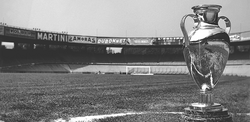
The inaugural final took place at the Parc des Princes between Stade de Reims and Real Madrid on 13 June 1956.
1958
% complete
Milan failed to capitalise after going ahead on the scoreline twice in the 1958 final, only for Real Madrid to equalise.
Image source: 1958 European Cup final
1959
% complete
In a rematch of the first final, Real Madrid faced Stade Reims at the Neckarstadion for the 1959 final and won 2–0.
Image source: 1959 European Cup final
1960
% complete
The 1960 final holds the record for the most goals scored, with Real Madrid beating Eintracht Frankfurt 7–3 at Hampden Park, courtesy of four goals by Ferenc Puskás and a hat-trick by Alfredo Di Stéfano.
Image source: 1960 European Cup final
1960 - 1961
% complete
Real Madrid's reign ended in the 1960–61 season when bitter rivals Barcelona dethroned them in the first round.
Image source: 1960–61 European Cup
1963
% complete
Benfica wanted to repeat Real Madrid's successful run after reaching the showpiece event of the 1962–63 European Cup, but a brace from Brazilian-Italian José Altafini at Wembley gave the spoils to Milan, making the trophy leave the Iberian Peninsula for the first time ever.
Image source: 1963 European Cup final
1964
% complete
Inter Milan beat an ageing Real Madrid 3–1 at the Ernst-Happel-Stadion to win the 1963–64 season and replicate their local rival's success.
Image source: 1964 European Cup final
1967
% complete
Under the leadership of Jock Stein, Scottish club Celtic beat Inter Milan 2–1 in the 1967 final to become the first British club to win the European Cup.
Image source: 1967 European Cup final
1968
% complete
The 1967–68 season saw Manchester United become the first English team to win the European Cup, beating two-times winners Benfica 4–1 in the final.
Image source: 1968 European Cup final
1969
% complete
In the 1968–69 season, Ajax became the first Dutch team to reach the European Cup final, but they were beaten 4–1 by Milan, who claimed their second European Cup, with Pierino Prati scoring a hat-trick.
Image source: 1969 European Cup final
1970
% complete
The 1969–70 season saw the first Dutch winners of the competition.
Image source: 1969–70 European Cup
1970 - 1976
% complete
Ajax won the title in 1970–71, beating Greek side Panathinaikos in the final, and went on to win three years in a row (1971 to 1973), which Bayern Munich emulated from 1974 to 1976. Dutch and West German clubs together won seven back-to-back European Cups between 1970 and 1976.
1977 - 1984
% complete
Liverpool won their first two titles in 1977 and 1978, followed by victories for Nottingham Forest in 1978–79 and 1979–80. Liverpool won their third title before Aston Villa continued English dominance in 1982. English clubs won seven European Cup finals between 1977 and 1984.
1983 - 1984
% complete
Hamburger SV broke the English dominance in 1982–83, before Liverpool regained it in 1983–84.
Image source: 1983 European Cup final
1985
% complete
Following the 1985 European Cup final, which Liverpool lost to Juventus (1984–85), all English clubs were banned for five years (Liverpool for six years) due to the Heysel Stadium disaster.
Image source: Heysel Stadium disaster
1986 - 1992
% complete
Following the five-year ban on English teams, Steaua București won the European Cup in 1985–86, followed by Porto in 1986–87, PSV Eindhoven in 1987–88, Milan (twice), Red Star Belgrade and Barcelona before the competition was re-formulated as the UEFA Champions League.
1967
% complete
Each year the winning team is presented with the European Champion Clubs' Cup, the current version of which has been awarded since 1967. It was designed by Jürg Stadelmann, a jeweller from Bern, after the original was given permanently to Real Madrid in 1966 for their six titles. From 1968–69 until 2008–09, teams winning it three times in a row or five times overall kept it; since 2008, clubs receive replicas while UEFA retains the original.
Image source: European Champion Clubs' Cup
1991
% complete
In 1991, UEFA asked its commercial partner Television Event and Media Marketing (TEAM) to help brand the Champions League. By 1999, research showed the starball logo had achieved a recognition rate of 94 percent among fans.
1992
% complete
UEFA commissioned Tony Britten in 1992 to arrange an anthem, officially titled 'Champions League', an adaptation of Handel's Zadok the Priest, performed by London's Royal Philharmonic Orchestra and sung by the Academy of St Martin in the Fields chorus. Later versions were performed by Andrea Bocelli, Juan Diego Flórez, All Angels, Jonas Kaufmann, David Garrett and Mariza.
Image source: UEFA Champions League Anthem
1992
% complete
When the Champions League was created in 1992, it was decided that a maximum of eight companies should sponsor the event, each allocated four advertising boards around the pitch, logo placement at interviews and tickets. From the 2012–13 knockout phase, LED hoardings were used, extended from the play-off round from 2015–16, and since 2021 Virtual Board Replacement has offered region-based advertising.
2013
% complete
The final of the 2012–13 tournament had the competition's highest TV ratings to date, drawing approximately 360 million television viewers. In the anthem's performance, the chorus was played twice.
Image source: 2013 UEFA Champions League final
2021
% complete
Starting from the 2021–22 edition, UEFA introduced the UEFA Champions League Player of the Season award.
1989 - 1998
% complete
After the dominance of English clubs between 1977 and 1984, Italian football clubs dominated in the 1990s; in a nine-year period from 1989 to 1998, Italian clubs reached nine Champions League finals.
1992
% complete
The competition took on its current name in 1992, having added a round-robin group stage in 1991, moving beyond its original straight knockout format for league champions only.
2016 - 2018
% complete
Spanish clubs dominated the competition from 2014–18, with Real Madrid winning three back-to-back Champions League titles in 2016, 2017, and 2018. From the expansion of the Champions League in 1997–98 to the 2023–24 final, Spanish clubs reached 17 finals and English clubs reached 16.
Image source: Real Madrid CF in international football
2019 - 2020
% complete
Only one club has won all of their matches in a single tournament en route to victory: Bayern Munich in the 2019–20 season. For the 2019–20 season, runners-up Paris Saint-Germain earned nearly €126.8 million in total, compared with €125.46 million earned by Bayern Munich, who were awarded €112.96 million in prize money.
Image source: 2019–20 UEFA Champions League
Mar 2020 - Aug 23, 2020
% complete
During the COVID-19 pandemic, the tournament was suspended in mid-March 2020 and resumed in August 2020 after a five-month suspension. The quarter-finals and semi-finals were played as single-match knockout ties at neutral venues in Lisbon, Portugal, with the final taking place on 23 August 2020.
2026
% complete
Paris Saint-Germain are the current European champions, having beaten Arsenal on penalties in the 2026 final for their second consecutive title.
1997
% complete
The 1996–97 season was the final Champions League tournament in which only European league champions were allowed to compete; the tournament was won by Borussia Dortmund.
Image source: 1996–97 UEFA Champions League
1997
% complete
From the 1997–98 season, multiple entrants from certain countries were allowed into the competition. Between 1999 and 2008, no differentiation was made between champions and non-champions in qualification.
2005
% complete
An exception to the usual qualification system happened in 2005, after Liverpool won the Champions League but did not finish in a Premier League qualification place. In 2005–06, Liverpool and Artmedia Bratislava became the first teams to reach the group stage after playing all three qualifying rounds.
Image source: 2005 UEFA Champions League final
May 2013
% complete
It was decided that starting from 2015–16, the previous season's Europa League winners would qualify for the Champions League, entering at least the play-off round. From 2018–19, the Europa League winner received automatic group-stage qualification.
Image source: UEFA Europa League
2024
% complete
Beginning with the 2024–25 season, UEFA changed the format of its club competitions, abandoning the prior group stage of 32 teams divided into eight groups of four in favour of an expanded league phase. The two associations with the highest coefficients also receive an extra European Performance Spot.
Image source: 2024–25 UEFA Champions League
Or browse the full history timeline directory, with more than 2,000 topics.
This History of the Champions League timeline was generated with the help of AI, using information found on the internet.
We work hard to keep these timelines accurate, but mistakes do get through. If you spot one, email us at [email protected] and we'll fix it for future visitors.
Generate yours with AI or build it from scratch, for free.
Export your timeline, add your own events, edit or remove AI-generated events, and much more
No credit card required.
Cancel anytime.
Cancel anytime.
You can create an unlimited number of timelines with up to 10 events on each one, customize how they look, export them to PDF, PNG, PowerPoint, CSV, and Excel, and share them with a link. Paid plans raise the event limit and add features like spreadsheet imports and collaborators.
Yes. You can cancel your subscription from your account page at any time, and you will not be charged again. Your subscription stays active for the rest of the period you already paid for.
Yes. We will email you a reminder before the annual renewal, and we will also email you a receipt.
Yes. You can email us within 15 days of any payment, and we will issue you a full refund.
Check out our pricing docs or send us an email anytime: [email protected].