-
Use Cases
-
Resources
-
Pricing
1159
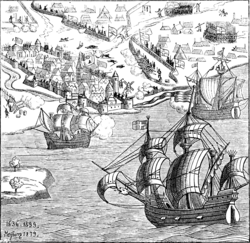
Merchant communities from northern German towns began forming cooperative associations known as hanses. These groups protected members, negotiated trading privileges, and laid the institutional foundations for the later Hanseatic League.
Image source: Hanseatic League
1159
Henry the Lion refounded Lübeck on the Trave River in 1159. Its favorable location between the Baltic and North Sea helped it become the League's principal political center and a major hub for trade with Scandinavia and eastern Europe.
Image source: Lübeck
1160
Lübeck received a town charter modeled on the law of Soest. Lübeck law later spread across many Baltic towns, creating a shared legal and administrative framework that supported Hanseatic commerce.
1241
Lübeck and Hamburg concluded a formal alliance to protect their merchants and roads. The agreement is commonly treated as an important step toward the organized Hanseatic League.
1237
Lübeck merchants secured important commercial privileges in England during the thirteenth century. These rights helped the German merchants develop a durable position in the English wool and cloth trade.
1282
The Hanseatic merchants established the Steelyard, or Stalhof, in London. The enclosed compound became the League's principal English kontor, providing warehouses, offices, living quarters, and a base for collective representation.
1282
The Peterhof trading compound in Novgorod became the League's main base in the eastern Baltic. Hanseatic merchants exchanged western goods for furs, wax, timber, grain, and other products from Rus'.
1292
Bruges became the League's most important western continental kontor. Hanseatic merchants used the city to connect Baltic goods with the textile, finance, and luxury markets of Flanders.
1356
A general assembly of Hanseatic towns was recorded at Lübeck in 1356. The Hansetag allowed member cities to coordinate policy, settle disputes, impose commercial measures, and organize collective military action.
1360
The Bergen kontor, centered on Bryggen, became the League's main base in Norway. Merchants controlled much of the stockfish trade and exchanged grain and manufactured goods for fish and other Norwegian products.
1370 - 1450
During the late fourteenth and fifteenth centuries, the League coordinated a network of roughly 150 to 200 towns and merchant communities. Its influence extended from London and Bruges to Novgorod, Bergen, and the major Baltic ports.
1476
A major fire destroyed much of Bergen, including parts of the Hanseatic trading quarter. The kontor was rebuilt, illustrating both the vulnerability and resilience of Hanseatic commercial infrastructure.
1367
At Cologne, Hanseatic towns and allies formed a military and commercial confederation against Denmark and Norway. The agreement marked the League's emergence as a major political and naval power in the Baltic.
1368 - 1370
The League attacked Denmark after King Valdemar IV threatened Hanseatic privileges and Baltic commerce. Hanseatic fleets captured Copenhagen and forced Denmark to negotiate from a position of weakness.
1370
The Peace of Stralsund ended the Hanseatic war with Denmark. Denmark recognized extensive Hanseatic privileges and granted the League influence over the selection of the Danish king, making this the League's greatest political victory.
1392 - 1401
The Vitalienbrüder, originally privateers in the Mecklenburg-Danish conflict, turned to piracy in the Baltic and North Sea. Their attacks disrupted trade until Hanseatic and allied forces defeated their principal leaders.
1401
Klaus Störtebeker, the best-known leader associated with the Vitalienbrüder, was captured and executed in Hamburg. His death symbolized the suppression of the pirate threat to Hanseatic shipping.
1426 - 1435
The League fought Denmark and its allies after King Eric of Pomerania imposed tolls and challenged Hanseatic privileges. Hanseatic naval pressure and economic sanctions helped preserve the League's Baltic trading rights.
1435
The Peace of Vordingborg ended the Dano-Hanseatic conflict. The settlement restored important commercial privileges and demonstrated that the League could still compel concessions from Scandinavian monarchies.
1468 - 1474
The League fought England after English attacks on Hanseatic shipping and disputes over merchant privileges. Hanseatic naval action and economic pressure forced England to accept favorable terms in the Treaty of Utrecht.
1474
The Treaty of Utrecht ended the Anglo-Hanseatic War and confirmed the League's privileges in England. The settlement strengthened the Steelyard's position and marked a late medieval high point for Hanseatic diplomacy.
1509 - 1512
The League again fought Denmark and Sweden during a struggle over Baltic trade and political influence. The resulting settlements preserved Hanseatic access and demonstrated the continuing importance of its naval power.
1494
Grand Prince Ivan III closed the Hanseatic Peterhof in Novgorod and expelled its merchants. The closure sharply reduced the League's access to the eastern Russian trade and reflected the growing power of centralized states.
1520 - 1560
Many Hanseatic towns adopted Lutheranism during the Reformation, while others remained Catholic or followed different policies. Religious and political divisions weakened the League's cohesion and altered its relations with neighboring rulers.
Image source: Reformation
1525
Lübeck forces captured and briefly occupied Visby on Gotland during conflict with Denmark and Sweden. The episode showed that Hanseatic cities still pursued military objectives, even as centralized kingdoms increasingly dominated Baltic politics.
Image source: Visby
1534 - 1536
Lübeck intervened in the Danish Count's Feud to restore Christian II, but its campaign failed. Denmark's victory reduced Lübeck's political influence and confirmed the decline of independent Hanseatic power in Scandinavia.
Image source: Count's Feud
1540
As commercial activity shifted from Bruges to Antwerp, the Hanseatic merchants moved their principal Flemish operations. The relocation reflected changing patterns of European trade and the growing importance of Atlantic markets.
1570
The Treaty of Stettin ended a major Scandinavian conflict in which Hanseatic interests were affected by competing Danish and Swedish control of Baltic trade. The settlement highlighted that monarchies, rather than the League, increasingly shaped regional politics.
1598
Queen Elizabeth I closed the Steelyard in London, ending the Hanseatic merchants' longstanding privileged position in England. The decision reflected the rise of stronger national states and English resistance to foreign commercial exemptions.
1618 - 1648
The Thirty Years' War devastated parts of Germany and disrupted inland and maritime commerce. Hanseatic towns suffered from occupation, requisitions, and changing political alliances, accelerating the League's institutional decline.
Image source: Thirty Years' War
1669
Lübeck, Hamburg, and Bremen convened the last recognized Hanseatic Diet in Lübeck. The meeting failed to restore the League as a broad political organization, leaving the three cities as its surviving core.
1669
After the 1669 Diet, the League ceased to function as an active alliance of numerous towns. Lübeck, Hamburg, and Bremen continued to use the designation Hanseatic cities and preserved elements of its diplomatic and commercial heritage.
1815
The three surviving Hanseatic cities entered the German Confederation as free cities. Their continued separate status carried the political memory of the medieval League into the nineteenth century.
Image source: German Confederation
1871
Hamburg, Lübeck, and Bremen became constituent states of the German Empire, although Hamburg and Bremen retained important port and municipal privileges. The transition ended their external sovereignty while preserving the Hanseatic identity.
Image source: German Empire
1900 - 2025
Modern cities around the Baltic and North Sea continue to commemorate their Hanseatic past through architecture, museums, festivals, heraldry, and tourism. The League remains an influential example of premodern commercial cooperation and urban diplomacy.
Or browse the full history timeline directory, with more than 2,500 topics.
This Hanseatic League timeline was generated with the help of AI, using information found on the internet.
We work hard to keep these timelines accurate, but mistakes do get through. If you spot one, email us at [email protected] and we'll fix it for future visitors.
Generate yours with AI or build it from scratch, for free.
Export your timeline, add your own events, edit or remove AI-generated events, and much more
No credit card required.
Cancel anytime.
Cancel anytime.
You can create an unlimited number of timelines with up to 10 events on each one, customize how they look, export them to PDF, PNG, PowerPoint, CSV, and Excel, and share them with a link. Paid plans raise the event limit and add features like spreadsheet imports and collaborators.
Yes. You can cancel your subscription from your account page at any time, and you will not be charged again. Your subscription stays active for the rest of the period you already paid for.
Yes. We will email you a reminder before the annual renewal, and we will also email you a receipt.
Yes. You can email us within 15 days of any payment, and we will issue you a full refund.
Check out our pricing docs or send us an email anytime: [email protected].