-
Use Cases
-
Resources
-
Pricing
The National Basketball Association (NBA) is the premier professional basketball league in the world. Founded in 1946 as the Basketball Association of America (BAA), it merged with the rival National Basketball League (NBL) in 1949 to form the NBA. Over the decades, the league grew from a small American circuit into a global entertainment powerhouse, shaped by iconic players like Bill Russell, Kareem Abdul-Jabbar, Magic Johnson, Larry Bird, Michael Jordan, Kobe Bryant, and LeBron James, and by landmark developments such as the ABA merger, the three-point line, the Dream Team's Olympic debut, and international expansion. More Less
Jun 6, 1946
% complete
The Basketball Association of America (BAA) was founded in New York City by owners of major ice hockey arenas, seeking to fill their venues on nights without hockey games. The league's first game was played between the New York Knickerbockers and the Toronto Huskies on November 1, 1946, marking the birth of what would become the NBA.
Image source: Basketball Association of America
Apr 23, 1949
% complete
Led by dominant center George Mikan, the Minneapolis Lakers defeated the Washington Capitols to win the final BAA championship. The Lakers went on to become the NBA's first dynasty, winning five titles in six years during the league's early era.
Aug 3, 1949
% complete
The BAA merged with its rival, the National Basketball League (NBL), to form the National Basketball Association. The new league began with 17 teams, combining the strengths of both organizations and establishing the foundation of professional basketball in North America.
Oct 30, 1954
% complete
The NBA adopted the 24-second shot clock, an innovation proposed by Syracuse Nationals owner Danny Biasone. The rule transformed the game by eliminating stalling tactics, dramatically increasing scoring and pace, and making basketball far more exciting for fans.
Image source: Shot clock
Mar 2, 1962
% complete
Playing for the Philadelphia Warriors against the New York Knicks in Hershey, Pennsylvania, Wilt Chamberlain scored an unprecedented 100 points, setting a single-game scoring record that still stands today and cementing his status as one of the most dominant players ever.
Image source: Wilt Chamberlain's 100-point game
Feb 2, 1967
% complete
The ABA launched as a rival league, distinguished by its red-white-and-blue ball, three-point line, and flashy style of play. It introduced innovations that would eventually be adopted by the NBA and produced stars like Julius Erving before merging with the NBA in 1976.
Image source: American Basketball Association
Sep 1976
% complete
After years of competition for players and markets, the ABA folded and four of its teams—the Denver Nuggets, Indiana Pacers, New York Nets, and San Antonio Spurs—joined the NBA, expanding the league and bringing along the popular three-point shot.
Image source: ABA–NBA merger
Oct 12, 1979
% complete
The NBA officially added the three-point line for the 1979–80 season, borrowing the ABA's most famous innovation. The rule gradually reshaped offensive strategy and, decades later, became central to the modern style of play.
Image source: Three-point field goal
Feb 1, 1984 - Feb 1, 2014
% complete
David Stern took over as commissioner and presided over three decades of extraordinary growth, expanding the league internationally, launching global broadcasting deals, growing the number of teams, and elevating the NBA into a worldwide entertainment brand.
Image source: David Stern
Jul 25, 1992 - Aug 8, 1992
% complete
Featuring Michael Jordan, Magic Johnson, and Larry Bird, the U.S. 'Dream Team' cruised to gold in Barcelona, captivating the world and supercharging the NBA's international popularity, inspiring a generation of foreign players to pursue NBA careers.
Dec 1956
% complete
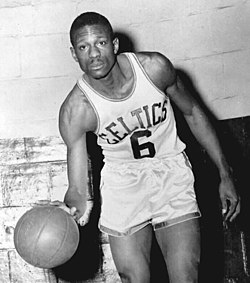
The Boston Celtics acquired Bill Russell, a defensive powerhouse from the University of San Francisco. Russell revolutionized defense and rebounding, anchoring a Celtics dynasty that would win 11 championships in his 13 seasons, including eight consecutive titles from 1959 to 1966.
Image source: Bill Russell
Mar 1959 - May 1966
% complete
Under coach Red Auerbach and with stars like Bill Russell, Bob Cousy, and later John Havlicek, the Boston Celtics won eight straight NBA championships from 1959 to 1966, a feat unmatched in major American professional sports.
Oct 12, 1979
% complete
Rookies Magic Johnson of the Los Angeles Lakers and Larry Bird of the Boston Celtics arrived in the same season, reviving the Lakers-Celtics rivalry and rescuing the league from declining ratings with their contrasting styles and compelling personal rivalry.
Image source: Magic & Bird: A Courtship of Rivals
May 16, 1980
% complete
Rookie Magic Johnson, playing center in Game 6 after Kareem Abdul-Jabbar's injury, scored 42 points to lead the Los Angeles Lakers over the Philadelphia 76ers. The victory launched the 'Showtime' era, during which the Lakers won five championships in the decade.
Image source: 1980 NBA Finals
Jun 19, 1984
% complete
The Chicago Bulls selected Michael Jordan third overall in the 1984 draft, one of the greatest drafts in history which also included Hakeem Olajuwon, Charles Barkley, and John Stockton. Jordan would become the most iconic player in NBA history.
Image source: Michael Jordan
Jun 12, 1991
% complete
Michael Jordan led the Bulls past Magic Johnson's Lakers to capture Chicago's first title. The Bulls then completed two separate three-peats (1991–93 and 1996–98), dominating the 1990s and turning Jordan into a global icon.
Image source: 1991 NBA Finals
Oct 6, 1993 - Jun 14, 1998
% complete
Jordan retired after his first three-peat to play baseball, returned in March 1995, and led the Bulls to three more championships from 1996 to 1998, capping it with his famous 'Last Shot' against the Utah Jazz in the 1998 Finals.
Image source: Chicago Bulls
Jun 15, 1999 - Jun 15, 2014
% complete
Drafting Tim Duncan in 1997, the Spurs built a model franchise under coach Gregg Popovich, winning five championships between 1999 and 2014 with sustained excellence built on fundamentals, selfless play, and remarkable consistency.
Jun 2000 - Jun 2002
% complete
With Shaquille O'Neal dominating inside and Kobe Bryant emerging as a superstar, the Lakers won three consecutive championships from 2000 to 2002, the first three-peat since Jordan's Bulls and a highlight of Phil Jackson's coaching career.
Image source: Shaquille O'Neal
Jun 26, 1996
% complete
The 1996 draft produced a legendary class including Kobe Bryant, Allen Iverson, Steve Nash, Ray Allen, and Ben Wallace. These players shaped the NBA for nearly two decades, with Bryant becoming one of the game's all-time greats with five championships.
Image source: 1996 NBA draft
Jun 26, 2003
% complete
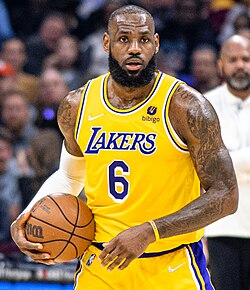
Anointed 'The Chosen One' while still in high school, LeBron James entered the NBA with immense expectations. He exceeded them, becoming the league's all-time leading scorer and a four-time champion widely regarded as one of the greatest players ever.
Image source: LeBron James
Nov 19, 2004
% complete
A massive brawl erupted between players of the Indiana Pacers and Detroit Pistons and fans at the Palace of Auburn Hills. The incident led to suspensions totaling more than 140 games and prompted the NBA to implement stricter conduct and security policies.
Image source: Malice at the Palace
Jul 8, 2010
% complete
LeBron James announced his move to Miami in a televised special called 'The Decision,' joining Dwyane Wade and Chris Bosh. The superteam reached four straight Finals and won back-to-back championships in 2012 and 2013, ushering in the player empowerment era.
Image source: 2010–11 Miami Heat season
Jun 16, 2015
% complete
Behind Stephen Curry's revolutionary long-range shooting, the Warriors defeated LeBron James's Cavaliers for the franchise's first title in 40 years. They reached five consecutive Finals and won four championships, redefining modern offense around the three-pointer.
Image source: 2015 NBA Finals
Apr 13, 2016
% complete
Golden State finished 73–9, breaking the Chicago Bulls' record of 72 wins. Despite losing the Finals to Cleveland after leading 3–1, the season showcased the peak of Curry-led small-ball basketball.
Image source: 2015–16 Golden State Warriors season
Jun 19, 2016
% complete
LeBron James delivered on his promise to bring a title to Cleveland, leading the Cavaliers back from a 3–1 deficit against the 73-win Warriors. His chase-down block on Andre Iguodala became iconic, and Cleveland ended its 52-year championship drought.
Jul 4, 2016
% complete
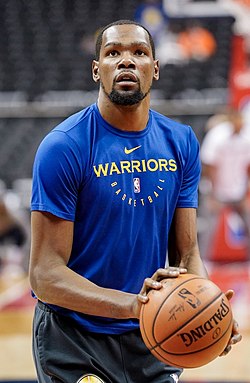
Kevin Durant signed with the already-dominant Warriors, creating a juggernaut that won championships in 2017 and 2018 while going 8–1 in those Finals. The move intensified debates about competitive balance and player movement.
Image source: Kevin Durant
Jun 13, 2019
% complete
Led by Kawhi Leonard's heroics, including a legendary buzzer-beater in the Eastern Conference Finals, the Raptors defeated the injured Warriors to become the first Canadian team to win the NBA championship.
Image source: 2019 NBA Finals
Mar 11, 2020 - Jul 30, 2020
% complete
The NBA became the first major American sports league to suspend play when Rudy Gobert tested positive for COVID-19. The season resumed months later in a quarantined environment at Walt Disney World known as the 'Bubble,' with no fans in attendance.
Image source: Impact of the COVID-19 pandemic on association football
Oct 11, 2020
% complete
In the Bubble playoffs, LeBron James and Anthony Davis led the Lakers to their 17th championship, tying the Celtics for the most in NBA history. The title carried special emotional weight following Kobe Bryant's tragic death in January 2020.
Image source: 2020 NBA Finals
Jul 20, 2021
% complete
Giannis Antetokounmpo delivered one of the greatest Finals performances ever, scoring 50 points in the closeout game as the Bucks beat the Phoenix Suns for Milwaukee's first championship since 1971.
Image source: 2021 NBA Finals
Or browse the full history timeline directory, with more than 2,000 topics.
This History of the NBA timeline was generated with the help of AI, using information found on the internet.
We work hard to keep these timelines accurate, but mistakes do get through. If you spot one, email us at [email protected] and we'll fix it for future visitors.
Generate yours with AI or build it from scratch, for free.
Export your timeline, add your own events, edit or remove AI-generated events, and much more
No credit card required.
Cancel anytime.
Cancel anytime.
You can create an unlimited number of timelines with up to 10 events on each one, customize how they look, export them to PDF, PNG, PowerPoint, CSV, and Excel, and share them with a link. Paid plans raise the event limit and add features like spreadsheet imports and collaborators.
Yes. You can cancel your subscription from your account page at any time, and you will not be charged again. Your subscription stays active for the rest of the period you already paid for.
Yes. We will email you a reminder before the annual renewal, and we will also email you a receipt.
Yes. You can email us within 15 days of any payment, and we will issue you a full refund.
Check out our pricing docs or send us an email anytime: [email protected].