-
Use Cases
-
Resources
-
Pricing
The NBA Finals is the annual championship series of the National Basketball Association (NBA), played between the winners of the Eastern and Western Conferences. First held in 1947 as the BAA Finals, it has grown into one of the most-watched sporting events in the world, showcasing legendary rivalries and iconic performances by teams like the Boston Celtics, Los Angeles Lakers, Chicago Bulls, and Golden State Warriors. More Less
Apr 1947
% complete
After being founded in 1946, the Basketball Association of America completed its inaugural season in April 1947 with the Philadelphia Warriors defeating the Chicago Stags in five games to claim the first championship in league history.
Image source: 1947 BAA Finals
1948
% complete
In 1948, the Minneapolis Lakers won the championship of the rival National Basketball League before joining the BAA, setting the stage for their future dominance in the merged league.
Image source: History of the Los Angeles Lakers
1949
% complete
Led by future Hall of Famer George Mikan, the Minneapolis Lakers won the third and final BAA championship in 1949 over the Red Auerbach-coached Washington Capitals.
1949
% complete
The BAA then merged with the National Basketball League to form the National Basketball Association before the 1949–50 season. The series was initially known as the BAA Finals prior to this merger.
1950
% complete
The Minneapolis Lakers won the inaugural NBA championship in 1950 to become the first team to repeat as champions. The competition was renamed the NBA World Championship Series from 1950 to 1985.
1951
% complete
In 1951, the Rochester Royals defeated the New York Knicks in the only Finals contested between two teams from the same state, something not possible under the current NBA alignment.
1952 - 1954
% complete
The Minneapolis Lakers won three straight Finals from 1952 to 1954 to become the first team to three-peat while also winning their fifth title in six seasons.
Image source: NBA Finals
1956
% complete
The Philadelphia Warriors won multiple championships, including the inaugural title in 1947 and another in 1956 to bookend the NBA's first decade. Of the five franchises to win a championship from 1947 to 1956, one folded and the other four all relocated by 1964.
1957
% complete
With the establishment of the Celtics dynasty in 1957, spearheaded by center Bill Russell, the Boston Celtics saw great success. The Celtics won 11 of the 12 NBA Finals they reached during 13 seasons (1957, 1959–66, 1968–69).
1959 - 1966
% complete
The Boston Celtics won eight straight NBA championships from 1959 through 1966, an unmatched streak of dominance that cemented them as the greatest dynasty of the era.
1964
% complete
In 1964, Wilt Chamberlain, who had moved to California alongside his team, led the San Francisco Warriors to a Western Division championship, but again failed to conquer the Celtics.
1966
% complete
The first clash between Bill Russell and Wilt Chamberlain in the playoffs came in 1966, with Boston winning the series 4–1 over Chamberlain's Philadelphia 76ers.
Image source: 1966 NBA Finals
1967
% complete
A tactical change brought Philadelphia to a new record of 68 wins in the 1966–67 season, as well as defeating the Celtics before winning the 1967 Finals, ending Boston's run of eight consecutive titles.
1968
% complete
In 1968, Boston overcame a 3–1 deficit against Philadelphia to once again arrive in the Finals, continuing their remarkable run of postseason success.
1969
% complete
In 1969, the Celtics faced great difficulty entering the postseason, as they had an aging team and multiple injuries to a number of players, yet they still captured another championship.
Image source: 1969 NBA Finals
1970
% complete
In 1970, a classic Finals featured the New York Knicks against the Los Angeles Lakers. The Knicks won their first championship, one of several franchises to claim a maiden title in the 1970s.
1971
% complete
Franchises that won their first titles in the 1970s included the Milwaukee Bucks in 1971, joining the Knicks among the decade's new champions.
1972
% complete
By season's end, the Lakers broke the record for most wins in a season with 69, one more than the 1966–67 Philadelphia 76ers, before taking home the championship for the first time since relocating to Los Angeles, beating the Knicks. The Knicks returned to win the Finals again a season later, followed by the Celtics' 12th title in 1974.
1975
% complete
In 1975, after compiling a 48–34 regular season record, the Golden State Warriors swept the Washington Bullets 4–0 in the NBA Finals.
1976
% complete
In 1976, the Phoenix Suns, after only eight years of existence, overcame an 18–27 losing record early in the regular season to build a remarkable run to finish 42–40 and reach the Finals.
1977
% complete
Franchises winning their first titles in the 1970s included the Portland Trail Blazers in 1977, following the ABA–NBA merger, after which the winner received the Brown Trophy, though under the name "World Championship Trophy" before being renamed in 1983-84.
1978
% complete
The Washington Bullets defeated the Seattle SuperSonics in 1978 to win their first championship, completing the list of first-time winners in the 1970s.
1979
% complete
The SuperSonics exacted revenge on the Bullets the following season, beating Washington in five games in 1979 to win their first title.
1980
% complete
Rookie Magic Johnson led the Showtime Lakers to the 1980 NBA Finals against the Philadelphia 76ers, who were led by Julius Erving, capturing the championship in a memorable series.
Image source: 1980 NBA Finals
1981
% complete
Boston reached the 1981 NBA Finals led by the "Big Three" of Larry Bird, Kevin McHale, and Robert Parish, winning the championship and reigniting the franchise's winning tradition.
1982
% complete
The Lakers returned to the Finals in 1982, this time led by new coach Pat Riley, in a rematch against the 76ers, winning another championship.
1983
% complete
With the new duo of Moses Malone and Julius Erving, the 76ers won the 1983 NBA Finals in a sweep of the Lakers.
1984
% complete
The Celtics and Lakers met in the Finals in 1984, 1985, and 1987. In 1984, the Celtics toppled the Lakers 4–3. Also in 1985, the format changed to 2–3–2 to ease cross-country travel.
1985
% complete
The teams faced off again in 1985 and 1987, but the Lakers came up on top both times, winning in 6 games despite losing Game 1 in 1985 by 34 points in the Memorial Day Massacre.
Image source: 1985 NBA Finals
1987
% complete
The 1987 Finals included Magic Johnson hitting a hook shot with two seconds left in Game 4 to give the Lakers a 107–106 win and a 3–1 series lead en route to the title.
Image source: 1987 NBA Finals
1988
% complete
The Lakers defended their title in the 1988 NBA Finals, winning the series in 7 games against the Detroit Pistons. They became the first team to win back-to-back NBA titles since 1969.
Image source: 1988 NBA Finals
1989
% complete
Seeking a three-peat in 1989, the Lakers were swept by the Pistons in a rematch of the previous year's Finals, marking a changing of the guard in the league.
Image source: 1989 NBA Finals
1990
% complete
In 1990, the Pistons went back-to-back, defeating the Clyde Drexler-led Portland Trail Blazers in five games to cap Detroit's era of dominance.
Image source: 1990 NBA Finals
1991 - 1998
% complete
The Bulls, led by head coach Phil Jackson and star players Michael Jordan and Scottie Pippen, won six titles in six Finals appearances from 1991 to 1998.
Image source: Chicago Bulls
1993
% complete
In 1993, the Bulls were matched against the Phoenix Suns, led by Charles Barkley, the league's reigning MVP, with Chicago prevailing for their third consecutive championship.
Image source: 1993 NBA Finals
1994 - 1995
% complete
Following Jordan's departure, the Houston Rockets, led by Hakeem Olajuwon, won the 1994 and 1995 NBA titles. Jordan returned to basketball late in the 1994–95 season after a short stint with baseball.
1996
% complete
The 1995–96 Bulls finished the regular season 72–10, attaining at the time the best regular season record in NBA history, on their way to another championship.
1997 - 1998
% complete
In 1997 and 1998, the Bulls met the Utah Jazz in the Finals twice. In both series, Chicago won by hitting winning shots in the sixth game — the first by Steve Kerr in 1997 in Chicago, and the second by Jordan in Utah in 1998.
Image source: 1998 NBA Finals
1999
% complete
During the 1999 NBA playoffs, the Spurs finished with a 15–2 mark, winning the championship. The Spurs won championships in 1999, 2003, 2005, and 2007.
Image source: 1999 NBA Finals
2000 - 2002
% complete
The Lakers won five championships in an 11-year span, including a three-peat from 2000 to 2002, led by Shaquille O'Neal and Kobe Bryant. They defeated the Indiana Pacers in 2000 and swept the New Jersey Nets in 2002.
Image source: Los Angeles Lakers
2001
% complete
During their 2001 postseason run, the Lakers swept their first three series and won the Finals against the Allen Iverson-led Philadelphia 76ers in five games, finishing with an unprecedented 15–1 record, the best postseason record in NBA history at the time.
Image source: 2001 NBA Finals
2003
% complete
During the 2003 NBA Finals, the Spurs defeated the New Jersey Nets in six games, which also marked the first championship contested between two former ABA teams.
2004
% complete
In the 2003 off-season, veteran stars Gary Payton and Karl Malone signed with the Lakers. Along with Bryant and O'Neal, they formed what many expected to be one of the best teams in NBA history and were heavy favorites to win the championship in 2004.
Image source: 2004 NBA Finals
2004
% complete
Following bad blood and eventual fallout with former Lakers teammate Kobe Bryant, O'Neal was traded from the Lakers to the Miami Heat in 2004, where he teamed up with rising star Dwyane Wade.
Image source: Shaquille O'Neal
2006
% complete
O'Neal and Wade led the Heat to a championship in 2006 at the expense of the Dallas Mavericks, who were favorites to win, after trailing 0–2 in the series.
Image source: 2006 NBA Finals
2007
% complete
The Spurs swept the LeBron James-led Cleveland Cavaliers in 2007. Tony Parker won the Finals MVP award, becoming the first European-born player to do so.
Image source: 2007 NBA Finals
2008
% complete
The Lakers returned to the Finals in 2008 against the Boston Celtics, renewing the teams' rivalry and marking the 11th Finals matchup between them, with Boston taking the title.
Image source: 2008 NBA Finals
2009
% complete
The Lakers bounced back from the 2008 loss by winning the 2009 NBA Finals, where they beat the Orlando Magic in five games.
2010
% complete
The Lakers met the Celtics once again in 2010, trailing 3–2 before winning the last two games at home to claim another championship.
Image source: 2010 NBA Finals
2011
% complete
In the 2010 off-season, the Miami Heat re-signed Dwyane Wade and added LeBron James and Chris Bosh via free agency to form a new "Big Three." Considered heavy title favorites, they appeared in four straight finals starting in 2011 against the Dallas Mavericks.
2013
% complete
The Heat repeated as champions in 2013, this time over the San Antonio Spurs, featuring a Heat comeback in Game 6 that is widely regarded as one of the greatest playoff games ever played.
Image source: 2013 NBA Finals
2014
% complete
Miami sought a three-peat in a 2014 rematch with the Spurs, but San Antonio prevailed in five games, winning the fifth and final title of Tim Duncan's career. The 2–2–1–1–1 format was restored in 2014.
Image source: 2014 NBA Finals
2014
% complete
In the 2014 off-season, James returned to the Cleveland Cavaliers where he teamed up with Kyrie Irving and Kevin Love to form a new "Big Three".
Image source: LeBron James
2015
% complete
The Warriors drew first blood in the 2015 NBA Finals, coming back from a 2–1 deficit to win the series 4–2, despite James' historic efforts.
2016
% complete
The Warriors opened up a 3–1 series lead in the 2016 NBA Finals, but James and Irving led the Cavaliers to two straight victories to force a deciding Game 7, which Cleveland won.
2017 - 2018
% complete
In 2017, the Warriors set a playoff record of 15 consecutive wins en route to a five-game victory in the Finals, followed by a dominant sweep in 2018.
2018 - 2019
% complete
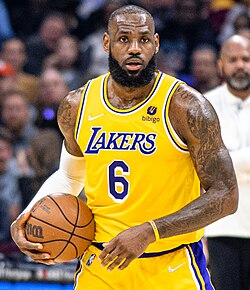
James joined the Los Angeles Lakers in 2018, but the team missed the playoffs for two consecutive years due to injuries. Anthony Davis then joined the Lakers in 2019.
2019
% complete
The Warriors made their fifth consecutive Finals appearance in 2019 against the Kawhi Leonard-led Toronto Raptors, who claimed their first championship.
Image source: 2019 NBA Finals
2020
% complete
James and Davis led the Lakers to the 2020 NBA Finals against the Miami Heat, marking the first time in NBA history that two teams that missed the playoffs the year before met in the Finals.
Image source: 2020 NBA Finals
2021
% complete
The Milwaukee Bucks defeated the Phoenix Suns in the 2021 NBA Finals, coming back from an 0–2 deficit to win in six games. It was the first Finals since 1971 to feature no players who had previously won a championship.
Image source: 2021 NBA Finals
2022
% complete
After missing the playoffs two years in a row due to injuries and roster changes, the Warriors returned to the 2022 NBA Finals for their sixth appearance in eight seasons, winning four championships in an eight-year stretch from 2015 to 2022.
Image source: 2022 NBA Finals
2023
% complete
The Denver Nuggets reached their first Finals in franchise history in 2023, defeating the Miami Heat, the second eighth-seeded team to ever make the Finals, in five games.
Image source: 2023 NBA Finals
2024
% complete
The Boston Celtics defeated the Dallas Mavericks in 2024, breaking their tie with the Lakers franchise to claim their NBA-record 18th title.
Image source: 2024 NBA Finals
2025
% complete
The Oklahoma City Thunder defeated the Indiana Pacers in seven games in 2025, marking the seventh unique champion in as many years, the longest such streak in league history. YouTube TV had been the presenting sponsor of the NBA Finals from 2018 to 2025.
Image source: 2025 NBA Finals
2026
% complete
The New York Knicks defeated the San Antonio Spurs in five games in 2026, including a 29-point comeback win in Game 4 that marked the largest in Finals history.
Or browse the full history timeline directory, with more than 2,000 topics.
This NBA Finals timeline was generated with the help of AI, using information found on the internet.
We work hard to keep these timelines accurate, but mistakes do get through. If you spot one, email us at [email protected] and we'll fix it for future visitors.
Generate yours with AI or build it from scratch, for free.
Export your timeline, add your own events, edit or remove AI-generated events, and much more
No credit card required.
Cancel anytime.
Cancel anytime.
You can create an unlimited number of timelines with up to 10 events on each one, customize how they look, export them to PDF, PNG, PowerPoint, CSV, and Excel, and share them with a link. Paid plans raise the event limit and add features like spreadsheet imports and collaborators.
Yes. You can cancel your subscription from your account page at any time, and you will not be charged again. Your subscription stays active for the rest of the period you already paid for.
Yes. We will email you a reminder before the annual renewal, and we will also email you a receipt.
Yes. You can email us within 15 days of any payment, and we will issue you a full refund.
Check out our pricing docs or send us an email anytime: [email protected].